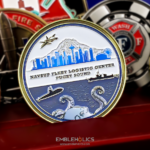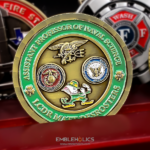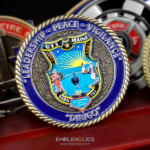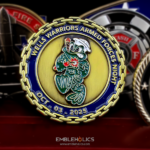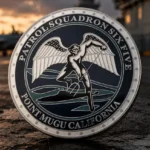
A squadron coin has two jobs and two faces to do them with: identify the squadron, and show what it flies. This one does it directly, with the squadron patch highlighted on the front and a P-3 Orion rendered in full three dimensional relief on the reverse, finished in antique silver.
Where Squadron Coins Came From
The practice traces back to early twentieth century aviators, who exchanged small coins representing their units. The coins also served a practical purpose: a pilot who was shot down and survived could use one to prove which side he belonged to.
That origin still shapes the object. A squadron coin is designed to be handed to someone else, which is why the squadron’s identity has to be legible to a stranger rather than only to its own people. It is also why squadron coins tend to carry the aircraft: the airframe is what another aviator recognizes immediately, and it says more about what the unit does than a crest can.
The Patch on One Face
Squadron patches are among the best source artwork we receive, and it is worth knowing why before you commission anything new.
A patch has to read on a flight suit: across a hangar, in poor light, on somebody moving. That pressure produces bold shapes, strong outlines, high contrast and a limited palette, which is almost exactly the specification for artwork that will be struck into metal. A squadron arriving with its existing patch is usually in a better starting position than one asking for something designed from scratch.
What still has to change:
Color count. Embroidery carries more colors cheaply than enamel does, so a palette may need consolidating. Keep the colors that carry meaning and drop the ones that were only shading.
Small lettering. Thread has a texture that helps small text read. Struck metal does not, so fine lettering either grows or goes.
And anything relying on the fabric. Stitch direction, thread texture and the raised edge of an embroidered border all do work that has no equivalent in metal and has to be replaced with relief, engraving or plating.
See more helicopter squadron challenge coins, an electronic attack squadron coin and a marine squadron challenge coin.
An Aircraft Sculpted in Relief
The reverse carries the P-3 Orion in full relief, modeled to be as accurate as possible. Aircraft are among the most rewarding subjects for sculpted work and among the least forgiving, for a specific reason.
Aviators know the airframe exactly. A slightly wrong wing position or an incorrect number of engines is invisible to most people and glaring to everyone in the squadron. This is the one subject where accuracy matters more than style, which is why reference material from the squadron is worth more than any amount of artistic interpretation.
Three quarters beats profile. A side-on aircraft is a flat silhouette and sculpting adds little to it. Turning it to a three quarter view gives the fuselage foreshortening and lets one wing come forward, which is what relief does well.
Propellers need care. On a turboprop the props are thin, fast-moving elements that cannot be rendered as discs without looking solid. The usual solution is to show the blades at rest with clear gaps, or to indicate rotation with a soft circular form rather than a hard outline.
And the undercarriage is usually better left up. Landing gear adds small fragile detail low on the airframe with nothing structural behind it. An aircraft in flight is both easier to sculpt and more flattering.
Antique Silver as a Finish
The coin uses an antique silver finish rather than a bright polish, which is the right choice for a sculpted face.
An antique finish darkens the recesses while leaving the raised surfaces lighter, so relief reads as depth without any paint at all. On a coin whose reverse is a sculpted aircraft, that is the whole mechanism: the shadow under the wing and inside the engine nacelles is what makes the model look three dimensional.
A bright polish would do the opposite, throwing light across the contours and flattening them. This is the single most common mistake on sculpted coins, and it is a finish decision rather than a sculpting one.
Antique silver also suits a retired squadron. A finish that reads as aged is appropriate for a unit whose history is closed, in a way that a bright modern chrome would not be. See antique vs polished challenge coin finishes.
Coins for a Disestablished Squadron
VP-65 is a retired Naval Air Squadron that flew P-3 Orions out of Southern California, and a coin for a unit that no longer exists works differently from one for an active squadron.
The audience is alumni, not members. Everyone who gets one is a former member, which means the design should reflect the squadron as it was rather than carrying anything current.
There is no authority to approve artwork. A disestablished unit has no commanding officer, so the artwork usually comes from a veterans association or from members’ own records. Patch photographs are often the best available source.
Reunions are the distribution event. Which makes attendance the quantity guide, with spares, since a disestablished squadron’s coin cannot easily be reordered once the people organizing it move on.
And the aircraft matters more, not less. For a retired squadron the airframe is part of the history. A P-3 on the coin dates the unit as precisely as any inscription would.
See more Navy challenge coins.
Order a Coin for Your Squadron
Professional artwork is free with unlimited revisions, and nothing goes into production until you approve a digital proof. The challenge coin minimum is 50 pieces, standard production runs about 45 to 50 days after final artwork approval, rush production is available on many projects, and shipping within the continental United States is included. Embleholics is veteran-owned, SDVOSB and registered in SAM.gov.
Two things that make a squadron coin better. Send your patch artwork or a clear photograph of the patch, since that is usually a stronger starting point than anything designed from scratch. And send reference images of the aircraft from the angle you want, because aviators spot an inaccurate airframe immediately and it is the one element where accuracy beats style. Request a free quote to begin.
Frequently Asked Questions
What is a navy squadron challenge coin?
It is a coin made for a single flying squadron, usually carrying the squadron’s patch on one face and its aircraft on the other. The format comes from early aviators who exchanged unit coins, and it is still designed to be handed to someone outside the squadron.
Can our squadron patch be used on a coin?
Yes, and patch artwork is usually a strong starting point. A patch already uses bold shapes, strong outlines and high contrast so it reads across a hangar, and those are the qualities that survive being struck in metal.
What has to change when a patch becomes a coin?
Mainly the color count, since embroidery carries more colors cheaply than enamel does, and small lettering, since thread texture helps fine text read where struck metal does not. Anything relying on stitch texture also has to be replaced with relief or engraving.
Can an aircraft be sculpted on a challenge coin?
Yes, and it is one of the better subjects for relief. Show it at a three quarter angle rather than in profile, since that gives the fuselage foreshortening and brings one wing forward, which is what sculpted relief does well.
How accurate does the aircraft need to be?
Very. Aviators know the airframe exactly, and a wrong wing position or engine count is invisible to most people and glaring to everyone in the squadron. Send reference images rather than leaving it to interpretation.
How are propellers handled on a coin?
Either shown at rest with clear gaps between the blades, or indicated with a soft circular form rather than a hard outline. Rendering spinning props as a solid disc makes them look like plates.
Why use an antique finish on a sculpted coin?
Because it darkens the recesses while leaving raised surfaces lighter, so relief reads as depth with no paint at all. A bright polish throws light across the contours and flattens them, which is the most common mistake on sculpted coins.
Can a disestablished squadron still order coins?
Yes, and the artwork usually comes from a veterans association or members’ own records rather than from a command, since there is no commanding officer to approve it. A clear patch photograph is often the best available source.
More Navy Projects