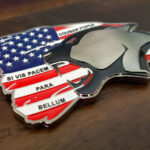
Electronic attack is the part of naval aviation nobody can photograph. A VAQ squadron’s work happens in the electromagnetic spectrum, which leaves a designer with a mission that has no obvious picture. This coin was made for Electronic Attack Squadron 139, the Cougars, an EA-18G Growler squadron at NAS Whidbey Island, Washington. Rather than attempt to illustrate electronic warfare, it is cut to the outline of a waving American flag, with the squadron’s cougar head on the front and an engraved Whidbey Island scene on the back.
Depicting a mission you cannot see
This is the VAQ community’s specific design problem. A strike squadron can show a bomb or a target. A patrol squadron can show the ocean. Electronic attack is jamming and suppression, and the only visible artifact is the aircraft.
Three ways squadrons solve it:
- Lean on the aircraft and the mascot. The most common approach, and what this coin does. The Growler is distinctive, the squadron’s animal is instantly recognizable to its own people, and neither requires explaining the mission.
- Abstract the spectrum. Radiating arcs, waveforms and lightning are the visual shorthand for electronic warfare. They work, but they are used widely enough that a coin built entirely on them can look generic.
- Show the place. The reverse of this coin is a Whidbey Island scene with a Growler over the water and the bridge. It says nothing about jamming and everything about who the squadron is and where they live, which is what the crews will care about in ten years.
The place option is underrated. Nearly all Navy expeditionary electronic attack squadrons are based at Whidbey Island, so the island is a shared identity across the whole community in a way that no mission imagery could be.
Using the flag as a coin shape
A coin cut to the outline of a waving flag is striking, and it is worth a moment’s thought before committing to it.
The practical considerations first. A waving flag outline has a rippled edge, which is more fragile than a smooth one and needs the undulations kept shallow so there are no thin peaks to bend. It also costs usable area: the curve means the design has to sit within a shape that is wider than it is tall and not rectangular, so lettering has to follow the wave rather than running straight.
Then the question of the flag itself. The US Flag Code discourages using the flag on articles of merchandise and for advertising. It is advisory rather than enforceable against private parties, and flag imagery appears on an enormous amount of military memorabilia including coins, so nobody is doing anything wrong here. But it is the kind of thing a service member may have a view on, and views differ.
A distinction worth drawing: depicting the flag as an element within a design sits more comfortably with most people than making the coin itself the flag, because the second produces an object shaped like a flag that will live in a pocket. If anyone on the design committee is likely to care, raise it early rather than after the dies are cut. For many commands it is a non-issue; for some it is not.
Mascot on one face, place on the other
Splitting the coin between the squadron’s animal and the squadron’s home is a reliable structure. The mascot identifies the unit to its own people. The place identifies it to everyone else and gives the coin meaning after the owner has moved on.
An embossed mascot head is the right treatment at coin scale. A full-body animal shrinks the head to the point where the face stops reading, and the face is what makes a mascot recognizable. Cropping to the head gives it four or five times the area and lets the relief do its work.
The restrained palette holds it together. A blue field behind the island scene and red, white and blue in the flag, with little else, keeps a coin that has a shaped outline, a mascot and a landscape from becoming cluttered. On a design doing three things at once, color discipline is what stops it looking busy.
About the squadron
Electronic Attack Squadron 139, the Cougars, flies the EA-18G Growler from NAS Whidbey Island, Washington. The squadron became operational on 1 July 1983, and in April 2019 it received the Navy’s Aviation Battle Efficiency Award, the Battle “E”, for the third consecutive year, covering 2016, 2017 and 2018.
Whidbey is close to us. Embleholics is a veteran-owned shop in Port Orchard, Washington, and the Whidbey Island squadrons are regional neighbours, so a fair amount of our naval aviation work comes from that community.
Ordering a squadron coin
Send the squadron patch, tell us the full squadron headcount, and say whether you want a shaped coin. If the shape is unusual we will show you the profile at actual size and flag anything fragile before a die is cut. You can see more Navy challenge coins we have produced, including the F/A-18 and EA-18G weapons school coin, or send your artwork through the free quote form.
Frequently Asked Questions
What is a VAQ challenge coin?
It is a coin for a Navy electronic attack squadron, the VAQ community, which flies the EA-18G Growler on jamming and suppression missions. These squadrons face a particular design problem, because their mission takes place in the electromagnetic spectrum and has no obvious picture, so their coins usually rely on the aircraft, the squadron mascot, or the squadron’s home base instead.
How do you show electronic warfare on a coin?
Three approaches work. Lean on the aircraft and the squadron mascot, which identifies the unit without explaining the mission. Abstract the spectrum with radiating arcs or waveforms, which reads correctly but is used widely enough to look generic on its own. Or show the squadron’s home base, which says nothing about the mission and a great deal about who the squadron is.
Can a challenge coin be shaped like a flag?
Yes. A waving flag outline needs its undulations kept shallow so there are no thin peaks to bend, and it costs usable area because lettering has to follow the curve rather than run straight. Separately, the US Flag Code discourages using the flag on merchandise. It is advisory rather than enforceable, and flag imagery is common on military coins, but opinions differ and it is worth raising with the command early rather than after the dies are cut.
Is a flag as a design element different from a flag as the coin’s shape?
Most people feel differently about the two. Depicting the flag within a design is widely accepted; making the coin itself flag-shaped produces an object in the form of a flag that will live in a pocket, which some service members have a view on. Neither is prohibited, but if anyone involved is likely to care, it is a conversation worth having at the design stage.
Should a mascot be shown full body or just the head?
The head, in almost every case. On a full-body animal the face shrinks to the point where it stops reading, and the face is what makes a mascot recognizable. Cropping to the head gives it several times the area and lets the relief define the features properly.
How many colors should a shaped coin use?
Fewer than a round one. A coin already doing several things at once, with a custom outline, a mascot and a scene, becomes cluttered quickly if the palette is not disciplined. Restricting color to a field behind one element and the few tones that genuinely carry meaning is what keeps a complex design readable.
What is VAQ-139?
Electronic Attack Squadron 139, nicknamed the Cougars, is a US Navy EA-18G Growler squadron based at NAS Whidbey Island, Washington. It became operational on 1 July 1983, and in April 2019 it was awarded the Navy’s Aviation Battle Efficiency Award for the third consecutive year, covering 2016 through 2018.
More Navy Projects