An oval coin gives you a landscape frame instead of a centered one. That suits ships, aircraft, skylines and anything else with a horizon, and it provides two long runs where a line of text can sit almost straight rather than curving around a rim.
Why Choose an Oval Coin?
The oval is the most useful shape in the catalogue and almost nobody asks for one, because it reads as a minor variation on a circle. It is not a minor variation. A circle and an ellipse frame completely different kinds of content.
An oval has a direction built into it. A circle does not. Every element on a round coin has to be arranged around a center point, which is why round designs gravitate toward a central device with text curved around it. An ellipse has a long axis, and a long axis is what you need the moment the subject is wider than it is tall.
Scenes need width. A ship. An aircraft in flight. A flight deck, a runway, a convoy, a bridge, a mountain range, a city skyline. Every one of those is a horizontal subject, and on a round coin every one of them has to be shortened, cropped or shrunk to fit inside a circle. In an ellipse it simply fits.
Text behaves differently. On a round coin, lettering curves continuously, which limits how long a line can run before it becomes awkward to read. An oval’s top and bottom are much flatter, so a longer line stays legible.
And it still reads as a coin. This is the quiet advantage. A square, a shield, a cut-out or a figurative outline all announce themselves as shaped pieces. An oval is close enough to round that it does not look like a novelty, which makes it the right choice for formal subjects where a custom shape would be inappropriate.
The trade-off is real and worth knowing. An ellipse has two tight ends, and a tight curve is a difficult place to put anything. Those ends usually want to stay empty, which means the genuinely usable area is narrower than the outline suggests.
What Suits a Landscape Frame?
Content that benefits: ships and submarines, aircraft in flight, flight decks and runways, vehicles and convoys, bridges and structures, skylines, terrain and horizons, and long unit or command titles that would otherwise have to be broken across several lines.
Content that does not: a circular seal, a round crest, a single centered device, a badge built on radial symmetry. All of those are designed for a circle, and placing one in an ellipse leaves dead space at both ends with nothing useful to do.
The rule in one line. If the subject is wider than it is tall, an oval helps. If it is as tall as it is wide, it does not.
Lettering on an Oval
This is the practical advantage most people have not thought about.
Text set around a circle is on a constant curve. Every letter sits at a slightly different angle to the one before it, and past a certain length the line becomes tiring to read and the letters at the bottom appear upside down relative to the ones at the top.
An oval’s top and bottom runs are far flatter. A line of type set along them behaves much more like type on a straight baseline, which means it can be longer, set smaller, and still read cleanly. For a command with a long formal title, that is the difference between fitting the name and abbreviating it.
One caution. The two ends of the ellipse are the tightest curves on the piece, so a line of text should be broken before it reaches them rather than carried all the way around. Text that tries to follow the full circumference of an oval looks pinched at both ends.
One Face for a Scene, One for the Mark
This coin splits the two jobs across the two faces, and that is the right structure for a design with a scene in it.
A scene needs the whole face. It has a foreground, a subject and a background, and it needs room for all three or it stops reading as a scene and becomes a cluttered device.
A logo needs clear space around it. An organizational mark was designed with margins, and crowding it undermines the thing that makes it recognizable.
Put both on both faces and you have two crowded sides, each of which half-works. Give each a face of its own and both get what they need. The same reasoning applied to two different techniques is covered on our page about two faces, two techniques.
About This NAVSUP Coin
NAVSUP Weapon Systems Support is a command within the Navy Supply Systems Command, responsible for supply and logistics support to Navy weapon systems.
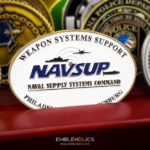
The coin is elliptical. One face carries an aircraft carrier with a jet launching from the deck. The other carries the NAVSUP logo on a plain, uncluttered field.
The shape is doing something specific here rather than being different for its own sake. An aircraft carrier is the longest object the Navy owns, and a flight deck with an aircraft leaving it is a horizontal subject in the most literal possible sense. On a round coin that scene has to be compressed, angled or cropped at the bow and stern. On an ellipse the deck runs the length of the coin and the aircraft has somewhere to be going.
It is also a good example of restraint on the second face. The logo sits on a plain field with nothing competing with it, which is what allows the busy face to be as busy as it is. A coin with a detailed scene on one side and a detailed treatment on the other gives the eye nowhere to rest.
For how aircraft are rendered accurately at coin size, see our page on rendering aircraft on a coin, and for terrain used as a background rather than as a subject, our page on engraved landscapes. For coins made for the command’s civilian staff rather than the organization, see our coins for the civilian workforce.
Can We Use Our Command’s Logo on a Coin?
Most commands can, but the authorization has to come from the command, not from us. Command logos, unit insignia, service seals and agency emblems are controlled by the organizations that own them, and the rules differ between branches and between commands.
Clear the artwork through your own chain of command before you order, and send us artwork your organization is authorized to supply. We produce from what the customer provides and we do not grant permission on anyone’s behalf. If you are unsure who signs off, your command’s public affairs office is usually the right place to ask.
Design an Oval Coin
Decide the shape before the artwork is drawn. An outline is part of the tooling rather than something applied afterwards, so an oval has to be chosen at the start, and a design drawn for a circle rarely transfers into one without being redrawn.
If you have a scene in mind — a ship, an airframe, a skyline — say so when you request a quote, because that is the single strongest reason to choose this shape and it will shape the whole layout. Professional artwork is free with unlimited revisions, and nothing goes into production until you approve a digital proof. The minimum order is 50 coins, standard production runs about 45 to 50 days after final artwork approval, rush production is available on many projects, and shipping within the continental United States is included. Embleholics is veteran-owned, SDVOSB and registered in SAM.gov. Browse more custom Navy challenge coins or request a free quote.
Artwork
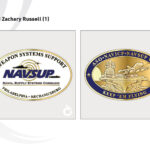
NAVSUP Weapon Systems Support Challenge Coin Artwork
Frequently Asked Questions
What is an oval challenge coin?
An oval or elliptical challenge coin is a non-round coin with a long axis, which gives it a landscape frame rather than a centered one. It suits horizontal subjects such as ships, aircraft and skylines, and it still reads as a conventional coin rather than a novelty shape.
When is an oval better than a round coin?
Whenever the main subject is wider than it is tall. Ships, aircraft in flight, flight decks, vehicles, bridges and skylines all have to be compressed or cropped to fit a circle. An oval also allows longer lines of text to sit almost straight.
Does an oval coin cost more than a round one?
An oval is a custom outline cut into the tooling, so it is part of the overall project quote rather than a separate charge. Quantity, size, plating and the complexity of the two faces usually affect a quote more than the choice of outline does.
How does lettering work on an oval coin?
The top and bottom runs of an oval are much flatter than a circle’s, so a line of type behaves more like text on a straight baseline and can be longer and smaller while staying readable. Break the line before it reaches the tight ends rather than carrying it all the way around.
Can a full scene be shown on one face of a coin?
Yes, and it usually needs the whole face to work, with a foreground, a subject and a background. Pairing a scene on one side with a plain logo on the other gives both what they need, where putting detail on both faces leaves the eye nowhere to rest.
What does not work well on an oval coin?
Circular seals, round crests and single centered devices built on radial symmetry. Those are designed for a circle, so placing one in an ellipse leaves unusable space at both ends. If the main element is round, a round coin is the better frame.
Can we use our command’s logo on a coin?
Command logos and unit insignia are controlled by the organizations that own them, so permission comes from your command rather than from a manufacturer. Clear the artwork through your chain of command and supply artwork your organization is authorized to provide.
What is the minimum order for oval coins?
The minimum order for custom challenge coins is 50 coins, including shaped and oval ones. Larger quantities reduce the cost per coin, and because the outline is part of the tooling it is worth settling the shape and the quantity together.
More Navy Projects