A reenlistment challenge coin marks a decision rather than an achievement. It is usually given by the person whose job is retention, a career counselor or retention NCO, at the moment a soldier signs on again, and it says something closer to “glad you stayed” than “well done.”
Who Gives Reenlistment Coins?
Career counselors and retention NCOs. These are the people whose actual job is keeping good soldiers in. They sit down with someone approaching the end of a contract, talk through options, handle the paperwork, and stand there at the ceremony when it is signed. Almost nobody in a unit has more standing occasions to hand over a coin, and almost nobody in this market sells to them.
Commanders at reenlistment ceremonies. The ceremony is often conducted by a commander, and a coin from the commander alongside one from the counselor is common.
Recruiters, for first enlistments, which is the same moment at the other end of a career.
Senior enlisted leaders, who tend to keep a supply for exactly this kind of moment.
The commercial point is the one the old page walked past. Reenlistments happen continuously. A division has people signing on every week of the year, which makes a retention coin an ongoing requirement rather than a single event order. The counselor is usually the person placing that order, they are usually doing it themselves, and they are buying for a whole tour rather than for a date in the calendar.
That also changes what a good order looks like. An event coin is sized to the event. A retention coin should be sized to how long the person ordering it expects to be in the job.
What Goes on a Reenlistment Coin?
The unit insignia, at whatever level the coin belongs to. Division, brigade, battalion.
The role of the person presenting it. Career Counselor, Retention NCO, Command Sergeant Major. This matters more than it does on other coins, because the coin is coming from a person in a defined job rather than from the unit generally.
The installation, which is covered in the next section and is often the strongest element available.
A motto or a line about service, kept short.
And one piece of advice that saves people money: leave the date off.
This comes up constantly and the instinct runs the other way, because a coin feels like it should record when. But a retention coin is handed out continuously for as long as the stock lasts, and a year stamped on it means every coin given after December looks out of date. Worse, it means the counselor has to reorder annually whether or not they have run out. A coin carrying the unit, the role and the installation and no year can be handed over for three years and will still be correct on the last day.
The same logic applies to first enlistment coins, promotion coins and the ceremonies around both. Anything given repeatedly over a tour should be undated.
Putting a Base or a Landscape on a Coin
The reverse of this coin carries an engraved landscape of the installation, and it is a better idea than it first appears.
Everyone posted there recognizes it instantly. A unit insignia means something to the people in that unit. The terrain around a base means something to everyone who has stood in the motor pool looking at it, regardless of which brigade they belong to. For a coin being handed to soldiers from across a whole division, that reach matters.
It does not date. Units reflag, insignia get updated, task organizations change. The landscape does not.
It belongs to the place rather than to any one unit. That makes it politically neutral in a way a subordinate unit’s emblem is not, which is exactly what you want on a coin crossing brigade lines.
How it is done well:
Engrave it rather than paint it. An engraved background sits below the surface and stays quiet. Painted scenery competes with the foreground and turns the coin into a picture with devices stuck on top of it.
Hold it back deliberately. The landscape is a setting, not the subject. If it is as prominent as the insignia, the design has two focal points and no hierarchy.
Simplify to the silhouette people actually recognize. Nobody recognizes a literal rendering of terrain. They recognize the outline, the one peak or ridge that appears in every photograph anyone has taken from that base. Reduce it to that and it reads at coin size; render it faithfully and it turns to mush.
For place imagery handled the other way, as the subject rather than the setting, see our page on place and landscape imagery on coins.
About This 7th Infantry Division Coin
The 7th Infantry Division is an active-duty U.S. Army division based at Joint Base Lewis-McChord in Washington State. This coin was made to be presented by the division’s Command Career Counselor.
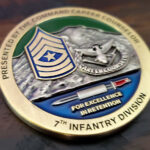
One face carries the division insignia, etched and painted. The reverse carries rank and unit devices set over an engraved landscape of the installation, with the mountain and terrain that define the view from the base reduced to a clean silhouette behind the foreground elements.
The detail worth pointing out is the eagle on the device, which is very small and still reads. That is the part of this coin that took the work. A recognizable bird at that scale is right at the limit of what a strike will hold, because the features that make an eagle an eagle, the hooked beak, the set of the head, the feather separation at the wing, are all fine lines that want to fill in or flatten out. Getting one to survive means simplifying it until only the identifying shapes remain and then cutting those slightly deeper than the surrounding relief so they hold their edges.
It is the same problem described on our page about aircraft, and the same answer: work out which details make the thing recognizable, protect those, and let everything else go.
This was made close to home, since Joint Base Lewis-McChord is in Washington and so are we. See another Joint Base Lewis-McChord project, coins made for unit and company coins, and for leadership handovers, our page on coins marking a change of command.
Can We Use Our Unit Insignia on a Coin?
Most units can, but the authorization has to come from the unit, not from us. Unit insignia, distinctive unit insignia, division patches and installation emblems are controlled by the organizations that own them, and the rules differ between branches and between commands.
The practical version is straightforward. Clear the artwork through your own chain of command before you order, and send us artwork your organization is authorized to supply. We produce from what the customer provides and we do not grant permission on anyone’s behalf. If you are unsure who signs off, your command’s public affairs office is usually the right place to ask.
Design a Coin for Your Retention Program
Order for the tour, not for the quarter. A retention coin gets handed out continuously, so the useful question is not how many reenlistments you have this year but how long you expect to be in the job. Ordering once at a higher quantity costs less per coin than reordering annually, and an undated design will still be correct at the end of it.
Professional artwork is free with unlimited revisions, and nothing goes into production until you approve a digital proof. The minimum order is 50 coins, standard production runs about 45 to 50 days after final artwork approval, rush production is available on many projects, and shipping within the continental United States is included. Embleholics is veteran-owned, SDVOSB and registered in SAM.gov. See more custom Army challenge coins or request a quote to get started.
Frequently Asked Questions
What is a reenlistment challenge coin?
A reenlistment challenge coin is given to a service member at the point they sign on for another term. It marks a decision rather than an achievement, which is why it usually carries the unit and the presenting role rather than an award citation or a date.
Who hands out reenlistment coins?
Career counselors and retention NCOs hand out most reenlistment coins, since retention is their job and they attend every ceremony. Commanders and senior enlisted leaders also present them, and recruiters give the equivalent at first enlistment.
What does a career counselor do?
A career counselor advises soldiers on their options as a contract nears its end and handles the reenlistment process when they decide to stay. The role exists to support retention, which means the counselor is present at reenlistment ceremonies as a matter of course.
What goes on a retention coin?
A retention coin usually carries the unit insignia, the role of the person presenting it, such as Career Counselor or Retention NCO, and often the installation. A short line about service is common. Dates are usually left off deliberately.
Should a reenlistment coin have a date on it?
Generally no. A retention coin is handed out continuously for as long as the stock lasts, so a year on the design makes every coin given after that year look out of date and forces an annual reorder. An undated coin stays correct for the whole tour.
Can a base or landscape be engraved on a coin?
Yes, and an installation’s terrain works well as a background because everyone posted there recognizes it and it does not date. Engrave rather than paint it, keep it behind the foreground elements, and simplify it to the silhouette people actually recognize rather than a literal view.
Can we use our unit insignia on a coin?
Unit insignia, division patches and installation emblems are controlled by the organizations that own them, so permission has to come from your unit rather than from a manufacturer. Clear the artwork through your chain of command and supply artwork your organization is authorized to provide.
What is the minimum order for retention coins?
The minimum order for custom challenge coins is 50 coins. For a retention program that is typically a few months of reenlistments in a large unit, so most counselors order well above it and design the coin undated so the stock lasts the whole tour.
More Army Projects