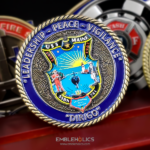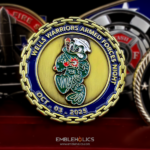
Government civilians work alongside military units without belonging to one, so a civilian challenge coin cannot be built from a unit, a rank or a rating. It is built instead from the organization, the function, the tier and length of service.
Why Civilian Employees Need Their Own Coins
The Department of Defense employs several hundred thousand civilians. They sit inside coin culture and almost entirely outside coin design, and the reason is structural rather than anything to do with status.
They work alongside the uniformed side every day. Logistics, acquisition, engineering, contracting, medical, intelligence, maintenance, training. In many commands the civilian workforce outnumbers the military one and provides the continuity, because civilians stay while uniformed staff rotate through on two and three year tours.
They have none of the things a unit coin is made of. No squadron, no battalion, no rating badge, no rank insignia, no warfare device, no patch. Every standard element of a military coin design is unavailable, and the usual templates simply do not apply.
They receive coins constantly. Anyone working in a command is on the receiving end of commanders’ coins, unit coins, visiting coins and recognition coins, because everyone around them hands them out.
And they rarely have one of their own to give back. That is the gap. A civilian who has been handed forty coins over a career often has nothing to offer in return, not because nobody thought of it but because the design problem was never solved.
Solving it means choosing different source material. The organization rather than the unit. The function rather than the rating. The tier or grade rather than the rank. And length of service, which in federal employment is formally tracked and formally recognized in a way military time in service is not.
What Occasions Do Civilians Mark?
Length-of-service milestones. Federal service recognizes service at ten, twenty, thirty years and beyond, formally and on a schedule. These arrive predictably, they are genuinely significant to the people receiving them, and almost nobody produces a coin for them. It is the single clearest unserved occasion in this whole category.
Retirement from civil service. Often after a career longer than most military ones, and frequently spent at the same command. A thirty-five year civilian retirement is a substantial event and the coin market largely ignores it.
Appointment to the Senior Executive Service. A significant step with no established ceremony coin, unlike a commissioning or a promotion to flag rank.
Moves between commands. Civilians change organizations without a change of station, so there is no PCS, no hail and farewell circuit, and often nothing marking a departure after years in one office.
Recognition where a military decoration is not available. Civilians are not eligible for most military awards, which leaves a real gap when someone has done something that in uniform would have been decorated. A coin is frequently what fills it.
What Is the Senior Executive Service?
The Senior Executive Service is the senior civilian tier of the United States federal workforce. It sits above the standard General Schedule grades and comprises the executives who run agency programs and organizations directly below presidential appointees.
In practical terms within the Department of Defense, SES members are broadly equivalent in seniority and responsibility to general and flag officers, and they are treated accordingly in protocol and precedence. A command’s SES members are typically its most senior permanent leadership, since they remain in place across changes of military command.
That last point is why an SES coin is worth making. The uniformed leadership rotates and the SES tier does not, which makes those executives the continuity of the organization.
What Goes on a Civilian Coin?
The command or agency emblem, which is the primary identifier when no unit insignia is available.
The SES or organizational insignia, where authorized.
Years of service, particularly on milestone and retirement coins. This is one of the few places a specific number belongs on a coin.
The function or directorate, since a civilian’s professional identity usually attaches to what they do rather than to where they sit.
A motto or a line about service, kept short.
What is normally absent is as defining as what is present: no rank device, no rating badge, no unit patch, no warfare qualification. Civilian coins therefore tend toward formal, emblem-led designs, and they lean on finish and metal for their effect rather than on the layered insignia that fills a military coin face. That is a constraint, but it is not a limitation, and the results are usually more restrained and better for it.
For related work, see our pages on program office and acquisition coins and Navy Supply Corps coins.
About This NAVSUP SES Coin
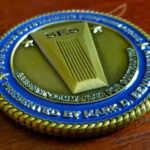
NAVSUP is the Navy’s supply command. This coin was made for its Senior Executive Service members, the command’s senior civilian executives.
The coin has a brass-colored base with a brushed finish, the command logo embossed on one face and the SES insignia on the other, with a single color used minimally across the design.
The restraint is exactly right, and it is worth explaining rather than treating as an absence of ambition. A coin at this level is handed between senior people, frequently to counterparts from outside the organization. That puts it in the same register as a presentation coin: the recipient may be meeting the command for the first time, the exchange is semi-formal, and the object is examined closely rather than pocketed.
In that setting, enamel color reads as decoration and brushed metal reads as authority. A brushed brass finish also changes as the coin turns in the hand, which a flat painted face does not, so a restrained coin can be more interesting to hold than a colorful one. Using a single color once, rather than filling every recess, means that one element is deliberately drawn attention to and everything else supports it.
The conventions that govern coins handed to outsiders are covered on our page about presentation and protocol coins.
Can We Use the SES or Agency Insignia on a Coin?
The Senior Executive Service insignia is a federal device, and agency emblems and seals are controlled by the organizations that own them. This is closer to the protected-emblem cases than to a unit crest, and it deserves more care than a patch would.
Our position is the same as it is for any controlled mark. We produce from artwork the customer is authorized to supply, and the authorization is the customer’s to obtain. We are a manufacturer rather than an authority on federal device use, and we do not grant permission on anyone’s behalf.
The practical advice: clear the artwork through your command’s public affairs or general counsel before ordering, and supply the approved rendering rather than an image sourced from the internet.
Design a Coin for Your Civilian Team
Embleholics is registered in SAM.gov and holds SDVOSB status, which matters if you are buying through federal procurement rather than personally. We can work with purchase orders and established payment terms where an organization’s purchasing requirements call for them.
Professional artwork is free with unlimited revisions, and nothing goes into production until you approve a digital proof. The minimum order is 50 coins, standard production runs about 45 to 50 days after final artwork approval, and rush production is available on many projects. Shipping within the continental United States is included. See more custom government challenge coins and our government contract work, or request a free quote.
Frequently Asked Questions
What is a government civilian challenge coin?
A government civilian challenge coin is made for federal employees rather than for uniformed personnel. Because civilians have no unit, rank or rating insignia, these coins are built around the command or agency emblem, the function or directorate, the employee’s tier, and length of federal service.
What is the Senior Executive Service?
The Senior Executive Service is the senior civilian tier of the United States federal workforce, sitting above the General Schedule grades and below presidential appointees. Within the Department of Defense, SES members are broadly equivalent in seniority to general and flag officers.
Do civilian employees receive challenge coins?
Yes, constantly. Civilians working at military commands receive commanders’ coins, unit coins and recognition coins from the uniformed staff around them. What they often lack is a coin of their own to give in return, which is the gap a civilian or directorate coin fills.
What goes on a coin for civilian staff?
A civilian coin usually carries the command or agency emblem, the directorate or function, years of federal service where the coin marks a milestone, and organizational insignia where authorized. Rank devices, rating badges and unit patches are not available, so designs tend to be emblem-led and formal.
Can a coin mark years of federal service?
Yes, and service milestones are one of the strongest occasions for a civilian coin. Federal service is formally recognized at ten, twenty and thirty years and beyond, those milestones arrive on a predictable schedule, and very few organizations produce anything to mark them.
Can we use the SES insignia on a coin?
The SES insignia is a federal device and agency emblems are controlled by the organizations that own them, so permission comes from your command rather than from a manufacturer. Clear the artwork through public affairs or general counsel and supply the approved rendering rather than a sourced image.
Can a government office buy challenge coins directly?
Yes. Embleholics is registered in SAM.gov and holds SDVOSB status, and can work with purchase orders and established payment terms where an organization’s purchasing requirements call for them. Discuss your procurement requirements when you request a quote.
What is the minimum order for government coins?
The minimum order for custom challenge coins is 50 coins. That suits a directorate, office or executive group rather than a whole command, and larger quantities reduce the cost per coin.
More Navy Projects