A field office challenge coin has to distinguish one office from every other office in the same agency. The strongest designs do it with local culture rather than with a map, because a state outline says where you are while a regional in-joke says who you are.
How Is the DEA Organized?
The Drug Enforcement Administration is a federal law enforcement agency organized into field divisions, each covering a region of the country, with district offices and smaller posts of duty underneath them.
That structure is the important part for anyone thinking about coins. A division is not one workplace. It is a headquarters plus a spread of offices across several states, each with its own building, its own group of people and its own sense of itself.
So coins are rarely ordered at agency level. They are ordered by a division, by a district office, by a task force group, or by a section within one, and each of those wants a coin that says which part of the agency it belongs to. The same pattern appears across every large federal agency, as our page on field office coins describes for a different one.
How Does a Field Office Coin Say Where It Is?
This is the actual design problem, and it is harder than it sounds. Thirty offices, one agency seal, and every one of them needs to be recognizably itself.
The obvious answers are the weak ones.
A state outline. A city skyline. A famous bridge, a famous building, a famous mountain. These are the first things anyone reaches for, and the trouble with all of them is that they are not yours. Every federal agency, every state police force, every fire department and every chamber of commerce in that state uses the same silhouette. A coin built on a state outline tells you the geography and nothing else, and it will look like four other agencies’ coins sitting in the same drawer.
Local culture is the better answer.
Not the landmark, the thing people who live there actually talk about. Regional folklore. The weather everyone complains about. The food outsiders find strange. A tradition specific to that part of the country. A joke that only makes sense within a few hundred miles.
Why it works: the audience for a field office coin is the field office. These coins go to the people in that building and to colleagues from other offices who visit. They are not marketing and they are not public-facing. A design that a stranger does not understand is a design the office recognizes instantly, and the recognition is the entire value of the object.
Where the line sits. A field office coin still belongs to the agency, so the local material works alongside the official identity rather than replacing it. The agency mark says which organization. The local material says which office. Both have a job and neither should do the other’s.
For more on drawing design ideas out of a group’s own culture, see our page on where coin design ideas come from.
Two Faces, Two Techniques
Most coins use one treatment across both sides. This one does not, and it is worth explaining why that works rather than looking like a mistake.
The front is sculpted relief with color: a figure modelled with real height, with paint filling specific areas. The reverse is engraved and flat: a black-and-white image cut into the surface with no relief and no color at all.
Those are opposite approaches. Relief builds up and catches light from the side. Engraving cuts down and reads as line work. Put half-heartedly on one coin, they clash, because the eye reads the flatter side as the unfinished one.
What makes it succeed here is that each face commits completely. The sculpted side is properly sculpted, with depth and modelling and color where it counts. The engraved side is properly engraved, fully flat, fully monochrome, no timid relief creeping in. Neither is a diluted version of the other, so the contrast reads as two deliberate choices rather than as inconsistency.
The general rule for anyone considering a two-technique coin: pick each face’s approach and push it all the way. A coin fails when both sides are doing a bit of everything.
About This New England DEA Coin
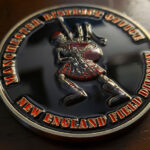
This coin was made for the DEA’s New England Division, Manchester District Office.
The front carries a skeleton playing bagpipes, sculpted in relief, with red picked out on the pipes and the clothing. The reverse carries a Bigfoot silhouette against a New England forest, engraved flat in black and white.
Neither element is agency imagery, and that is the point. Both are local.
Bagpipes are deeply embedded in Northeastern law enforcement culture. Police and fire departments across the Northeast maintain pipe bands, Emerald Societies have run them for generations, and pipes are played at line-of-duty funerals and memorial services throughout the region. To anyone who has worked in law enforcement in that part of the country, a piper is not a whimsical choice. It is a reference everyone in the building will read immediately.
Bigfoot is regional folklore, a running Northeastern woods joke, and setting the silhouette against a New England forest doubles the reference.
Put together, without a map, a state outline or a landmark anywhere on the coin, the two faces say New England to anyone who works there and nothing much to anyone who does not. That is exactly what a field office coin is supposed to do, and it is a considerably better solution than a silhouette of Massachusetts would have been.
See also county drug task force coins, coins shaped around a city, and our wider range of custom law enforcement challenge coins.
Can We Use Our Agency Insignia on a Coin?
Most offices can, but the authorization has to come from the agency, not from us. Agency seals, badges, division devices and office identifiers are controlled by the organizations that own them, and federal agency seals in particular are governed by their own rules.
The practical version is straightforward. Clear the artwork through your own chain of command before you order, and send us artwork your agency is authorized to supply. We produce from what the customer provides and we do not grant permission on anyone’s behalf. If you are unsure who signs off, your division’s administrative or public affairs office is usually the right place to ask.
Design a Coin for Your Office
Tell us which office it is for and what people there would find funny, and a designer will build something around it at no cost. The material is usually already in the room: the thing everyone complains about, the local legend, the food, the weather, the nickname nobody remembers the origin of.
Professional artwork is free with unlimited revisions, and nothing goes into production until you approve a digital proof. The minimum order is 50 coins, which suits a single office rather than a whole division. Standard production runs about 45 to 50 days after final artwork approval, rush production is available on many projects, and shipping within the continental United States is included. Embleholics is veteran-owned, SDVOSB and registered in SAM.gov. Request a free quote to get started.
Frequently Asked Questions
What is a field office challenge coin?
A field office challenge coin belongs to one office within a larger agency rather than to the agency as a whole. It carries the agency identity alongside something that marks out that particular office, so it can be distinguished from coins made by the same agency elsewhere in the country.
Can an individual district office order its own coins?
Yes, and most federal agency coins are ordered this way. Divisions, district offices, task force groups and individual sections all order their own designs. The 50-coin minimum is set at a level that suits a single office rather than requiring an agency-wide order.
How do you make a coin represent a region?
Local culture works better than geography. State outlines, skylines and landmarks are used by every organization in that state, so they identify the place without identifying the office. Regional folklore, traditions, weather and food are more specific and mean more to the people receiving the coin.
Can two sides of a coin use completely different techniques?
Yes, provided each side commits fully to its own approach. A sculpted, colored face opposite a flat engraved face reads as two deliberate choices. Problems arise when both faces do a little of each, because the contrast then looks accidental rather than intended.
What is the difference between sculpted relief and engraving?
Sculpted relief builds the design up off the surface with modelled height, so it catches light from the side and can carry color in its recesses. Engraving cuts down into the surface and reads as line work, staying flat and usually monochrome. Relief suits figures, engraving suits scenes and fine detail.
Can a coin design be humorous for a federal agency?
Yes, for coins that stay inside the office. Humor and local references work well on coins given to colleagues and visiting agents, because those recipients share the context. Coins presented to the public, to partner organizations or at formal occasions should be more conventional.
Can we use our agency insignia on a coin?
Agency seals, badges and division devices are controlled by the organizations that own them, so permission has to come from your agency rather than from a manufacturer. Clear the artwork through your chain of command and send us artwork your agency is authorized to supply.
What is the minimum order for agency coins?
The minimum order for custom challenge coins is 50 coins. That suits a single district office, task force group or section rather than a whole division, and larger quantities reduce the cost per coin.
More Law Enforcement Challenge Coins Projects