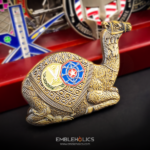
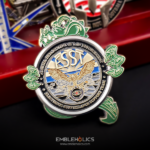
A CBP challenge coin has a problem that unit coins do not. U.S. Customs and Border Protection deploys agriculture specialists across more than 180 ports of entry, and every one of them uses the same agency seal, the same uniform and the same name. The seal is therefore the one thing on the coin that says nothing about which office it came from. This coin, ordered by Field Operations in San Francisco, solves it by putting the city on the front and the agriculture mission on the reverse.
One Seal, More Than 180 Ports of Entry
Anyone ordering a coin for a field office, a district, a division or a resident agency runs into the same thing. The organization is national, the emblem is national, and the coin is for a specific group of people in a specific place.
The instinct is to enlarge the agency seal and add the office name underneath it in small type. That produces a coin that is correct and interchangeable, which is the worst outcome for an object whose purpose is to mean something to the person holding it.
The better structure separates the two jobs.
- The seal establishes legitimacy. It belongs on the coin, often on the reverse or inside a rim, and it does not need to be large to do its work.
- Something local establishes identity. A landmark, a geographic feature, a port, a bridge. This is the part people recognize and the part that makes the coin specific.
- Something occupational establishes what you actually do. For this coin, the detector dog. For a marine unit it might be a vessel, for an air branch an aircraft.
Get those three onto two sides and the coin is finished. Most field office coins carry only the first.
Why a Landmark and Not a City Name
San Francisco in text is information. The Golden Gate in relief is recognition, and the difference matters more on a coin than on almost any other object.
Text has to be read, which means it has to be large enough to read, which on a coin means it competes for the space the artwork needs. A landmark is identified before it is read, from further away, and by people who never look closely. It is the only practical way to put a place on a coin without spending the coin’s real estate on letters.
One caution that is easy to get wrong. Choose the landmark outsiders know, not the one locals are fond of. These coins are handed to visiting officers, partner agencies and people from other ports, so the device has to be legible to someone who has never been to the city. A nationally famous bridge qualifies. A beloved local building usually does not.
The Dog Is the Agriculture Mission
A detector dog on an agriculture specialist coin looks at first like a law enforcement image borrowed onto the wrong coin. It is the opposite. The dog is the most recognizable part of the agriculture mission itself.
CBP agriculture specialists work at ports of entry to stop harmful plant pests, foreign animal diseases and other biological threats from arriving in passenger baggage and in cargo. The canine teams are the part of that work the travelling public actually sees. They are trained at the USDA’s National Detector Dog Training Center in Georgia to find fruit, vegetables, meat and soil that can host invasive pests, and the program came to CBP with roughly 75 teams when the Homeland Security Act moved the agriculture inspection function over from USDA. It now runs more than 200 teams.
So the two sides of this coin are not a landmark and an unrelated dog. They are where this office is and what this office does, and the dog is the better of the two choices because it is specific to agriculture rather than shared with every other enforcement function at the port.
Brushed Gold Instead of Polished
The coin is matte gold with a brushed effect rather than bright polished gold, and that is a deliberate difference in register.
Polished gold reads as an award. It is the finish of trophies, medals and prizes, and on a round coin it tilts the whole object toward commemoration. Brushed or matte gold reads as something issued. It keeps the warmth and the authority of gold while losing the shine that makes a coin look like a prize, which is the right note for a working agency coin that gets handed across a desk.
Brushing also helps the artwork. A mirror surface bounces light in all directions and flattens shallow relief, where a brushed surface holds a consistent soft highlight that lets sculpted detail keep its shadows.
The blue and green accents are used sparingly on an otherwise monochrome field, which is roughly the limit. Two accent colors on metal still read as metal with highlights. Three or four and the metal becomes the background rather than the material, and the coin starts to look like a printed badge.
A Cityscape Is Not a Landscape
Sculpting a skyline is a different problem from sculpting scenery, and it is harder in one specific way.
Natural forms are irregular, so small imperfections in a die read as texture. Built forms are not. A bridge tower, a suspension cable or a building edge is a straight line, and a straight line shows every waver. The consequence is that a cityscape needs fewer and bolder buildings than an accurate skyline contains. Four or five recognizable masses with clean edges will read as a city. Twenty accurate ones will read as a comb.
This coin also uses a raised rim with the inscriptions set inside it, on both sides, which is worth stealing. A rim is a physical barrier: it gives lettering its own channel, at its own height, so the text cannot visually collide with the artwork no matter how busy the artwork is. On a coin carrying a detailed skyline, that separation is doing real work.
Permission for Landmarks and Seals
Two authorization points apply to a coin like this one, and both are worth settling before the artwork stage.
Federal agency seals and emblems are controlled by the agency, and their use on merchandise is governed by agency policy. Order through your office and confirm what is approved rather than assuming a seal available online is a seal you may reproduce.
Landmarks can also carry restrictions. Bridges, stadiums, buildings and monuments are sometimes subject to trademark or licensing rules covering commercial use of their name or image, and whether one applies depends on the landmark. Check before you build a design around one.
We produce from the artwork a customer supplies, we rely on the customer to hold the right to supply it, and we do not grant permission on anyone’s behalf.
Design a Coin for Your Field Office
Send your agency seal, any local landmark or feature you want used, and the occupational element that represents what your office actually does. Tell us which of the three matters most, because that decides what goes on the front.
Professional artwork is free with unlimited revisions, and nothing goes into production until you approve a digital proof. Standard production runs about 45 to 50 days after final artwork approval, rush production is available on many projects, and shipping within the continental United States is included. Embleholics is veteran-owned, SDVOSB and registered in SAM.gov. See more Department of Homeland Security challenge coins, a Border Patrol coin, or a federal law enforcement coin.
Finished Coin (Front)
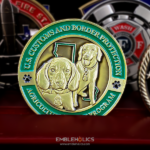
Finished Coin (Back)

Frequently Asked Questions
What is a CBP challenge coin?
A CBP challenge coin is a coin made for U.S. Customs and Border Protection personnel, usually at the level of a field office, port of entry or specialized program rather than for the agency as a whole. Because every port shares the same agency seal, these coins normally pair the seal with a local landmark and an element representing the office’s particular mission.
What does a CBP agriculture specialist do?
CBP agriculture specialists work at ports of entry to prevent harmful plant pests, foreign animal diseases and other biological threats from entering the country in passenger baggage and in cargo. CBP deploys them at more than 180 ports of entry, including airports, seaports and land border crossings.
Why is there a detector dog on an agriculture specialist coin?
Because the canine teams are the most visible part of the agriculture mission. CBP agriculture detector dogs are trained at the USDA’s National Detector Dog Training Center in Georgia to find fruit, vegetables, meat and soil that can carry invasive pests, and the program transferred to CBP from USDA with roughly 75 teams under the Homeland Security Act. The dog is specific to agriculture rather than shared with other enforcement functions at a port.
How does a local field office make its coin distinct from the agency’s?
By giving the three elements separate jobs. The agency seal establishes legitimacy and does not need to be large. A local landmark or geographic feature establishes which office it is. An occupational element, such as a detector dog, a vessel or an aircraft, establishes what that office actually does. Most field office coins carry only the seal, which is why so many of them are interchangeable.
Can a landmark such as a bridge be used on a challenge coin?
Often, but check first. Bridges, stadiums, buildings and monuments are sometimes subject to trademark or licensing rules covering commercial use of their name or image, and whether that applies depends on the specific landmark. A manufacturer produces from the artwork the customer supplies and relies on the customer to hold the right to supply it, so confirm any restriction before the artwork stage.
Is brushed gold or polished gold better for an agency coin?
Brushed, in most cases. Polished gold is the finish of trophies and medals, so it tilts a coin toward looking like an award, while brushed or matte gold keeps the authority of gold and reads as something issued rather than won. Brushed surfaces also hold a softer, more consistent highlight, which lets sculpted relief keep its shadows instead of being flattened by reflection.
How do you stop lettering competing with artwork on a coin?
Use a raised inner rim and set the lettering inside it. The rim is a physical barrier at a different height from the artwork, so the text occupies its own channel and cannot visually collide with a busy design. It is a more reliable solution than simply reducing the type size, which tends to make the lettering hard to read instead.
How many colors should an agency coin use?
Two accents on a metal field is a good limit. At two, the coin still reads as metal with highlights. At three or four, the metal becomes a background rather than the material, and the coin starts to look like a printed badge rather than a struck one.
More Law Enforcement Challenge Coins Projects