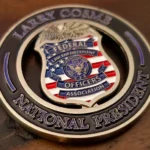
This coin was made for a professional association of federal officers, not for a federal agency. Its members work across dozens of different organizations, so instead of any one agency’s seal it carries a badge outline cut clean through the center, which is the one symbol they all share.
A Coin for the Profession, Not the Agency
The distinction is the whole page. An association representing officers from many agencies cannot put any single agency’s device on its coin without leaving most of its membership out.
Membership spans employers. Officers come from across the federal government, and the association exists precisely because their shared interests cut across those organizations.
A badge is the shared symbol. Whatever agency issued it, every federal officer carries one. It is the only device that means the same thing to all of them, which is why it earns the center of the coin.
The money is dues rather than appropriations. That means no federal procurement process, a short decision chain and a quantity set by membership.
And this coin marks a term of office, honoring the association’s National President and National Executive Vice President.
The general version reaches well past law enforcement. Any organization whose members belong to different employers has the same problem: trade associations, professional bodies, alumni groups, veterans organizations and multi-agency task forces. The answer is always the same, which is to find the object or emblem the members share rather than the one their employers issue.
For the agency side of the same world, see a federal law enforcement challenge coin, and for a local police association, a police union coin.
Cutting the Badge Through the Coin
The most interesting thing here is what is not there. The center of the coin is hollowed out so the badge outline exists as a void rather than as a raised device, with the badge’s lines and lettering embossed and painted around it.
A void reads as a silhouette instantly, because the eye follows the edge. There is nothing competing inside the shape to slow recognition down.
It makes the badge the subject without raising it above everything else. Relief creates hierarchy by height; a cutout creates it by absence, which is quieter and often stronger.
Whatever is behind the coin becomes part of the design. Hold it up and the badge fills with whatever you are looking at. No struck relief can do that.
And people notice a coin they can see through. On a desk full of coins, this is the one that gets picked up.
The production notes are real. A large interior cutout removes structural metal, so the remaining frame has to be thick enough to hold its shape. Internal corners concentrate stress and want radiusing rather than sharp angles. And the piece will not sit in standard packaging. See cutout challenge coins for more on the technique.
Coins That Mark a Term of Office
This coin honors two elected officers, and officeholder coins are common across associations, unions, lodges and boards without anyone having written down how they work.
The run is tied to a term rather than a headcount, which makes it small.
The design usually names the office rather than the person, which keeps it usable across successive holders and spreads the die cost over several terms.
If names do appear, the coin becomes a one-off. The die is used once and the whole cost falls on a single short run.
So the decision worth making early is whether the coin belongs to the office or to the person. That one choice sets the quantity, the cost per piece and whether the artwork can be reused in two years.
Who Federal Officers Work For
Federal law enforcement officers serve across many departments and agencies, most of them within the Department of Justice and the Department of Homeland Security, with others in the executive, legislative and judicial branches.
That spread is the reason an association covering them exists, and the reason its coin had to be built the way it was. See more government challenge coins.
Order a Coin for Your Association
Professional artwork is free with unlimited revisions, and nothing goes into production until you approve a digital proof. The challenge coin minimum is 50 pieces, standard production runs about 45 to 50 days after final artwork approval, rush production is available on many projects, and shipping within the continental United States is included. Embleholics is veteran-owned, SDVOSB and registered in SAM.gov.
Two things to tell us at the start. If your members come from different organizations, describe what they have in common rather than sending a logo, because that is what the coin will be built from. And say whether the coin belongs to an office or to a person, since it changes both the quantity and the artwork. Request a free quote to begin.
Finished Coin (Front)

Finished Coin (Back)
Frequently Asked Questions
What is a law enforcement association coin?
It is a coin made for a professional membership organization representing officers, rather than for a police department or federal agency. The association is funded by member dues and governed by elected officers, and its coin has to represent a profession rather than a single employer.
How is an association coin different from an agency coin?
An agency coin can carry that agency’s seal, because everyone receiving it works there. An association coin cannot, because its members come from many organizations. It has to be built from a shared symbol instead, which is why this one uses a generic badge outline rather than any particular agency’s device.
What goes on a coin for members from different employers?
Whatever the members share rather than whatever their employers issue. For law enforcement that is the badge; for a trade body it might be the tool or the product; for an alumni group the institution. Starting from the shared object avoids a design that quietly excludes most of the membership.
Can a badge shape be cut through a challenge coin?
Yes, and it is an effective treatment because a void reads as a silhouette faster than a raised device does. The frame around the cutout has to be thick enough to hold its shape, and internal corners should be radiused rather than left sharp, since that is where stress concentrates.
Does a large cutout weaken a coin?
It removes structural metal, so the remaining frame carries all the strength. That is manageable with the right thickness and softened internal corners. It also means standard packaging will not fit the piece, so protection has to be specified separately.
Can we put a federal agency badge on a coin?
Agency badges and seals are controlled devices, so the authorization has to come from the agency rather than from us. Many associations avoid the question entirely by using a generic badge outline, which represents the profession without reproducing anyone’s specific insignia. We produce from what the customer supplies and do not grant permission on any agency’s behalf.
Should an officeholder’s name go on the coin?
Only if you want a one-off. Naming the office rather than the person lets the same die serve successive terms, which spreads the tooling cost and keeps future reorders cheap. Naming the individual makes the coin personal and means the die is used once.
How many coins does an association usually order?
Officeholder coins are usually small runs near the 50-piece minimum, since they are tied to a term rather than to a membership roll. Association-wide coins are sized to the membership, and larger quantities bring the cost per piece down significantly.
More Law Enforcement Challenge Coins Projects