This coin solves a problem that comes up constantly and rarely gets solved well. A law enforcement agency’s badge needs a formal round field to sit in, and the people ordering the coin want some personality in it. Putting a cartoon on the same face as a badge ruins the badge. This design keeps them apart: the coin stays a conventional round coin carrying an owl on one face and the FDLE badge on the other, and a cartoon alligator holds it from behind.
Three Ways to Add a Shape to a Coin
Custom shapes get discussed as one option and there are really three, with different consequences.
- Projections from a round body. Keys, handles, wings or spokes extending out from a conventional coin. The round field stays intact and the outline becomes distinctive. See the crossed keys coin.
- The coin cut to a figure’s outline. The coin becomes the subject, which is the most striking option and the most demanding, because figures have thin extremities. See the Golden Swordsman coin.
- A figure holding or framing the coin. The coin remains a complete round coin and a character is added around or behind it, as here. This is the least used of the three and in many cases the most useful.
The reason it is useful is that nothing is sacrificed. A figural coin gives up its flat field, so formal artwork has nowhere proper to sit. A composite like this one keeps a full circular face for the badge and gets the character from the figure outside it. You are not choosing between formality and personality, you are giving each one its own territory.
Why This Suits a Law Enforcement Agency Particularly
Agency badges are the artwork most damaged by informal treatment, and there are two separate reasons to keep them inside a clean round field.
The first is simply that a badge is a formal device designed to be read on its own, and crowding it with cartoon elements undermines it. The second matters more. A coin that reproduces a badge closely enough, at roughly badge size and in roughly badge shape, drifts toward territory that federal and state rules on insignia exist to keep clear. Keeping the badge inside an obviously circular coin removes that entirely, because the piece announces itself as a coin before anything on it is read. There is more on that on the ATF coin page.
So a composite coin lets an agency have a mascot without the mascot touching the badge, which is why it works here and why it is worth proposing more often.
Cartoon and Formal on the Same Piece
The alligator is a cartoon and the FDLE badge is finely detailed relief. Those are two different registers and the coin carries both without a clash, because they are physically separated.
Cartoon style is the right choice for the alligator for the same reason it suits any mascot at this scale: heavy outlines, flat shapes, exaggerated features and no fine internal detail, all of which survive reduction. A realistically rendered alligator would lose its scales, its eye and its character at coin size. More on that on the Coast Guard coin.
The badge is the opposite case: fine relief with small elements, which needs a flat field, good striking depth and no competition. Put the two on the same face and each would damage the other. Put the cartoon outside the coin and the badge inside it and both get what they need.
An Owl and an Alligator
Both devices are doing work and neither is arbitrary.
The alligator is Florida, as directly as a device can be. It is the state reptile, it is what the state is known for internationally, and it needs no caption anywhere in the world. For a state agency whose coin may be handed to visitors from other states and other countries, that legibility is the point.
The owl with spread wings on the front is the kind of device a unit chooses for itself. An owl is the traditional emblem of seeing what others cannot and of working after dark, which makes it an apt and discreet choice for a technical support unit, and it says so without describing anything about the work. That restraint is correct on a coin that will circulate outside the agency.
About the Florida ESST
ESST stands for Electronic Surveillance Support Team. It is a Florida Department of Law Enforcement program under which regional teams, staffed by personnel from participating local agencies, support law enforcement across the state. Local agencies join through a mutual aid agreement with FDLE.
See a federal field office coin for how a national agency handles the same identity problem, and more law enforcement challenge coins.
Order a Composite Coin
Send your agency badge or seal plus any mascot artwork, and say whether you want the mascot on the coin or around it. If formal artwork has to stay formal, a figure framing a round coin is usually the answer.
Professional artwork is free with unlimited revisions, the minimum order is 50 coins, and nothing goes into production until you approve a digital proof. Standard production runs about 45 to 50 days after final artwork approval, rush production is available on many projects, and shipping within the continental United States is included. Embleholics is veteran-owned, SDVOSB and registered in SAM.gov. See custom shaped challenge coins.
Finished Coin (Front)
The Florida ESST Challenge Coin features an owl with wings spread, symbolizing vigilance and technical expertise.
Finished Coin (Back)
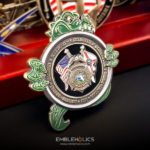
The playful alligator outline adds a unique twist, setting this coin apart from standard designs.
Frequently Asked Questions
What is an FDLE challenge coin?
An FDLE challenge coin is a coin for the Florida Department of Law Enforcement or one of its programs or regional teams, typically carrying the FDLE badge on one face. This one was made for the Electronic Surveillance Support Team program and pairs the badge with the team’s own device and a Florida alligator.
Can a mascot be added to a coin without putting it on the coin face?
Yes, and it is the most underused option in custom shapes. A figure can hold or frame a conventional round coin, so the circular face stays intact for formal artwork while the character sits outside it. Unlike a coin cut to a figure’s outline, nothing is given up: you keep a full flat field and still get a distinctive shape.
What are the three ways to give a coin a custom shape?
Projections from a round body, such as keys, handles or wings, which keep the round field intact. The coin cut to a figure’s outline, which makes the coin the subject but gives up the flat field and needs careful handling of thin extremities. Or a figure holding or framing a conventional coin, which keeps everything and is the least used of the three.
Why keep an agency badge inside a round field?
Two reasons. A badge is a formal device designed to be read alone, so crowding it with informal elements undermines it. And a coin that reproduces a badge closely at roughly badge size and shape moves toward the territory that rules on official insignia exist to keep clear, while a badge inside an obviously circular coin removes any ambiguity about what the object is.
Can a cartoon and fine detailed relief appear on the same coin?
Yes, if they are physically separated. Cartoon style uses heavy outlines and flat shapes that survive reduction, while fine relief needs a flat field and no competition. On the same face each damages the other, so putting the cartoon outside the coin and the detailed artwork inside it gives both what they need.
Why use a state animal on an agency coin?
Because it is legible to everyone. An alligator says Florida without a caption, including to people from other states and other countries, which matters for a coin a state agency hands to visiting agencies and partners. State animals, birds and reptiles work the same way state outlines do, and often read faster.
What does an owl represent on a unit coin?
An owl is a traditional emblem of seeing what others cannot and of working after dark, which is why units that operate at night or in a technical support role often adopt one. It communicates character without describing anything about the work, which is the right level of discretion for a coin that circulates outside the agency.
What is the Florida ESST?
ESST stands for Electronic Surveillance Support Team, a Florida Department of Law Enforcement program under which regional teams staffed by personnel from participating local agencies support law enforcement across the state. Local agencies join through a mutual aid agreement with FDLE.
More Law Enforcement Challenge Coins Projects