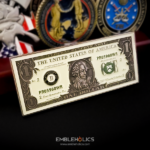
This coin is not round. It is cut to the proportions of a bank note, with a dollar bill embossed across one face. That is the widest format anyone orders, and it brings a set of problems a round coin never has.
The Widest Format There Is
Coin formats run from a circle, which has no orientation at all, through squares and ovals, to a rectangle. A bank note is further along that line than any of them: roughly twice as wide as it is tall.
What that gives you:
Room for a long subject. Anything wide and low fits here that would never fit on a disc. A scene with a horizon, a row of elements, a line of text at a readable size.
Lines of text that are actually lines. On a round coin every line of type is a different length and has to be centred and balanced. On a note-shaped piece each line has the same width available, which is why documents and inscriptions suit this format.
What it costs you:
Four corners, all of them exposed. A wide rectangle has the longest perimeter of any common format and the corners are the outermost points. They get radiused slightly, and anyone who has handled a sharp-cornered piece understands why.
It will not sit in a pocket comfortably. A note-shaped piece is a display object or a wallet object, not something that lives loose with keys.
A long thin shape flexes along its length. The middle of a wide piece is the part that bends, so a note format is struck heavier than a disc of similar area.
For the mechanics of rectangular formats generally, see our rectangular coin page, and for shape work overall, custom shaped challenge coins.
Currency Is the Most Finely Engraved Artwork There Is
Here is the real challenge of a design like this, and it has nothing to do with the shape.
Bank notes are engraved to defeat copying. That is their entire purpose. The lathe work, the guilloche patterns, the micro-lettering, the fine parallel line shading in the portrait: all of it exists specifically because it is difficult to reproduce. Putting that onto a struck coin means asking a die to hold the one kind of artwork that was designed to be unholdable.
Three things make it work:
Choose what to keep. A note has four or five distinct layers of detail. A coin can hold two. The border pattern and the central device survive; the shading inside the portrait and the micro-lettering do not, and deciding that in advance is better than discovering it on the proof.
Coarsen the repeating patterns. A guilloche or lathe pattern has to be redrawn at a spacing the die can hold. Reproduced at true density it closes up into a grey band, which loses the thing that made it look like currency.
Let relief do what ink cannot. A printed note is flat. A struck one is not. Raising the central device above the field gives the piece something no banknote has, and it is the right place to spend the depth.
Before You Put Currency on Anything
One thing to settle early. Reproductions of United States currency are regulated, and the rules exist to stop anything being passed as, or mistaken for, money. A struck metal coin is obviously not a bank note and nobody is going to spend one, but the question is worth answering properly rather than assumed.
We are a coin manufacturer and not a law firm. An organization planning a design that closely reproduces currency should put the question to its own counsel rather than to a vendor, and we will make what is approved. The same principle applies to federal insignia, which we cover on our federal law enforcement coin page.
Two Faces Doing Different Jobs
One face here carries the embossed note. The other carries an engraved scene with lettering.
That division is the right way round for a wide format. The note face is a reproduction, which means it is fixed artwork and benefits from the whole width being given to it. The scene face is original artwork, which means it can be composed for the format rather than fitted into it.
One practical note on the pairing. When one face is a dense reproduction and the other is an open scene, the finish has to tie them together or the piece reads as two unrelated objects stuck back to back. Matching the edge treatment across both faces is the simplest way to do it, because a shared border frames two very different designs as one thing.
See plating options for how the base metal affects a dense engraved face.
About the Coin
The coin commemorates a certified undercover operation conducted by Homeland Security Investigations. CUC stands for Certified Undercover Operation, meaning an investigation that has received formal written certification from a senior official.
That is as much as the page should say. A coin that marks work of this kind is made for the people who did it, and a vendor’s gallery page is not the place to describe how such operations are run, what certification permits, or anything about the work itself. The design is what we can usefully talk about.
For another federal agency project, see this CBP field office coin, and for more, government challenge coins.
Order a Bank Note or Rectangular Coin
Free professional artwork, unlimited revisions and a digital proof before anything is produced. Free shipping within the continental US, a 50-coin minimum, and most orders complete 45 to 50 days after artwork approval, with rush production available. Embleholics is veteran-owned, an SDVOSB, and registered in SAM.gov.
If your design reproduces something finely engraved, send it at the highest resolution you have and tell us which parts matter most. On dense artwork the job is deciding what to keep, and that decision is better made with you than for you.
Frequently Asked Questions
What is a dollar bill challenge coin?
A dollar bill challenge coin is cut to the proportions of a bank note rather than struck as a disc, usually with currency artwork embossed on one face. It is the widest common format, roughly twice as wide as it is tall.
Why choose a bank note shape?
Because it suits wide subjects and lines of text. Every line of type has the same width available, which a round coin never offers, so inscriptions and documents sit naturally on it.
What are the drawbacks of a wide rectangular coin?
Four exposed corners that need radiusing, a shape that does not sit comfortably loose in a pocket, and flex along its length, which means it is struck heavier than a disc of similar area.
Can currency artwork be reproduced on a coin?
Some of it can, but not all. A bank note carries four or five layers of detail and a coin can hold about two, so the border pattern and the central device survive while fine shading and micro-lettering do not. Deciding what to keep belongs at the artwork stage.
Why is currency so hard to reproduce on metal?
Because it was engraved specifically to resist copying. The lathe patterns, the fine parallel shading and the micro-lettering exist to make reproduction difficult, which is exactly the kind of artwork a die struggles to hold.
Are there rules about reproducing US currency?
Yes. Reproductions of United States currency are regulated, and the rules are aimed at anything that could be passed as or mistaken for money. A struck coin is plainly not a bank note, but anyone planning a close reproduction should put the question to their own counsel rather than to a manufacturer.
How do you tie two very different faces together?
Match the edge treatment across both. A shared border frames a dense reproduction on one side and an open original scene on the other as one object, where differing edges would make the piece read as two things joined back to back.
What does CUC stand for?
CUC stands for Certified Undercover Operation, an investigation that has received formal written certification from a senior official. The coin commemorates one such operation.
What is the minimum order for a shaped coin?
The minimum is 50 pieces, the same as for a round coin. A shaped format changes the tooling and the thickness rather than the quantity, so the shape itself does not raise the minimum.
More Law Enforcement Challenge Coins Projects