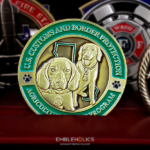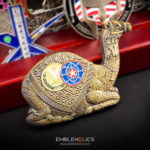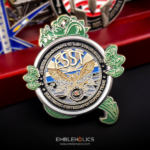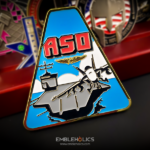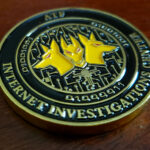
A federal law enforcement challenge coin carries a different kind of artwork from a company logo or a unit patch. Federal agency insignia are protected by statute as well as by agency policy, and that has one firm design consequence: a coin should carry a seal, not imitate a badge. This ATF coin does exactly that, with the bureau’s seal on one face and the unit’s name on the other, on a plain round coin.
Federal Insignia Is Protected by Statute, Not Just Policy
Most of the permission questions in this trade are licensing matters. Company logos are governed by brand guidelines, military service emblems by each service’s trademark licensing program. Federal law enforcement insignia sit in a different category, because there is a criminal statute as well.
Title 18 of the United States Code, section 701, makes it an offence to manufacture, sell or possess any badge, identification card or other insignia of the design prescribed by the head of a federal department or agency, or any colorable imitation of one, except as authorized under regulations. The penalty is a fine or up to six months.
That statute exists to prevent people impersonating federal officers, and it is aimed at badges and credentials. A challenge coin is neither, which is why agency coins are produced routinely and openly with the agency’s authorization. But the existence of the statute does produce a practical design rule, and it is the most useful thing on this page.
A Coin Should Not Look Like a Badge
Keep the coin recognizably a coin. That sounds obvious and it is routinely got wrong, because a badge is a handsome piece of artwork and the temptation to reproduce it faithfully is strong.
Three things to avoid, and all three are decided at the artwork stage.
- Do not cut the coin to the badge’s outline. A shield-shaped coin carrying a department’s exact badge artwork at roughly badge size stops being a commemorative object and starts being an object that resembles credentials.
- Do not match badge dimensions. Scale matters. A device clearly larger or smaller than the real badge reads unambiguously as a coin.
- Prefer the seal to the badge. An agency seal is an institutional device meant for documents, buildings and publications. A badge is a credential worn by an individual. The seal is almost always the better choice on a coin, and it is the safer one.
There is more on the equivalent question at municipal level in permission to use a police badge on a coin.
Who Can Actually Order One
Order through the agency, not around it.
A squad, a task force or a group of agents wanting a coin still needs the agency’s authorization to reproduce its insignia, and most federal agencies have a specific office or process for that. An individual agent’s enthusiasm is not authorization, and neither is the insignia being freely available online.
Our position is the same here as everywhere else. We produce from the artwork a customer supplies, we rely on the customer to hold the right to supply it, and we do not grant permission on anyone’s behalf. Nothing on this page is legal advice; if you are unsure what your agency permits, ask your agency.
A Unit Defined by Function, Not by Place
The unit this coin was made for is a specialized center within ATF rather than a geographic field office, and that is a harder design brief than it sounds.
A field office has a city, and a city gives you a landmark, a skyline or a state outline to work with. A functional unit has none of that. It has a name, a parent agency, and work that in a law enforcement context should not be illustrated on a souvenir.
So the available material reduces to the agency seal and the unit’s name, which is precisely what this coin carries. For the contrast, see how a geographic office solves the same problem on the CBP field office coin.
Why Plain Is Correct Here
This coin is a simple round piece with a seal on one side and lettering on the other, and that is the right answer rather than a missed opportunity.
An agency seal is a prescribed device that cannot be restyled, the unit’s work cannot be depicted, and a badge should not be imitated. Once those three are true, there is nothing left to be clever with, and the quality of the coin rests entirely on execution: a correctly reproduced seal, clean lettering, an even field and consistency across the run.
That is a harder job than a busy coin, for reasons set out on the Defense Logistics Agency coin page. A plain coin has nowhere to hide.
About the ATF
The Bureau of Alcohol, Tobacco, Firearms and Explosives was established as an independent bureau in 1972. Its work covers violent crime reduction, the prevention of terrorism, and the investigation of criminal and regulatory violations of federal firearms and explosives law.
See more US government challenge coins, another ATF coin project, and a federal law enforcement coin.
Order a Coin for Your Agency or Unit
Send the approved seal artwork and the unit name, and confirm the authorization route before the artwork stage. If you are considering a badge-based design, tell us, because there is usually a better and simpler option.
Professional artwork is free with unlimited revisions, the minimum order is 50 coins, and nothing goes into production until you approve a digital proof. Standard production runs about 45 to 50 days after final artwork approval, rush production is available on many projects, and shipping within the continental United States is included. Embleholics is veteran-owned, SDVOSB and registered in SAM.gov.
Frequently Asked Questions
What is a federal law enforcement challenge coin?
A federal law enforcement challenge coin is a coin for a federal agency, field office, task force or specialized unit, carrying the agency’s seal and the unit’s name. Because federal insignia are protected by statute as well as by agency policy, these coins are ordered through the agency with its authorization rather than independently.
Is it legal to put a federal agency seal on a challenge coin?
With the agency’s authorization, yes, and agency coins are produced routinely. Title 18 of the United States Code, section 701, makes it an offence to manufacture, sell or possess a badge, identification card or other insignia of a federal department or agency, or a colorable imitation, except as authorized. The statute is aimed at preventing impersonation of federal officers, and a challenge coin is neither a badge nor a credential. This is not legal advice, so if you are unsure what your agency permits, ask your agency.
Can a challenge coin be shaped like a badge?
It is better not to be. A coin cut to a department’s badge outline, carrying that badge’s exact artwork at roughly badge size, stops reading as a commemorative object. Keep the coin recognizably a coin by avoiding the badge outline, using a scale clearly different from the real badge, and using the agency seal rather than the badge.
What is the difference between an agency seal and a badge?
A seal is an institutional device intended for documents, buildings and publications. A badge is a credential issued to an individual officer and carried as proof of authority. For a coin, the seal is almost always both the better design choice and the safer one.
Who authorizes a federal agency coin?
The agency, through whatever office or process it has for insignia use. A squad, task force or group of agents needs that authorization even when ordering and paying for the coins themselves. Insignia being available online is not authorization, and nor is an individual’s enthusiasm for the project.
How do you design a coin for a unit that cannot show its work?
Use what is available: the agency seal, the unit’s name, and the parent organization. A geographic field office can add a local landmark or state outline, but a functional unit defined by what it does rather than where it sits has no such option, and in a law enforcement context the work itself should not be illustrated on a souvenir.
Why are federal agency coins usually plain?
Because the seal is a prescribed device that cannot be restyled, the work cannot be depicted, and a badge should not be imitated. Once those constraints apply there is nothing left to embellish, so the coin’s quality rests on execution rather than on design: a correctly reproduced seal, clean lettering, an even field and consistency across the whole run.
When was the ATF established?
The Bureau of Alcohol, Tobacco, Firearms and Explosives was established as an independent bureau in 1972. Its responsibilities include reducing violent crime, preventing terrorism, and investigating criminal and regulatory violations of federal firearms and explosives law.
More Law Enforcement Challenge Coins Projects