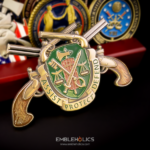
This coin was made for a police guild rather than for the department itself. That distinction changes who pays for it, who approves the design and what artwork can be used, and it is the reason a guild coin and a department coin are different objects.
A Guild Is Not the Department
A police guild, union or association is a separate organization from the agency its members work for. They share people and nothing else, and the differences all matter when a coin gets ordered.
Different money. A guild runs on member dues rather than a city budget. There is no procurement process and no purchasing department, which makes these some of the most straightforward orders in law enforcement. The decision chain is short and the quantity is set by membership.
Different approver. A board of working officers signs off, not a chief and a city purchasing office. The people deciding are the people who will carry the coin.
Different purpose. A department coin is presented. A guild coin circulates among members and their families, which is why guild pieces tend to be more personal, more practical and less formal.
Different artwork rights, and this is the one that stalls orders. The department badge usually belongs to the city, not to the guild. A guild is a separate legal entity, so whether it can reproduce that badge on its own merchandise is a question for the city rather than for us, and the rules are frequently stricter for items that will be sold than for items given away.
Ask your city before artwork begins rather than after. Plenty of associations design an original device instead, and that often ends up the better outcome, because the result belongs to the guild outright and cannot be withdrawn. For the same situation outside law enforcement, see union challenge coins.
What Guild Coins Get Used For
The occasions are different from a department’s, and more frequent:
Member recognition and welcomes, as officers join the guild. Retirements, which a guild usually marks more personally than a department does. Line of duty remembrance, which is the most important use and the one handled most carefully. Benevolent fundraising, where coins are sold to support members and families in difficulty. And giving to community supporters, which a guild can do freely where a department sometimes cannot.
Because a guild coin moves among members and their families rather than being handed to visiting officials, it can be a working object rather than a display piece. This one is also a bottle opener, which is a very guild thing to want and makes sense in that setting. For how the function is built into a design, see whether a coin can be a bottle opener.
Black, Blue and Brass
This coin uses a brass-colored base with black background paint and a blue accent, a three-striped shield on one face, a flag pattern on the other, and bold condensed lettering.
That palette is everywhere in American law enforcement, and it is everywhere because it works.
Black gives maximum contrast for a shield. A badge or shield shape needs a hard edge against its background, and nothing provides that better than a black field.
Blue is the service’s own color, so it carries meaning without needing explanation.
Brass reads as traditional rather than modern, which suits an institution with a long history.
The honest counterpoint is that it is the default. A black, blue and brass coin looks like every other agency’s, because most agencies make the same three choices. If a guild wants its coin to be recognizably its own, the place to spend that distinctiveness is the shape, the emblem or one unexpected color, not the base palette. Changing the palette for its own sake usually makes a coin look less serious rather than more distinctive. Our page on color, plating and finish options covers the alternatives.
About the Department
The Bellingham Police Department serves the city of Bellingham in Whatcom County, Washington, and is the largest police agency in the county. It is accredited by the Washington Association of Sheriffs and Police Chiefs, which is a voluntary standard that a minority of agencies in the state hold.
The guild represents its officers as a separate organization, and it was the guild rather than the city that commissioned this coin.
Order a Coin for Your Guild or Association
Professional artwork is free with unlimited revisions, and nothing goes into production until you approve a digital proof. Standard production runs about 45 to 50 days after final artwork approval, rush production is available on many projects, and shipping within the continental United States is included. Minimum quantities differ between products, and pieces that double as bottle openers are quoted separately from challenge coins, so ask when you request a quote. Embleholics is veteran-owned, SDVOSB and registered in SAM.gov.
Two things to settle first. If you are a guild rather than the agency, confirm with your city whether you can use the department’s badge before artwork begins, because that is the most common thing that holds these orders up. And tell us your membership number, since that usually sets the quantity. See more police challenge coins or request a free quote.
Frequently Asked Questions
What is a police union challenge coin?
It is a coin made for a police union, guild or association rather than for the department itself. The organization is separate from the agency, funded by member dues and governed by a board of working officers, so the coin is ordered and paid for by the members rather than by the city.
How is a guild coin different from a department coin?
A department coin is presented, usually by a chief or a command officer, and paid for from a city budget. A guild coin circulates among members and their families, is funded from dues, and is approved by a board of officers. Guild coins tend to be more personal and more often functional.
Can a police union use the department’s badge on a coin?
It depends on the city, and the question should be asked before artwork begins. The badge is usually the city’s mark rather than the guild’s, and a guild is a separate legal entity, so permission has to come from the city. Restrictions are often stricter for items that will be sold than for items given away.
Who approves a guild coin design?
The guild’s own board, made up of serving officers. That is a shorter decision chain than a department order, which typically needs command approval and a purchasing process, and it is one reason guild orders tend to move quickly.
What do police associations use coins for?
Member recognition and welcomes, retirements, line of duty remembrance, benevolent fundraising for members and families in difficulty, and giving to community supporters. The range is wider than a department’s because a guild is not bound by the same rules on gifts and sales.
Can a police coin also be a bottle opener?
Yes. The opener is built into the outline at the design stage rather than cut into a finished coin, so it has to be part of the plan from the start. Minimum quantities for pieces that double as openers are quoted separately from standard challenge coins.
Why are police coins usually black, blue and brass?
Because the combination works. Black gives a shield or badge the hardest possible edge against its background, blue is the service’s own color and needs no explanation, and brass reads as traditional. The drawback is that most agencies choose the same three, so the palette rarely distinguishes one coin from another.
How many coins should a guild order?
Membership number is the usual starting point, plus a margin for new members joining and for coins given to community supporters. Ordering above the immediate need is normally cheaper per piece than reordering, since a second order pays setup again on a die that has already been made.
More Police Projects