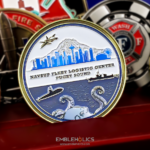
A coin made at a forward base does not stay among Americans. This one was produced for NAVSUP Fleet Logistics Center Bahrain, on Naval Support Activity Bahrain, the installation that hosts US Naval Forces Central Command and the US 5th Fleet. Its design is deliberately traditional: rope-pattern edging around the rim, a bald eagle and the NAVSUP logo rendered in very fine engraved line work.
Design for an audience that is not all American
This is the practical difference between a coin made at a domestic command and one made at a forward base. A command in the 5th Fleet area of responsibility works alongside coalition navies, host-nation officials and local national employees every day, and its coin circulates among all of them. The audience is wider and less predictable than at home.
A few things follow from that:
- Imagery should travel. National symbols, the command’s own heraldry and the work the command does all read anywhere. Unit in-jokes, regional American references and slang do not, and a recipient who cannot read the coin politely says nothing.
- Be deliberate about host-nation references. Including a host-nation symbol can be a genuine courtesy, and it is often appreciated. It can also be done clumsily. If you want one, ask someone at the command who knows the country rather than picking an image that looks regional, and avoid anything with religious or political weight unless you are certain.
- Leave off anything that would be awkward locally. Alcohol references in particular are a staple of American unit humour and sit badly in parts of the Gulf. A coin that circulates among host-nation staff is not the place for them.
- Local national employees are part of the command. Overseas installations employ substantial local workforces, often for many years, and they are routinely left out of coin counts. They are frequently the longest-serving people at the command.
None of this is a constraint on making a good coin. It is an argument for the more formal register, which is exactly what this design chose.
When a rope border is the right call
A rope edge is the most traditional border in military coinage, and that is a reason to use it, not to avoid it. We have written elsewhere about removing classical borders to modernise a coin, which is the right move for some commands. The opposite case applies here.
A rope border signals institution and permanence, and it carries a naval association through its resemblance to line and cordage. For a command representing the United States Navy in a formal setting abroad, looking established is the point. A contemporary, borderless coin would read as a design choice; a rope-bordered one reads as the Navy.
It also frames fine detail well. A busy engraved centre needs something to contain it, and a rope border gives the eye a boundary. On a coin with delicate line work, the border stops the design bleeding into the edge.
Fine line engraving, and what it demands
Very fine engraved lines are the hardest thing to hold on a struck coin, and they are what gives this one its character. A bald eagle rendered in line work, with individually described feathers, is a long way from a bold relief eagle, and it only survives under particular conditions.
- Line depth matters more than line width. Shallow fine lines fill with polishing compound and plating and disappear. The same lines cut deeper hold.
- Finish choice is not free. A heavy polish rounds over fine detail. An antique or satin finish preserves it, and antiquing actively helps by darkening the recesses so the lines read.
- Size is the limit. There is a point below which a line stops being a line, and fine engraving pushes against it. If a design with this much detail has to go on a small coin, something has to be simplified, and it is better to decide what rather than let the striking decide for you.
About the command
NAVSUP is the Navy’s supply command, providing goods, services and quality-of-life support to the Navy and Marine Corps worldwide. NAVSUP Fleet Logistics Center Bahrain delivers operational logistics and quality-of-life programs to Navy, joint and coalition personnel, Department of Defense civilians and their families across the NAVCENT area of responsibility, from Naval Support Activity Bahrain.
Coalition support is explicitly part of the job, which is the clearest possible argument for the design approach above. A command whose stated mission includes supporting partner nations should have a coin that works in a partner nation’s hands.
Ordering a coin for an overseas command
Tell us where the command is, who the coin will be given to, and your full headcount including local national staff and civilians. Shipping to an overseas base is its own question and worth settling at the quote stage rather than at the end; our guide to APO and FPO shipping covers the mechanics, and rush production exists for tight rotations. You can see more Navy challenge coins, including the NAVSUP FLC Pearl Harbor coin, or send your details through the free quote form.
Frequently Asked Questions
How is a coin for an overseas command different?
Its audience is wider. A forward-deployed command works with coalition partners, host-nation officials and local national employees daily, so the coin circulates well beyond Americans. That argues for imagery that travels, care with host-nation references, and leaving off anything that reads awkwardly in the local context.
Should we put a host-nation symbol on the coin?
It can be a real courtesy, and it is often appreciated, but it should be done deliberately. Ask someone at the command who knows the country rather than choosing an image that merely looks regional, and steer clear of anything carrying religious or political weight unless you are confident. Done carelessly it lands worse than not doing it at all.
Is there anything to avoid on a coin for a Gulf command?
Alcohol references in particular. They are a staple of American unit humour and sit badly in much of the region, and a coin that will be handed to host-nation staff and officials is not the place for them. More generally, the forward-deployed context argues for a more formal register than a domestic unit coin.
Should local national employees get coins?
Yes, and they are frequently overlooked. Overseas installations employ substantial local workforces, often for many years, and those employees are regularly the longest-serving people at the command. Include them in the headcount rather than counting only US military and civilian staff.
When should a coin use a rope border?
When the command wants to look established rather than contemporary. A rope edge is the most traditional border in military coinage and carries a naval association through its resemblance to cordage, which suits a command representing the Navy formally, particularly abroad. It also frames a detailed centre, giving busy engraving a boundary so it does not bleed into the edge.
How fine can engraved detail be on a coin?
Finer than most people expect, but only with the right conditions. Line depth matters more than width, because shallow fine lines fill with polishing compound and plating and vanish. The finish has to cooperate too: a heavy polish rounds over fine detail while an antique or satin finish preserves it, with antiquing actively helping by darkening the recesses.
How do we get coins to an overseas base?
Through the military postal system to an APO or FPO address, which is slower and less predictable than domestic delivery and needs the address formatted correctly as a military rather than a foreign address. Raise it at the quote stage along with your rotation or deadline, so the schedule can be worked backwards from when the coins actually need to be in hand.
More Navy Projects