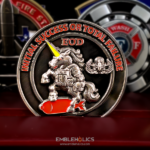
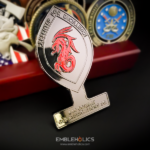
Most unit coins reach for traditional decoration: a rope border, a laurel wreath, an antique finish. This one for Goldwater Air National Guard Base deliberately does none of that. The brief asked for a contemporary coin that still carried the base’s original insignia unchanged, which is a narrower problem than it sounds, because the usual way to modernize a design is to simplify the crest, and that was exactly what was off the table.
Modernizing the frame instead of the crest
When the insignia has to stay as it is, everything around it is what changes. Official unit emblems are prescribed artwork. They cannot be restyled, recolored, or redrawn to suit a design trend, and a unit would be right to refuse if asked. That leaves the coin’s own elements as the only place to work, and there are more of them than people expect.
Three decisions carried this coin:
- No classical border. Rope, laurel, braid and beaded borders are the default on military coins and the single strongest signal of a traditional design. Removing the border and letting the field run clean to the edge changes the character of a coin more than any other single choice.
- A plain machined edge. The edge was cut plain rather than reeded or decoratively milled. It reads as a manufactured object rather than a commemorative medal.
- Flat gloss color, no texture. The enamel was specified glossy and untextured, with no sandblasted field behind it and no antiquing in the recesses. Antiquing is what makes a coin look aged, so leaving it out is most of what makes this coin look current.
The crest itself is untouched. That is the point of the exercise: the official artwork is reproduced faithfully, and the modern feel comes entirely from the coin around it.
Gloss and antique are a single choice with a long shadow
This is the decision that determines whether a coin looks traditional or contemporary, and it is usually made last and casually. An antique finish darkens the recessed areas, which throws the relief forward and gives the coin the look of something struck decades ago. A polished or satin finish with glossy enamel does the opposite: it reads as new, clean and bright.
Neither is better, but they suit different jobs. An antique finish flatters heritage subjects, veterans’ associations, memorial pieces and anything with a historical lineage. A bright gloss finish suits active units, technical fields, award coins and anything where the organization wants to look current rather than venerable. Decide which story the coin is telling before choosing the finish, because retrofitting it means a new production run.
One practical caveat. Glossy, untextured enamel shows surface imperfections more readily than a textured or antiqued finish does, because there is nothing to break up the reflection. It is a less forgiving specification, which is worth knowing but is not a reason to avoid it.
Goldwater Air National Guard Base
Goldwater Air National Guard Base sits next to Phoenix Sky Harbor International Airport in Arizona. It was built under a 99-year lease signed in 1949 and rebuilt during the 1990s to make room for a third runway at the airport. Formerly known as Sky Harbor Air National Guard Base, it was renamed on 9 December 2016 in honor of Barry Goldwater, the Arizona senator who served in the Arizona Air National Guard.
A base coin and a wing coin are different pieces. The installation hosts the Arizona Air National Guard’s 161st Air Refueling Wing, and the wing’s own coins carry the wing’s mission and heraldry. The base coin represents the installation and the people who run it, which is why its design centers on the base insignia rather than on the flying mission. If you are ordering for a wing or squadron rather than for the installation, the subject changes, and so does the imagery.
Ordering a coin that has to keep official artwork
Send the insignia in the highest resolution you have, and tell us it cannot be altered. We will work within that and bring you the options that exist elsewhere: border or no border, edge treatment, finish, and whether the field is textured. Those four choices cover almost the whole range between a traditional coin and a contemporary one, and we will show you the difference on a proof rather than describing it. You can see more Air Force challenge coins, including the 65th Air Base Group award coin, and more National Guard challenge coins, or send your artwork through the free quote form.
Frequently Asked Questions
Can a challenge coin look modern and still use our official insignia?
Yes, and the insignia does not need to change. Official unit emblems are prescribed artwork and should be reproduced faithfully, so a contemporary look comes from the coin around the crest: removing classical borders such as rope or laurel, specifying a plain machined edge, using glossy untextured enamel, and leaving out antiquing. Those changes alter the character of a coin substantially without touching the emblem.
What is the difference between an antique and a glossy finish?
An antique finish darkens the recessed areas, which pushes the relief forward and gives the coin the look of something struck decades ago. A polished or satin finish with glossy enamel reads as new, clean and bright. Antiquing suits heritage subjects, veterans’ associations and memorial pieces; gloss suits active units, technical fields and award coins.
Does removing the border really change how a coin looks?
More than any other single choice. Rope, laurel, braid and beaded borders are the default on military coins and the clearest signal of a traditional design. Letting the field run clean to the edge, with a plain machined rim, changes the coin’s whole character while leaving the central artwork alone.
Is glossy enamel harder to produce well?
Slightly, yes. Glossy untextured enamel has nothing to break up the reflection, so it shows surface imperfections more readily than a textured or antiqued finish. It is a less forgiving specification rather than a problematic one, and it is worth knowing before you choose it rather than afterwards.
Should we order a base coin or a wing coin?
It depends who the coin represents. A base coin stands for the installation and the people who operate it, so its design centers on the base insignia. A wing or squadron coin stands for a flying unit and carries that unit’s mission and heraldry. Goldwater ANGB hosts the 161st Air Refueling Wing, and the two organizations would properly have separate coins.
What is Goldwater Air National Guard Base?
Goldwater Air National Guard Base is an Air National Guard installation adjacent to Phoenix Sky Harbor International Airport in Arizona. It was built under a 99-year lease signed in 1949 and rebuilt in the 1990s to accommodate a third airport runway. Previously called Sky Harbor Air National Guard Base, it was renamed on 9 December 2016 for Barry Goldwater, the Arizona senator and Arizona Air National Guard member.
Can you change the colors in our unit emblem to match a design?
No, and you should be wary of anyone who offers. Official insignia colors are prescribed, not chosen, so altering them produces artwork a unit cannot properly use. Where a coin needs a different color balance, the right place to adjust is the field, the border and the plating around the emblem, not the emblem itself.
More Air Force Projects