Pearl Harbor is one of the few place names on a coin that carries meaning before anyone reads the unit on it, which is both an opportunity and something to handle with care. This one was made for NAVSUP Fleet Logistics Center Pearl Harbor, the command that supplies the Pacific Fleet from O’ahu. Rather than a round coin it is cut in the shape of a pineapple, with the NAVSUP logo on one face and the commanding officer’s insignia on the other.
A command coin and a commemorative coin are not the same thing
This is the distinction that matters most at Pearl Harbor, and it is easy to blur. A commemorative coin marks 7 December 1941 and the people who died there. A command coin belongs to an organization that happens to be based at Pearl Harbor today and does a job that has nothing to do with the attack.
Mixing them produces something uncomfortable. A logistics command’s coin carrying the date, a sinking battleship or memorial imagery is borrowing a memorial to decorate a unit piece. The people most likely to notice are exactly the people the command works alongside.
So a command coin from Pearl Harbor should lean on the place, not the event. Hawai’i, the harbor, the Pacific, the island, the work the command actually does. This coin does it with a pineapple, which could not be further from memorial imagery and says Hawai’i instantly.
If you genuinely are making a commemorative piece, for an anniversary, a survivors’ organization or a memorial event, that is a different design with a different register, and the usual rules for memorial coins apply: no humor, no mascots, restrained finishes, and great care with names.
Regional symbols and why they outperform unit crests
A pineapple has no official standing anywhere, and that is precisely why it works. Unit crests identify a command to people who already know the command. A regional symbol identifies it to everyone, and it gives the coin an emotional attachment to a place that people carry with them when they transfer away.
Service members move constantly, which makes place-based coins unusually durable. A sailor who did three years at Pearl Harbor keeps the coin that says Hawai’i long after they have forgotten the organizational chart. The same logic applies anywhere with a strong local identity, and it is why we see so many of these: a pineapple for O’ahu, a fleur-de-lis for Louisiana, a state outline for Washington.
Choosing one is mostly about recognizability at silhouette. The test is whether someone can identify the place from the outline alone with no color and no text. A pineapple passes easily. Many regional symbols do not, and those are better used as artwork on a conventional coin than as the coin’s shape.
Cutting a pineapple
A pineapple is a more forgiving shape than it looks. The body is a rounded oval, which is structurally sound, and the crown of leaves is the only complication. Leaves drawn as individual thin spikes would be fragile; drawn as a connected mass with the tips slightly thickened and softened, they survive a pocket perfectly well.
The body texture is the detail worth getting right. A pineapple’s crosshatch is a repeating diamond pattern, which is exactly what die-struck relief does well, and it gives the whole face a texture for the logo to sit against. It is the same principle as any textured field: the pattern costs nothing extra because it lives in the die, and it makes the raised elements read better.
Usable area is the real constraint. Once the crown takes the top third, the logo and lettering have to fit in the body, so a long command name needs planning. NAVSUP FLC Pearl Harbor is already a mouthful, which is part of why this design puts the logo on one face and the CO’s insignia on the other rather than trying to fit both plus text on a single side.
About the command
NAVSUP Fleet Logistics Center Pearl Harbor, formerly Fleet and Industrial Supply Center Pearl Harbor, provides logistics support to the Pacific Fleet. It sustains the surface ships and submarines homeported at Pearl Harbor along with a large number of shore commands and activities, supports transient vessels and visiting battlegroups including those of allied navies, and operates as a defense fuel support point under Defense Logistics Agency Energy. The command is responsible for facilities across O’ahu and Kaua’i and is staffed by both military members and civilian employees.
That mix of military and civilian staff is worth remembering when ordering. Logistics commands often have more civilians than uniformed personnel, and civilian employees are frequently left out of the coin count because the manning figure people reach for is the military one. They are usually the ones who have been there longest.
Ordering a coin for a Pearl Harbor command
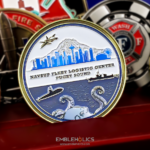
Tell us whether the coin is for the command or for an occasion, and give us a full headcount including civilians. Those two answers set the register and the quantity. If you want a shaped coin, send us the symbol you have in mind and we will tell you honestly whether it reads at silhouette before any die work starts. You can see more Navy challenge coins we have produced, including the NAVSUP Fleet Logistic Center coin and the VR-59 commanding officer’s coin, or send your details through the free quote form.
Frequently Asked Questions
What should a Pearl Harbor command coin show?
The place and the command’s work, not the 1941 attack. A command based at Pearl Harbor today is doing a job unrelated to the attack, and putting the date, memorial imagery or a sinking battleship on a unit coin borrows a memorial to decorate an organizational piece. Hawaiian and maritime imagery, the harbor itself, and the command’s own mission are the appropriate subjects.
What is the difference between a commemorative coin and a command coin?
A commemorative coin marks an event and the people involved in it, and carries a memorial register: restrained, no humor, careful with names. A command coin identifies an organization and can be as light as the command wishes. At a location with a significant history, keeping the two separate is what stops either from feeling wrong.
Why use a regional symbol instead of a unit crest?
Because a crest identifies the command only to people who already know it, while a regional symbol identifies it to everyone and attaches the coin to a place. Service members move constantly, and a coin tied to somewhere they lived tends to outlast one tied to an organizational chart they have left behind.
How do you know if a symbol works as a coin shape?
Test it at silhouette. If someone can identify the place from the outline alone, with no color and no text, it works as a shape. If it only reads once colored or labeled, it is better used as artwork on a conventional coin than as the coin’s profile. A pineapple passes this test comfortably; many regional symbols do not.
Is a pineapple shape difficult to produce?
Less than it appears. The body is a rounded oval, which is structurally sound, and only the crown needs attention: drawn as a connected mass with slightly thickened and softened tips rather than as individual thin spikes, it holds up to daily carry. The crosshatch body texture is straightforward in die-struck relief and gives raised elements a surface to read against.
How much text fits on a shaped coin like this?
Less than on a round coin of the same width, because the shape eats usable area and there is no rim to run text around. Once a crown or similar feature takes a third of the face, logos and lettering have to share what remains. Splitting content across both faces, as this coin does, is usually better than crowding one.
Should civilian employees be included in a coin order?
Yes, and they are frequently missed. Logistics and support commands often have more civilian staff than uniformed personnel, but the headcount people quote is usually the military one. Civilians are also typically the longest-serving members of the command, which makes leaving them out particularly unfortunate.
More Navy Projects