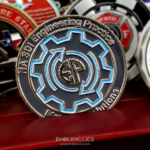
Brass colored, simple and classic, with a vintage look and flawlessly machined detail. The faces carry relief elements and inscriptions, and the edge carries engraved patterns. It was made for Graduate School USA as a commemorative piece for its Federal Workforce Training Solutions program.
Coins for Training and Education Organizations
A training provider is a different coin client from a unit, and the differences shape what the coin is for.
The audience is students, not staff. A unit coin goes to members. A training organization’s coin goes to the people who came through its courses, which is a far larger and more dispersed group, and one that renews every year.
Which makes it a completion marker. Finishing a professional course produces a certificate, and a certificate goes in a drawer. A coin is the version of that somebody keeps on a desk, and for adult professional education that distinction matters.
The cohort is the affiliation. People who went through the same course share that and nothing else, often coming from different agencies entirely. A coin is one of the few objects that represents a cohort rather than an employer.
And it is ordered once and issued for years. A training organization runs the same course repeatedly, so a coin with no date or cohort number on it can be reordered from the same die indefinitely. That is an argument for keeping anything time-specific off it.
See also academy graduation challenge coins and a recruit class challenge coin, which takes the opposite approach by naming the class.
Serving the Federal Workforce
Graduate School USA describes itself as the first organization in the United States created to provide continuing professional education to the federal community. It opened in October 1921 as the USDA Graduate School and has supported the federal workforce for a hundred years. Its stated mission is to improve government performance by giving public employees skills, training and tools, and its core values are Guided By Data, Service Minded, Unwavering, Smart Risk Taking and Act Like An Owner.
The federal civilian workforce is a coin audience worth naming, because it sits inside the coin tradition without being military. Federal employees work alongside uniformed personnel, attend the same ceremonies and receive coins from agency leadership, so the object needs no explaining. But a civilian organization’s coin cannot borrow military conventions wholesale, which is why a classic, institutional register like this one is the right answer rather than a unit-style crest and motto.
See also a government civilian and SES challenge coin.
A Classic Register in Brass
The brief was simple and classic with a vintage look, and the execution comes down to four choices that have to agree with each other.
A warm metal. Brass rather than nickel or chrome. A cool metal reads as contemporary however the rest is handled, and nothing else will pull the piece back.
Relief rather than color. Raised elements on the field, with the form reading through shadow rather than through paint. Bright enamel is unmistakably current.
Restrained content. One device, an inscription, nothing extra. A classic coin’s authority comes from what it leaves out.
And precise machining. This is the part that cannot be skipped. A classic design has no color or novelty to distract, so the surface quality and the crispness of the detail are the product. The page calls it flawlessly machined, and on a coin like this that is not a flourish, it is the whole thing.
See antique vs polished finishes and a vintage challenge coin.
Engraved Patterns on the Edge
The edge carries engraved patterning rather than being left plain, which suits a classic piece particularly well.
A patterned edge is a currency convention. Milled and engraved rims come from coinage, originally so anyone could see whether metal had been shaved off. The association has stuck, which means an edge pattern is one of the most efficient ways to make a piece read as a proper coin rather than a stamped disc.
It is visible when the faces are not. Held between finger and thumb, or sitting in a stack, a coin shows its edge and nothing else. A patterned edge means the piece is doing something from every angle.
And it costs very little. The edge is machined as part of producing the coin either way, so a pattern there is a small addition rather than a separate process. It is the cheapest way to make a coin feel more substantial.
The constraint is depth: the rim is the thinnest part of the coin, so edge work has to stay shallow. It also reads by shadow, which means it shows better on a warm or matte metal than on a mirror polish.
Marking a Centenary Without Dating the Coin
An organization at a hundred years has an obvious temptation to put the number on the coin, and it is worth thinking twice.
A centenary coin is a one-year object. Once the anniversary passes it becomes a historical piece, and a training organization that issues coins to every course cohort will be handing out a dated coin for years afterward.
The alternatives are to order two designs, a dated commemorative for the anniversary year and an undated standard piece for continuing use, or to let the design register carry the age instead. A classic, vintage-looking coin communicates a long history without stating a number, which is the more economical answer if you only want one die.
Order a Training or Professional Coin
Professional artwork is free with unlimited revisions, and nothing goes into production until you approve a digital proof. The challenge coin minimum is 50 pieces, standard production runs about 45 to 50 days after final artwork approval, rush production is available on many projects, and shipping within the continental United States is included. Embleholics is veteran-owned, SDVOSB and registered in SAM.gov.
Two suggestions. If the coin will be issued to course cohorts over several years, leave dates and cohort numbers off so one die serves indefinitely, and order a separate dated piece if you also want an anniversary commemorative. And ask about an edge pattern, since it is the cheapest way to make a coin feel substantial and it is usually left plain simply because nobody raises it. Request a free quote to begin.
Frequently Asked Questions
What is a professional development challenge coin?
It is a coin from a training or continuing education organization, usually given to people completing a course. It marks completion in a form people keep, where a certificate goes in a drawer.
Why do training organizations order coins?
Because their audience is students rather than staff, renewing every year, and those students often come from different employers. A coin represents the cohort, which is the one affiliation they share.
Should a course coin carry a cohort number?
Only if you want a separate coin per cohort. An undated, unnumbered design can be reordered from the same die indefinitely, which suits an organization running the same course repeatedly.
Do federal civilian organizations use coins?
Yes. Federal employees work alongside uniformed personnel and receive coins from agency leadership, so the object needs no explaining. A civilian organization’s coin should not borrow military conventions wholesale, though.
What makes a coin look classic?
Four choices that have to agree: a warm metal such as brass, relief rather than bright color, restrained content, and precise machining. A cool metal or an enamel-heavy palette will read as contemporary whatever else is done.
Why does a classic design need better machining?
Because there is no color or novelty to distract from the surface. On a restrained coin the finish quality and the crispness of the detail are the product, so flaws that a busy design would hide are fully visible.
What does an engraved edge pattern add?
It makes the piece read as a proper coin rather than a stamped disc, because milled rims come from currency. It is also visible when the faces are not, and it costs very little since the edge is machined either way.
Should a centenary coin carry the number?
Only if it is a one-year commemorative. An organization that issues coins continuously will be handing out a dated piece for years afterward, so a classic design that communicates age without stating a number is often the better single die.
More Corporate Projects