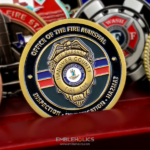
This coin was made to honor the graduates of Recruit Class 20-1. The base is a shiny pale gold, the brief was something simple with minimal ornament and paint, and the result carries an engraved biohazard symbol on one face and the fire department emblem on the other, each sitting on a light gray central field.
A Coin for a Class, Not an Organization
A recruit class coin is a different object from a department coin, and the difference changes what belongs on it.
The class is the unit. These people went through something together over a fixed number of weeks, and the group exists only as that cohort. After graduation they scatter across different stations and different departments, and the class is the one affiliation they will never share with anyone else.
So the class number matters more than the department name. On a department coin, a date or a number is a liability because it ages the piece. On a class coin the number is the whole point. Recruit Class 20-1 is specific to those people, and a coin without it would be a department coin they happen to own.
It is handed out once, to a known number of people. Which makes the quantity decision easy, unlike almost every other coin. The only reason to order well above the class size is if the instructors, the academy staff and the sponsoring departments are also getting one, which they usually should be.
And it is a graduation gift, not a working object. Most will be kept rather than carried, which means the budget is better spent on finish quality than on durability features like a protective coating.
See also academy graduation challenge coins, a sergeants major academy class coin and a fire academy challenge coin.
The Biohazard Symbol as a Device
Putting a biohazard symbol on the front is an unusual choice for a fire academy coin and a well judged one.
It reflects what modern fire service training actually covers. A recruit class is not only fire suppression: it is emergency medical response, hazardous materials, bloodborne pathogen protocols and the rest of the curriculum that comes with being the first vehicle on scene at almost anything. A biohazard symbol says that more honestly than an axe and a helmet would.
It is also, technically, an excellent coin device.
Three-fold radial symmetry. The symbol is built from three identical lobes arranged around a center, which fills a circular face completely and has no orientation to get wrong.
Bold, closed shapes. No thin lines, no fine internal detail, nothing that softens when reduced. It reads at any size.
And universal recognition. Almost no other symbol is as instantly understood, which means it carries meaning with no supporting text.
The one caution is that the symbol is a regulated safety marking in its actual use, so it works as an emblem on a commemorative piece but is not something to place on anything that might be mistaken for equipment labeling.
Restraint on a Pale Gold Base
The client asked for something simple: minimal ornaments, minimal color, minimal paint. The execution is a shiny pale gold base with the devices engraved and the biohazard symbol painted in a gray slightly darker than the field behind it.
That last detail is the interesting one. Painting an element in a tone close to its background, rather than in a contrasting color, is a subtle technique and it does something specific: the element reads through relief and shadow rather than through color, so it looks carved rather than printed. On a commemorative piece that is a more formal register than bright enamel would be.
A pale gold base supports it. A warm, light metal tone reads as a presentation finish, and against it a soft gray device looks intentional where a bright color would look like decoration.
Two practical points if you want this approach. The engraving has to be cut deeper than it would be under a contrasting color, because the design is relying on shadow rather than on color difference to read. And the proof matters more than usual, since a low-contrast design can look flat in a flat-lit photograph while reading well in the hand. See finish and engraving options.
About the Academy
The Snohomish County Fire Training Academy is a shared training program and facility provided by several Washington cities, including Arlington, Everett, Mukilteo, Lake Stevens and Marysville. South County Fire, the county’s largest fire and EMS provider, serves more than 250,000 residents.
A shared academy is a particularly good coin client, because the recruits arrive from several different employers and leave to several different stations. The class is genuinely the only thing they all have in common, which is exactly the condition under which a coin means something. For a department whose new hires come through this academy, see a bulldog challenge coin.
Order a Coin for Your Class
Professional artwork is free with unlimited revisions, and nothing goes into production until you approve a digital proof. The challenge coin minimum is 50 pieces, standard production runs about 45 to 50 days after final artwork approval, rush production is available on many projects, and shipping within the continental United States is included. Embleholics is veteran-owned, SDVOSB and registered in SAM.gov.
Two things to plan. Work backward from the graduation date, allowing about 45 to 50 days of production after final artwork approval plus the artwork and proof rounds, because a graduation date does not move. And count the instructors, academy staff and sponsoring departments into the quantity, not just the recruits; a class coin that only the graduates received is the usual regret. Request a free quote to begin.
Frequently Asked Questions
What is a recruit class challenge coin?
It is a coin made for one specific academy class rather than for the department or academy itself. The class number is central to the design, because the cohort is the affiliation those graduates will never share with anyone else.
Should a class coin carry the class number?
Yes. On a department coin a number or date ages the piece, but on a class coin it is the entire point. Without it you have a department coin that the graduates happen to own.
How many class coins should we order?
Enough for the recruits plus the instructors, academy staff and sponsoring departments. A class coin that only the graduates received is the most common regret, and the 50 piece minimum usually covers all of them anyway.
When should we order for a graduation?
Work backward from the date. Allow about 45 to 50 days of production after final artwork approval, plus time for artwork and proof rounds. A graduation date does not move, so start earlier than feels necessary.
Why use a biohazard symbol on a fire academy coin?
Because it reflects what the training actually covers. A recruit class includes emergency medical response, hazardous materials and bloodborne pathogen protocols, not only fire suppression, and the symbol says that more honestly than an axe and helmet.
Does a biohazard symbol work well at coin size?
Very well. It has three-fold radial symmetry so it fills a circular face with no orientation to get wrong, it is built from bold closed shapes with no fine detail to lose, and almost everyone recognizes it without supporting text.
Can an element be painted in a color close to the background?
Yes, and it produces a more formal result. The element then reads through relief and shadow rather than through color contrast, so it looks carved rather than printed, which suits a commemorative piece.
Does a low-contrast design need different engraving?
Yes, cut deeper. With no color contrast to carry it, the design depends entirely on shadow, so the recesses need more depth than they would under a bright enamel fill. It is also worth judging the proof in the hand rather than from a flat-lit photograph.
More Firefighters Projects