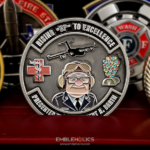
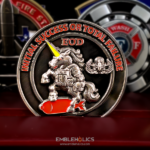
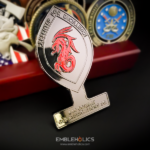
This coin is awarded by the commander of the Department of Defense fire academy at Goodfellow Air Force Base. It is finished in matte silver with color applied only to the squadron insignia and the unit’s Wolfpack mark, leaving most of the surface bare.
Coins at a Schoolhouse
A training unit is not like an operational one. It does not deploy, it has no mission area, and most of its people are passing through. What it has instead is throughput: thousands of students a year arriving in classes and leaving qualified.
That changes the coin in four specific ways.
Who receives one is the first decision. Every graduate, every honor graduate, or only the permanent staff. Those are three completely different quantities and three different coins, and settling it first saves redesigning later.
A graduate coin is somebody’s first coin. For many students it is the first challenge coin they have ever been handed, which argues for something clear and traditional rather than clever.
A staff coin is a commander’s instrument. This one is awarded by the squadron commander, which makes it a recognition piece given sparingly rather than a graduation token handed out by the hundred.
And class-specific artwork means a new die every cycle. This is the one that costs money. A unit that wants the class number on the coin is committing to fresh tooling each course. The usual compromise is unit artwork on the die with the class detail engraved, stamped or printed on the packaging instead.
For graduate coins specifically, see academy graduation challenge coins, and for the wider category, a training academy coin.
Paint Only Where It Counts
The base is matte silver, left raw with no machined pattern anywhere, and color appears only on the squadron insignia on one face and the Wolfpack lettering on the other.
A matte base scatters light rather than reflecting it, so the painted areas become the only thing on the coin that catches the eye. On a polished base the whole surface competes.
Leaving most of the coin bare makes it look considered. Restraint reads as a decision when it is consistent. The same coin with color added in two more places would read as unfinished rather than deliberate.
A bare field gives the insignia room, which matters when the insignia is the only detailed element on the piece.
And fewer painted areas means fewer production steps, which is a real cost difference on a run of any size.
The honest counterweight: a mostly bare coin has less presence on a table of brightly enameled ones, and a matte finish shows scuffs differently from a polished surface. For a coin handed over individually by a commander that is the right trade. For something given out at a conference it would not be. Our page on finishes and spot color covers the alternatives.
A Wolf Paw and an Insignia
The two devices sit on separate faces, and that split is the standard answer when a unit has both an official identity and a name it gives itself.
The squadron insignia is the formal one: approved, fixed, and the device that appears on paperwork. The Wolfpack mark is what the unit calls itself. Giving each a face means neither has to compromise, and it is the same structure used on fire shift coins and company coins throughout the gallery.
One production note on the reverse: an etched paw with embossed lettering across it puts two techniques on one face. The etched mark sits back into the surface and the raised lettering stands forward, so the words read over the device rather than fighting it for the same plane.
What the Academy Trains
The fire academy at Goodfellow trains fire emergency services personnel for the Department of Defense and for international partner nations. The same squadron also trains specialists in nuclear treaty monitoring.
That combination is genuinely unusual, and it is worth stating plainly rather than leaving buried in an organizational description. Two unrelated technical disciplines under one training squadron is not a common arrangement. For a comparable training piece, see a medical and fire academy coin.
Order Coins for Your Schoolhouse
Professional artwork is free with unlimited revisions, and nothing goes into production until you approve a digital proof. The challenge coin minimum is 50 pieces, standard production runs about 45 to 50 days after final artwork approval, rush production is available on many projects, and shipping within the continental United States is included. Embleholics is veteran-owned, SDVOSB and registered in SAM.gov.
Two things to settle first. Tell us whether the coin is for graduates or for staff, because that decides the quantity and the design before anything else does. And if you want class or course numbers on it, ask about engraving rather than tooling, since a new die per class is rarely worth the cost. See more firefighter challenge coins.
Frequently Asked Questions
What is a fire academy challenge coin?
It is a coin made for a fire training school rather than for an operating department. This one belongs to the Department of Defense fire academy at Goodfellow Air Force Base and is awarded by the squadron commander, which makes it a recognition piece rather than a graduation token.
Should a training unit give coins to every graduate?
It depends what you want the coin to mean. Giving one to every graduate makes it a completion token and needs a quantity matched to annual throughput. Reserving it for honor graduates or for staff recognition makes it an award and keeps the runs small. Both work, but they are different coins.
Can a class or course number go on the coin?
Yes, but engrave it rather than tooling for it. Putting the class number into the die means new tooling for every course, which is rarely worth the cost. Striking the unit artwork and then engraving or stamping the class detail afterward gives the same result for a fraction of the outlay. More in Numbered and Serialized Challenge Coins.
What is a commander’s award coin?
It is a coin presented personally by a commander for performance, rather than issued to everyone in a unit. The runs are much smaller than a unit coin, the design is usually more restrained, and the value to the recipient comes from who handed it over as much as from the piece itself.
What does spot color mean on a challenge coin?
It means color applied only to selected elements rather than across the whole design, leaving the rest as bare metal. On this coin the insignia and the Wolfpack lettering are painted and everything else is left matte silver, which makes the colored areas the only thing drawing the eye.
Does a matte finish look cheaper than polished?
No, though people often assume so. Matte scatters light rather than reflecting it, which makes painted and engraved detail easier to read and gives the coin a more deliberate appearance. Polished reads as more traditional and shows fingerprints more readily.
Should the official insignia and the unit nickname both appear?
Yes, and the cleanest way is to give each its own face. The official insignia is fixed and formal; the nickname is what the unit actually calls itself. Separating them means neither has to be compromised to fit alongside the other.
How often would a schoolhouse reorder?
It depends on whether the coin goes to students or staff. A graduate coin is consumed at the rate of the training pipeline and reorders predictably. A commander’s award coin is given sparingly and a single run can last for years.
More Air Force Projects