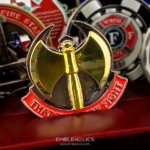
A class coin belongs to a cohort rather than to a unit, which makes it the one kind of challenge coin that should carry a date. Everywhere else a year shortens a coin’s useful life. Here the year and the class number are the only things that make the coin specific to the people holding it.
Who Orders Class and Graduation Coins?
The class does, almost always through one person who volunteered or was voted into it. A class leader, a class president, a social committee, occasionally a senior student who simply took it on.
The range of courses is wide: service academies and officer candidate schools, basic training and recruit classes, NCO academies and professional military education, qualification and specialist courses, warrant officer and flight training, police and fire academies, and the civilian leadership programs that government and corporate organizations run on the same cohort model.
What makes a class a genuinely unusual buyer is that the number is known. Almost every other customer is estimating. A unit does not know how many people will be posted in next year. A department does not know how many events it will attend. A class leader has a roster, a graduation date and a seating plan, which makes this the one order where the quantity question has an actual answer.
Should a Class Coin Have a Date on It?
Yes, and this is the exception to advice you will find on most of the rest of this site.
For a unit coin, a retention coin or a coin a senior leader hands out across a tour, a year on the face is a liability. It makes the coin look stale after twelve months of a three-year supply and it forces a reorder before the stock runs out. That reasoning is set out on our page about why most coins should be undated.
A class coin inverts it completely. A cohort is defined by when it was. Class 50 and Class 51 did the same course at the same school with the same insignia, and the only thing separating them is the number and the year. Leave those off and you have produced a school coin that happens to have been given to a class, which is a different and much weaker object.
So the class number should be the largest piece of text on the coin, not a detail around the rim. It is the element doing all the work.
How Many Should a Class Order?
Start with the roster, then add four groups people reliably forget.
- The instructors and the class advisor. They were part of the cohort’s experience and they expect to be included.
- School staff who dealt with the class directly.
- Replacements. Coins get lost, given away on impulse and handed to family members. Assume a proportion will need replacing within a year.
- The classmates who change their minds. There are always people who decline at collection time and want one six months later.
The reason this matters more here than on most orders is that a class disbands. Within weeks of graduation the cohort is spread across the country or the world, nobody holds the money any more, and there is no organization left to place a second order. It is the same constraint that makes a ship’s final coin difficult, described on our page about ordering when there will be no second run.
Order generously while the class is still in one place.
What Goes on a Class Coin?
The class number. The single most important element, and the one that distinguishes this coin from every other coin the school has ever produced.
The year. For the reasons above.
The school’s insignia. Usually the front, and usually the largest device.
The school motto, where it has one.
Branch, service or corps devices for the services represented in the class, and service ribbons where the school uses them.
The class’s own nickname or device, if the cohort developed one. Classes often do, and it is the detail that means most to the people in the room, even though it means nothing to anybody else.
What usually comes off is individual names. A class of a few hundred will not fit, and a coin naming only the leadership tends not to go down well.
Coins for Distance and Non-Resident Classes
Some cohorts never assemble. The Army names these classes explicitly, with a distance learning designation appended to the class number, and most services and schools now run an equivalent alongside the resident course.
A distance class has no shared building, no hallway, no formation photograph on a parade field and frequently no graduation everybody can physically attend. The people in it completed the same course to the same standard as the resident cohort, often while holding a full-time job in a unit somewhere else.
Which means the coin does more work for a distance class than for any other kind of cohort. It is realistically the only physical object that will ever prove the class existed as a group. Stated plainly rather than sentimentally, that raises the case for spending a little more on the piece than the budget first suggested, because there is nothing else.
It also changes the logistics. A resident class hands coins out at an event. A distance class has to post them to people individually across a dozen states and several countries, which affects both the timeline and the shipping arrangement. Mention it when you request a quote so it can be planned rather than discovered.
About This Class 50-DL Coin
The Sergeants Major Academy at Fort Bliss, Texas, is the senior level of enlisted professional military education in the U.S. Army. This coin was produced for Class 50-DL, a distance learning cohort.
The design is a conservative round coin with the SGM-A logo and insignia embossed on both faces, Army insignia and engraved service ribbons on the reverse, and the class designation carried on the piece.
The demanding part of a design like this is not any single element. It is that there are several small devices sharing one face, and on a coin carrying multiple small insignia the spacing between them does more work than the detail inside them.
The eagle on this coin is a good example. At that scale, the features that make an eagle recognizable are a handful of fine lines, and they sit right at the limit of what a strike will hold. But a viewer does not notice a slightly soft feather. A viewer notices immediately if one device sits closer to the rim than its neighbor, or if the gap between two insignia is wider on one side than the other. The eye reads an uneven interval long before it reads a missing detail, which is why a face like this is laid out before it is drawn.
For the staff side of a training organization rather than its students, see our page on coins for schoolhouse staff, and for another training organization’s work, our training squadron coins.
Can We Use the Academy’s Insignia on a Coin?
Usually, but the authorization comes from the school rather than from us, and there is a point specific to class coins.
A class is not the school. A cohort putting the academy’s insignia on a coin is using an institution’s mark, and the class’s own agreement is not the same as the institution’s permission. Schools that run classes continuously generally have a settled position on this, so it is a quick question to ask and a slow problem to fix afterwards.
Clear the artwork through the school before you order, and send us artwork your organization is authorized to supply. We produce from what the customer provides and we do not grant permission on anyone’s behalf.
Design a Coin for Your Class
Start before the course ends. A class that has already graduated and dispersed is far harder to collect money from and far harder to get a decision out of, and the graduation date does not move.
Standard production runs about 45 to 50 days after final artwork approval, and artwork development happens before that window opens, so three months before graduation is a comfortable start and six weeks is not. Professional artwork is free with unlimited revisions, and nothing goes into production until you approve a digital proof. The minimum order is 50 coins, rush production is available on many projects, and shipping within the continental United States is included. Embleholics is veteran-owned, SDVOSB and registered in SAM.gov. See more custom Army challenge coins or request a free quote.
Frequently Asked Questions
What is a graduation challenge coin?
A graduation challenge coin is made for a class or course cohort rather than for a unit. It carries the school’s insignia along with the class number and year, and it is ordered by the class itself, usually through a class leader, to mark completion of the course.
Who orders coins for a military class?
The class orders its own, almost always through one volunteer such as a class leader or class president. Service academies, basic training classes, NCO academies, professional military education courses, qualification courses and police and fire academies all work the same way.
Should a class coin include the year and class number?
Yes. A cohort is defined by when it was, so the class number and year are the only elements distinguishing one class coin from the next. The class number should be the largest piece of text on the coin rather than a detail around the rim.
How many coins should a class order?
Start from the roster and add instructors, the class advisor, school staff, replacements for lost coins and the classmates who ask later. Order generously while the class is still together, because a cohort disbands within weeks of graduation and there is no organization left to place a second order.
Can a distance learning class have its own coin?
Yes, and the coin arguably matters more for a distance cohort than a resident one, because there is no shared building, no hallway and often no group photograph. It is usually the only physical object proving the class existed as a group. Allow for posting coins individually rather than handing them out.
What is the Sergeants Major Academy?
The Sergeants Major Academy at Fort Bliss, Texas, is the senior level of enlisted professional military education in the U.S. Army. It runs both resident and distance learning cohorts, with distance classes carrying their own class designation. You can see one finished design in this Sergeants Major Academy Class Coin.
Can we use the academy’s insignia on a coin?
A school’s insignia belongs to the institution rather than to the class, so permission comes from the school rather than from the cohort or from a manufacturer. Schools running classes continuously usually have a settled position, so ask early and supply artwork the school authorizes.
What is the minimum order for class coins?
The minimum order for custom challenge coins is 50 coins. A class larger than that should order above its roster to cover instructors, staff, replacements and late requests, since the cohort disperses after graduation and a second order is rarely practical.
More Army Projects