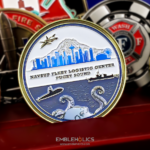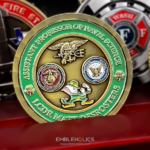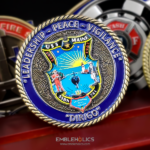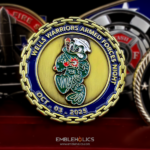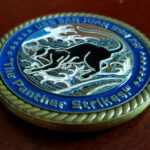
A decommissioning challenge coin marks the end of a ship’s service. It is the last coin that ship will ever have, and because there will be no second order, the quantity and the design both have to be right the first time.
What Is a Decommissioning Coin?
When a ship or submarine reaches the end of its service, the Navy holds a ceremony and the crew produces a coin. It goes to the people who served aboard, and it records the whole of the ship’s life rather than any single part of it.
That is different from an anniversary coin, which marks a point partway through. A twenty-fifth anniversary coin is made by a ship that is still going, still deploying, and will produce more coins later. A decommissioning coin is made by a ship that will not.
The distinction matters practically and not just emotionally. An anniversary coin that runs short can be reordered next year. A decommissioning coin cannot, because within months there will be no command to place the order, no budget line to place it against, and no crew to organize it. Ship anniversary conventions are covered on our page about ship anniversary coins.
A generation of Cold War-era hulls is now reaching the end of its service, and every one of those ships holds a ceremony.
Why There Is No Second Chance
There is no reorder. That single fact should shape every decision made about a decommissioning coin, and it is the most useful thing anyone planning one can be told.
The number of recipients is also larger than a serving ship’s coin, and the reason catches people out. A normal ship’s coin goes to the current crew. A decommissioning coin goes to:
- The final crew, who take the ship out of service
- Former crew members, sometimes from decades earlier, who follow the news and turn up to the ceremony
- Plankowners, the original commissioning crew, who have a particular claim on the occasion
- Families, including families of people who served aboard and have since died
- Visiting officers, former commanding officers, and the wider community
A ship in service for thirty years has had thousands of people pass through it, and a decommissioning brings a surprising number of them back. Orders that were sized for the current crew routinely run out on the day of the ceremony, and the people who miss out are frequently the ones who served longest.
So order more than the arithmetic suggests. The ordinary advice about not over-ordering does not apply here. There is no next time.
Related occasions work the same way: final deployment and last-cruise coins, inactivation coins, and reunion coins ordered years later by former crew associations, which are often the same design produced again by the association rather than by the ship.
What Goes on a Decommissioning Coin?
The commissioning date and the decommissioning date, together. The pair is the whole point, and on this kind of coin the dates are usually given real prominence rather than tucked into the rim.
Years of service, often stated as a number.
The hull number, which for people who served aboard is as much the ship’s name as its name is.
The ship’s own device or mascot.
Home ports, where a ship has had more than one.
The motto.
What is usually left off is as important. A single deployment, the current commanding officer, a recent award, anything tied to one moment in the ship’s life. A decommissioning coin belongs to everyone who ever served aboard, which means it should not privilege the final crew’s version of the ship over anyone else’s. A coin covered in references to the last two years will mean less to a plankowner than one carrying the dates, the hull number and the device.
2D and 3D on the Same Coin
This coin is the clearest example on the site of the difference between the two, because it uses one on each face.
The two-dimensional face. The surface with the panther is etched, and the outlines are left at their original height. The design is cut down into the metal around the image rather than built up, so the result is flat: a clean graphic with crisp edges and no modelling.
The three-dimensional face. The relief on the other side is engraved at angles, so the surfaces slope rather than stepping straight up and down. That is what makes a sculpture rather than a raised outline, because the angled faces catch light differently as the coin turns and the eye reads them as form.
What each is good for:
Flat, etched work holds fine line detail and reads clearly at small size. Text, thin lines, intricate patterns and anything precise belongs here. It also stays legible when the coin is small, because nothing depends on the viewer seeing a shadow.
Sculpted relief gives depth and presence and makes an object look like an object rather than a picture of one. It needs room, and it needs light, and it loses fine detail that flat work would have held.
Most coins pick one. This one uses both, one per face, which is the sensible way to combine them: a graphic, detailed side and a sculptural side, each doing what it is best at, rather than a muddle of both on a single face. Sculpted work as a capability in its own right is covered on our page about sculpted and 3D coin work.
About This USS San Juan Coin
USS San Juan, SSN 751, was commissioned in August 1988 and served for thirty-five years before departing Groton for the last time to begin the decommissioning process.
The coin uses a classic Navy format. A rope pattern runs the rims. One face carries an etched panther against a patterned background. The other carries a Navy emblem sculpted in relief.
The rope rim is the right choice for a piece like this, because it is the most traditional border in naval design and a decommissioning coin is not the place to be inventive. Rim treatments generally are covered on our page about rim and edge designs.
For more of the submarine force, see our page on submarine coins.
Can We Use Our Ship’s Insignia on a Coin?
Most commands can, but the authorization has to come from the command, not from us. Ship crests, command insignia, hull devices and service marks are controlled by the organizations that own them.
The practical version is straightforward. Clear the artwork through your own chain of command before you order, and send us artwork your organization is authorized to supply. We produce from what the customer provides and we do not grant permission on anyone’s behalf.
One point specific to decommissioning: do this early. A ship approaching the end of its service is losing people steadily, and the person who knows where the approved artwork lives may transfer before you get to them.
Design a Decommissioning Coin
Order more than you think you need. Former crew and families come out of the woodwork for a decommissioning, and there is no second run. Of everything on this page, that is the sentence worth acting on.
Start early for the same reason. Standard production runs about 45 to 50 days after final artwork approval, artwork development happens before that, and a ceremony date does not move. Professional artwork is free with unlimited revisions, and nothing goes into production until you approve a digital proof. The minimum order is 50 coins, rush production is available on many projects, and shipping within the continental United States is included. Embleholics is veteran-owned, SDVOSB and registered in SAM.gov. See more custom Navy challenge coins or request a free quote.
Frequently Asked Questions
What is a decommissioning challenge coin?
A decommissioning challenge coin marks the end of a ship’s service and is produced for the ceremony that retires it. It records the whole life of the ship, from commissioning to decommissioning, and it is the last coin that ship will ever have.
How is it different from an anniversary coin?
An anniversary coin marks a point partway through a ship’s service, and the command can reorder it later. A decommissioning coin marks the end, so there is no reorder, no budget to place one against and no crew left to organize it.
Who receives a decommissioning coin?
The final crew, former crew members from across the ship’s service, plankowners from the commissioning crew, families, former commanding officers and visiting guests. That is a far wider group than a serving ship’s coin reaches, which is why orders are usually larger.
How many should be ordered?
More than the current crew size suggests. A ship in service for decades has had thousands of people pass through it, and a decommissioning brings many of them back. Orders sized for the final crew frequently run out at the ceremony, and there is no second run.
What goes on a decommissioning coin?
The commissioning and decommissioning dates, years of service, the hull number, the ship’s device and its motto. Single deployments, current officers and recent events are usually left off, because the coin belongs to everyone who served aboard rather than only to the final crew.
What is the difference between a 2D and a 3D coin design?
A 2D design is etched, with the image outlines left at their original height, producing a flat graphic that holds fine detail and reads well at small size. A 3D design is engraved at angles so surfaces slope, creating sculpted form that catches light but needs more room.
Can former crew or a reunion association order coins later?
Yes. Reunion associations frequently order coins years after a ship leaves service, often reproducing the original design. The order is placed by the association rather than by the command, and it works the same way as any membership organization order.
What is the minimum order for decommissioning coins?
The minimum order for custom challenge coins is 50 coins, but decommissioning orders are usually far larger, because the recipients include former crew, plankowners and families as well as the final crew. Larger quantities also reduce the cost per coin.
More Navy Projects