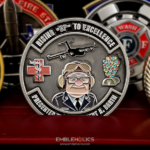
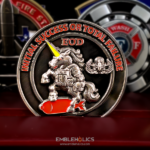
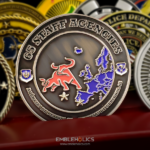
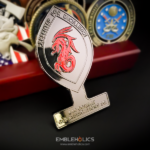
This 312th Training Squadron coin does something quietly clever. The squadron’s nickname is the Wolfpack, and instead of putting a wolf on the coin, they put a paw print. The official squadron insignia takes the other face, and the whole piece is restricted to black, white and red on brushed metal. Each of those three decisions is worth borrowing.
The Trace Instead of the Animal
A wolf’s head is a bad coin subject and a paw print is an excellent one, for reasons that have nothing to do with how good the artwork is.
A drawn wolf needs fur texture, an eye, a muzzle and an expression. Those are exactly the elements that fail first when an image is reduced to coin size: fine texture turns to mush, a small eye becomes a dot, and an animal’s whole character lives in a few millimeters around its face. A paw print needs none of it. It is four toes and a pad, in solid shapes, with no internal detail to lose.
And it still says wolf. That is the useful part. Using the trace a thing leaves rather than the thing itself gets you the same meaning in a form that survives the process.
The idea generalizes further than most people try. A wake instead of a ship. A contrail instead of an aircraft. A boot print, a tire track, a handprint, a tread pattern. Each one is bolder, simpler and more durable at size than the object that made it, and each one asks the viewer to complete the thought, which is a stronger effect than showing them the answer.
Text Cut Into a Raised Device
The word Wolfpack is engraved across the embossed paw print rather than placed beside it, and that is a specific technique worth knowing.
Cutting lettering into a raised element does two things at once. It gives the text a surface at a single consistent height, which is where lettering strikes most cleanly, and it puts dark cut lines on a face that is catching the light, which is the highest contrast available without using any paint. A word engraved into a lit raised surface is easier to read than the same word raised on a flat field.
It also saves space, which matters more on a coin than anywhere else. The device and the text occupy the same area instead of competing for two areas. On a design with a single bold subject, laying the name across it is usually better than finding a gap to put it in.
The one condition is that the raised element has to be broad and flat enough to accept the letters. It works on a paw pad, a shield, a banner or a wing. It does not work across something with its own internal detail, because the cut text and the detail fight each other.
Why Black, White and Red Is the Most Reliable Triad
The squadron specified black, white and red only, and that particular set is not an arbitrary three.
Black and white are not really colors, they are the two ends of the value scale. They carry structure rather than hue, which means they do the work of separating shapes, and they do it at any size and under any lighting. Red is then the one hue that holds its identity when it gets small and that reads strongly against both black and white without needing to be large.
So a black, white and red coin is doing something different from a three-color coin. It is two values plus one hue, which is why it looks disciplined rather than busy, and why it is the palette so many units converge on without being told to. Swap red for a mid-tone like olive or navy and the same scheme loses most of its punch, because a mid-tone has neither the value contrast of black and white nor the attention-holding quality of red.
The brushed metal underneath adds a fourth value without adding a color, scattering light so the painted areas stay the brightest things on the coin.
The Official Insignia on the Other Face
The squadron insignia is a cross with a crossed hatchet and wrench behind it, and it is immediately readable once you know what the unit does.
The 312th trains fire protection, so the cross on its emblem is the fire service device, and the tools behind it are the tools of the trade. That is a common and useful property of training unit insignia: because they represent a specialty rather than a geography or a lineage, they tend to show the actual implements of the job, which makes them unusually legible to outsiders and unusually good coin artwork. There is more on the fire service cross and how it behaves as a shape on the Boise firefighters coin.
Putting the official insignia on one face and the unofficial mascot on the other is the right division. The insignia is what the squadron is; the Wolfpack is who the people in it are. Neither needs to give way to the other, and a two-sided object is built for exactly that.
About the 312th Training Squadron
The 312th Training Squadron is a United States Air Force training squadron at Goodfellow Air Force Base, Texas. It delivers fire protection training, with instruction at the Louis F. Garland Fire Academy on the base, and it trains students from across the Department of Defense as well as international partners.
See the Goodfellow AFB fire academy coin, a 644th Combat Communication Squadron coin, and Air Force squadron coins and what goes on them.
Order a Coin for Your Squadron
Send your squadron insignia and your nickname or mascot artwork, and say which one should take the front. If you want to limit the palette, give us the colors by name, because a specified list is easier to design to than an instruction to keep it clean.
Professional artwork is free with unlimited revisions, the minimum order is 50 coins, and nothing goes into production until you approve a digital proof. Standard production runs about 45 to 50 days after final artwork approval, rush production is available on many projects, and shipping within the continental United States is included. Embleholics is veteran-owned, SDVOSB and registered in SAM.gov. See more Air Force challenge coins.
Finished Coin (Front)

Finished Coin (Back)

Frequently Asked Questions
What is an Air Force training squadron coin?
An Air Force training squadron coin is a coin for a unit that delivers technical training rather than operating aircraft. These coins typically pair the squadron’s official insignia, which usually shows the tools of the specialty being taught, with the squadron’s nickname or mascot on the other face.
Why use a paw print instead of a drawn wolf?
Because a paw print survives reduction and an animal’s head does not. A drawn wolf relies on fur texture, an eye and a muzzle, all of which degrade at coin size, while a paw print is four toes and a pad in solid shapes with no internal detail to lose. It still reads as wolf, which is the point.
What else works like a paw print on a coin?
Any trace a subject leaves rather than the subject itself. A wake instead of a ship, a contrail instead of an aircraft, a boot print, a tire track, a handprint or a tread pattern. Each is bolder and more durable at small size than the object that made it, and it asks the viewer to complete the thought.
Can text be engraved over a raised element on a coin?
Yes, and it is often better than placing the text alongside. Cutting letters into a raised surface gives them a single consistent height to strike at and puts dark lines on a face that catches the light, which is the strongest contrast available without paint. It also lets the device and the name share one area instead of competing for two. The raised element has to be broad and flat enough to take the letters.
Why do black, white and red work so well together on a coin?
Because it is really two values plus one hue rather than three colors. Black and white sit at the ends of the value scale, so they separate shapes at any size and in any light, and red is the one hue that keeps its identity when small and reads strongly against both. Replacing red with a mid-tone such as olive or navy loses most of the effect.
Why is there a cross on an Air Force squadron insignia?
Because the 312th trains fire protection, and the cross is the fire service’s device. Training unit insignia often show the implements of the specialty they teach, which is why they tend to be more immediately readable than insignia based on geography or lineage.
Should a coin carry the official insignia or the unit nickname?
Both, on separate faces. The official insignia states what the unit is and the nickname or mascot states who the people in it are, and a two-sided object is well suited to carrying two things that should not be blended. Which one takes the front depends on whether the coin is issued by the unit or bought by the people in it.
What does the 312th Training Squadron do?
The 312th Training Squadron at Goodfellow Air Force Base in Texas delivers fire protection training, with instruction at the Louis F. Garland Fire Academy, for students from across the Department of Defense and from international partners.
More Air Force Projects