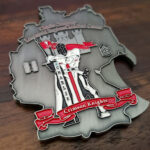
This Charlie Company challenge coin is not about the United States. It is cut to the outline of Germany, and the imagery on it is a knight and a castle, neither of which is American and neither of which belongs to the unit. They belong to Landstuhl, the German town where the company is stationed. That is the interesting thing about coins made by units posted overseas for years at a time: the coin ends up recording where the people actually are rather than where they are from.
A Coin About Where the Unit Actually Is
Charlie Company belongs to the Troop Command at Landstuhl Regional Medical Center, the US military hospital in the Rhineland-Palatinate. Soldiers rotate through a posting like that for years, and families come with them. People learn the town, drive the roads, eat in the restaurants and climb up to the castle on a Sunday.
A coin built only from US Army devices would say nothing about any of that. Three decisions on this coin say all of it.
- The outline of Germany as the coin’s shape. The host country, not the home one.
- A castle. The landmark that stands above the town.
- A knight. The figure the town is known for.
On the shape, one practical note worth having. Germany’s outline is compact, roughly as tall as it is wide, with no long thin extremities. That makes it a genuinely good coin shape. Countries and regions with narrow peninsulas or long thin tails make fragile coins, because the slender sections bend and snap. Check the proportions of an outline before committing to it, and see custom shaped challenge coins for how these are tooled.
The Knight and the Castle Are Landstuhl’s
A knight and a castle on a coin from a unit in Germany could be generic medieval decoration. These almost certainly are not, and the detail is worth putting on the page because it is the difference between a souvenir and the company’s own coin.
Landstuhl sits below the ruins of Nanstein Castle, and the castle was the seat of Franz von Sickingen, a knight of the early sixteenth century. In April 1523 Nanstein was besieged and reduced by artillery within hours, and Sickingen died of his wounds on 7 May that year. He is the town’s defining historical figure, Landstuhl styles itself Sickingenstadt after him, and the town marked the five hundredth anniversary of his death in 2023.
So a knight and a castle, on a coin for a unit stationed at Landstuhl, are Sickingen and Nanstein. That is a reference anyone who has served there will get immediately and nobody else will, which is exactly what you want from a unit coin.
Two rules follow for any unit doing the same thing.
Choose the specific reference, not the generic one. A castle says Germany. That particular castle says Landstuhl. Generic local colour produces a coin that could have come from any base in the country, which defeats the purpose.
Get it right, because the host nation will see it. These coins are handed to local officials, host nation employees, partner units and families. A misdrawn landmark, a misspelled place name or the wrong historical figure is noticed quickly and remembered. Check the detail with someone local before the proof is approved.
One Side in Color, One Side in Metal
The two faces of this coin are finished differently, and that is a deliberate choice rather than a saving.
The insignia side is a red painted field. The other side is bare metal apart from the knight and the ribbons, which are picked out as accents. The result is that the coin has a front and a back in the hand, which a coin with two equally colourful faces does not.
This matters more than it sounds. When both sides of a coin are busy and painted, a person turning it over has no sense of which one they were meant to look at first, and neither side gets the benefit of being the quiet one. Making one face a flat color field and the other predominantly metal gives the eye somewhere to start and somewhere to rest. It is the simplest hierarchy available on a two-sided object and it costs nothing.
Coloring the Field Instead of the Detail
On the insignia side the paint goes on the background and the engraved elements are left unpainted and darkened for tone. That is the reverse of the usual approach, and it is worth knowing when to use it.
The normal method is to color the detail and leave the field in metal. It works when the detail is made of reasonably large enclosed areas that can hold paint.
Coloring the field and leaving the detail in metal works when the detail is fine. Thin engraved lines cannot hold enamel reliably, because a recess has to be wide enough for paint to sit in without bleeding into the next one. Flood the background with a single color instead and every one of those thin lines reads as dark metal against it, with no minimum width to worry about. Darkening the engraving deepens the contrast further.
The limit is that it only works with one background color. Two color fields on the same face reintroduce the boundary problem you were trying to avoid, so this is a single-color technique.
Design a Coin for Your Company
Send your unit insignia and tell us what local imagery you want used, including the specific landmark or figure if you have one in mind. If you want the coin cut to an outline, say so early, because the proportions of the shape decide whether it will be durable.
Professional artwork is free with unlimited revisions, the minimum order is 50 coins, and nothing goes into production until you approve a digital proof. Standard production runs about 45 to 50 days after final artwork approval, rush production is available on many projects, and shipping within the continental United States is included, with overseas and APO delivery quoted separately. Embleholics is veteran-owned, SDVOSB and registered in SAM.gov. See an Alpha Company coin, a 104th Engineer Company coin, or more Army challenge coins.
Frequently Asked Questions
What is a Charlie Company challenge coin?
A Charlie Company challenge coin is a coin made for a lettered company within a battalion or troop command. Because lettered companies share their parent unit’s heraldry, these coins usually carry something the company chose for itself, such as a mascot, a motto or local imagery from wherever the company is stationed.
Can a challenge coin be shaped like a country?
Yes, and host country outlines are popular with units stationed overseas. What decides whether it works is the proportions. A compact outline roughly as tall as it is wide makes a durable coin, while a country with long narrow peninsulas or thin extremities produces slender sections that bend or snap, so those are better drawn as a map on a conventional coin face.
Should a unit stationed overseas use local imagery on its coin?
It is one of the strongest options available, because it records where the people actually served rather than only which army they belong to. The key is to pick a specific local reference rather than a generic one. A castle says Germany, while one particular castle says the town. Check the detail with someone local first, since these coins are handed to host nation officials and employees.
Who was Franz von Sickingen and what is Nanstein Castle?
Franz von Sickingen was a German knight of the early sixteenth century whose seat was Nanstein Castle above Landstuhl. Nanstein was besieged and largely destroyed by artillery in April 1523, and Sickingen died of his wounds on 7 May 1523. He remains Landstuhl’s defining historical figure, the town is known as Sickingenstadt after him, and the castle ruins are its most prominent landmark.
Should both sides of a challenge coin be painted?
Usually not. If both faces are busy and fully painted, neither reads as the front and the person turning the coin over has no sense of where to start. Making one face a color field and the other predominantly bare metal gives the coin a clear front and back, which is the simplest hierarchy available on a two-sided object and costs nothing.
Is it better to color the background or the detail on a coin?
It depends on how fine the detail is. Color the detail when it consists of reasonably large enclosed areas that can hold paint. Color the background instead when the detail is thin engraved line work, because narrow recesses cannot hold enamel without it bleeding, and a single flooded background color makes every thin line read as dark metal against it. The background method only works with one color per face.
What is the minimum order for a company challenge coin?
The minimum is 50 coins, which suits a company well since a lettered company is usually larger than that. Ordering above the current strength is worth considering, because people rotate through and a coin built on the unit and its location rather than on a roster or a date stays correct for years.
What is Landstuhl Regional Medical Center?
Landstuhl Regional Medical Center is the United States military hospital at Landstuhl in Germany, serving US personnel and families in Europe and acting as a treatment and evacuation point for service members and civilians moving through the medical system. Its Troop Command includes the lettered companies that administer and support the hospital’s soldiers.
More Military Projects