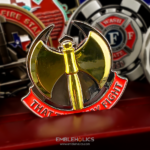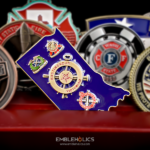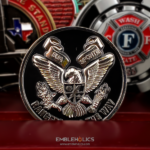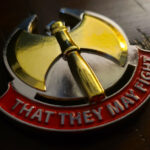
This engineer company challenge coin is cut to the outline of an axe with a ribbon beneath it, and the axe head is sculpted in relief rather than engraved flat. A tool is one of the most natural subjects for a unit that uses tools, and it is also one of the least forgiving shapes to strike.
Why a Tool Makes a Good Coin Shape
A coin cut to a tool says what a unit does rather than what it is called. An engineer company could have put its emblem on a round coin and been understood by other engineers. An axe is understood by everyone.
Three reasons tool shapes work better than most:
The silhouette is already familiar. Nobody has to learn what an axe looks like, which means the shape identifies the coin before any detail, lettering or color is visible. That is the test any custom shape has to pass.
A tool has mass and a line. An axe is a heavy head on a long shaft, which gives the design two clearly different areas to use rather than one undifferentiated field.
It suits relief. A tool is an object, so sculpting it in depth makes it read as a thing rather than a picture of a thing. A flat engraved axe on a round coin is a drawing. A sculpted axe-shaped coin is closer to the object itself.
For shape work in general, see custom shaped challenge coins.
The Handle Is the Weak Point
Here is the part a buyer needs to know before they commission an axe, a hammer, a wrench, a shovel or any other tool shape.
A tool is a mass on a stick, and the stick is the problem. The head carries most of the metal and most of the artwork. The handle is long, narrow and unsupported along its whole length, and it is where the piece will flex and eventually fail.
Three things keep it sound:
Thicken the handle beyond what the drawing suggests. A handle drawn to realistic proportions is thinner than struck metal wants to be at that length. Widening it slightly is barely noticeable and it is the difference between a piece that lasts and one that bends.
Shorten it. Most tool shapes read perfectly well with a handle shorter than the real proportion. The head is what identifies the tool, so the handle can be cropped back toward it without losing anything.
Connect it to something. This is what the ribbon on this coin is doing. A band running under the handle gives it a second attachment and turns an unsupported projection into part of a connected shape. That is good engineering disguised as decoration.
The ribbon brings its own constraints, and they are the same ones a crest-shaped coin faces. We cover those on our Army engineer crest coin page: short text only, two or three words per band, and a floor on letter height below which struck lettering closes up.
A Shape With a Direction
An axe faces one way. That sounds obvious and it has a consequence most people do not think about until the proof arrives.
The piece has a fixed orientation, so there is a right way up and a right way round, and the artwork on both faces has to be set to match. On a round coin either face can be rotated freely. On an axe the handle is at the bottom on one side and at the bottom on the other, which means the reverse artwork reads in the mirrored outline.
That is why the castle sits on the reverse here rather than a second sculpted tool. A symmetrical device drops into a mirrored outline without any trouble. Something with its own direction would have had to be flipped, and then the two faces would disagree about which way the piece is facing.
Sculpted Front, Engraved Back
The front carries the axe head sculpted in depth. The reverse carries the castle engraved, with inscriptions machined into the ribbon on both sides.
That division is the right way round and it is worth saying why.
Sculpt the object, engrave the device. A tool is a three-dimensional thing and relief is how metal shows depth. An insignia is flat artwork that was designed to be reproduced, and engraving it keeps the lines sharp where building it up in relief would round them over.
Depth needs metal behind it. A deeply sculpted face needs thicker stock, which on a shaped piece with a narrow handle is an argument for striking the whole thing heavier than a round coin of the same size.
And the highest points lose detail first. On deep relief the peaks take the most deformation, so the finest detail belongs on the lower planes rather than on the top of the sculpt.
The castle is the Engineer branch insignia, carried by the branch since the nineteenth century. Like any official device it should come to us as source artwork rather than as a photograph of a patch. See also a Corps of Engineers coin.
Paint and Protection on a Shaped Piece
This coin was finished with paint and a protective layer, and on a shaped piece that matters more than it does on a disc.
A round coin has a raised rim, and the rim is the first thing to touch any surface. The artwork sits protected inside it. A shaped piece has no rim at all, which means the outermost points of the shape, here the corners of the axe head and the end of the handle, are also the points that take every knock.
Two consequences worth knowing. Keep fine detail and painted areas away from those outer points, because that is where wear starts. And a protective layer is doing real work on a shaped piece rather than being an upsell, because there is no rim standing between the artwork and the world.
See plating options for what each base metal contributes under the paint.
About the 104th Engineer Company
The unit, nicknamed the Titans, traces its lineage to 1944, when it was constituted as the 1366th Engineer Dump Truck Company and first activated at Camp Ellis, Illinois. It is now an engineer company within a brigade engineer battalion.
That lineage is worth keeping on the coin’s page for the same reason it is worth keeping on the coin. A company-level unit is reorganized, redesignated and reflagged more often than anything above it, and a lineage back to a dump truck company in 1944 is something no current organization chart can take away.
See more Army challenge coins.
Order a Tool-Shaped Coin
Free professional artwork, unlimited revisions and a digital proof before anything is produced. Free shipping within the continental US, a 50-coin minimum, and most orders complete 45 to 50 days after artwork approval, with rush production available. Embleholics is veteran-owned, an SDVOSB, and registered in SAM.gov.
Send us the tool you have in mind and we will tell you where it needs thickening or shortening before anyone draws artwork. On a shaped piece the proportions and the engineering are the same conversation, and it is much cheaper to settle at the shape stage than at the proof.
Frequently Asked Questions
What is an engineer company challenge coin?
An engineer company challenge coin is made for a company-level Army engineer unit rather than for the branch as a whole. It usually carries the unit’s own identity alongside the Engineer branch castle, and the run is small because a company is a small organization.
Can a challenge coin be shaped like a tool?
Yes, and tools are among the better custom shapes because the silhouette is already familiar. An axe, a hammer or a wrench identifies itself before any lettering or color is visible, which is the test any custom shape has to pass.
Where does a tool-shaped coin break?
At the handle. The head holds most of the metal and the handle is long, narrow and unsupported, so it flexes and fails there. Thickening it slightly, shortening it, or connecting it to a ribbon or band keeps the piece sound.
Why do shaped coins have ribbons under them?
Partly for the text, and partly because the band gives a projecting element a second attachment point. A ribbon running under a handle turns an unsupported projection into part of a connected shape, which is structural work that happens to look decorative.
Does a shaped coin need to be thicker than a round one?
Usually, yes. The narrowest section decides how much the whole piece flexes, so a shape with a thin handle or a long projection is struck heavier than a disc of similar size, and deep relief on the same piece adds to that.
Should artwork be sculpted or engraved?
Sculpt objects and engrave devices. A tool or a vehicle is a three-dimensional thing and relief is how metal shows depth, while an insignia is flat artwork designed to be reproduced, and engraving keeps its lines sharp where relief would round them over.
Why is the back of a shaped coin harder to design?
Because the outline is mirrored on the reverse. A shape with a direction, such as an axe, faces one way on the front and the other way in the back’s outline, so a symmetrical device sits on the reverse far more comfortably than something with its own direction.
What is the castle on an Army engineer coin?
The castle is the insignia of the Army Corps of Engineers, carried by the branch since the nineteenth century. It is fixed artwork and should be reproduced from source rather than redrawn from a photograph of a patch or a crest.
Do shaped coins need a protective coating?
They benefit from one more than round coins do, because a shaped piece has no raised rim to take the wear. The outermost points of the shape are the first to be knocked, so fine detail and paint are kept away from them and a protective layer is doing real work.
More Army Projects