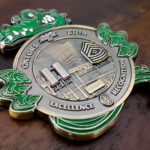
A company challenge coin represents a unit of roughly a hundred people, which is the smallest echelon above the individual that reliably has a nickname and a character of its own. This one was made for Alpha Company at an Army medical center in Germany, and it is built around the company’s alligator mascot rather than its formal designation. It’s featured here as our Alpha Company Challenge Coin.
Company Is Where Identity Starts
Battalions and brigades are structures. A company is roughly the largest group where everybody knows everybody, and that is where nicknames, mascots and in-house humor actually live. It is the reason company coins outnumber every other echelon.
Four things follow from that, and they are worth understanding before you design one.
A company coin can be informal in a way a higher one cannot. A grinning cartoon alligator works at company level. The same cartoon on a brigade coin looks unserious, and on a command coin it would look like a mistake. The echelon sets the register, and getting that wrong is the single most common error in unit coin design.
The nickname outranks the designation. “The Gators” means more to the people in the company than the letter and the parent unit do. The designation belongs in the lettering; the nickname gets the artwork.
The parent organization still earns space. This coin puts the medical center’s logo on the front alongside the company’s own mark, which is the standard and correct answer. Leaving the parent off entirely makes a coin feel like a breakaway rather than a company piece.
And the runs are small. A company is a hundred-odd people, which puts the order near the lower end of a production run rather than the upper. For another piece at the same echelon, see a Charlie Company coin.
The Gators
The front of this coin carries a grinning cartoon alligator, sculpted and painted bright green, which is where the company’s nickname comes from.
A mascot gives a unit something to draw when the actual work does not photograph. That is especially true of a medical unit, where the job is care rather than equipment, and it is the same reason intelligence and communications units reach for animals and allegory. For more on mascots as a design subject, see a mascot challenge coin.
One production point matters here. A cartoon has to be sculpted rather than printed flat to survive at coin size. A flat cartoon depends on its outlines, and fine outlines are the first thing to go when artwork is reduced. Building the figure in relief and then adding color keeps it readable, because the shape is held by the metal rather than by a line.
Two Flags on One Graphic
The front also carries a device combining the United States and German flags, which is what a unit stationed abroad does instead of putting a map on the coin.
A unit posted overseas is shaped by where it is, and acknowledging the host nation in its own colors says that in a way a geographic outline does not. Three practical points if you want to do the same:
Combine the flags rather than placing them side by side. Two flags sitting next to each other reads like a diplomatic photograph. Merged into one device, they read as a single identity.
Keep them as an accent rather than the subject. The flags are context for the unit, not the point of the coin.
And get the host nation’s colors right. That is the detail local staff and partner personnel will check first, and the one most likely to be approximated.
For another piece made for a unit stationed in Germany, see this Army coin from Kaiserslautern.
The Building on the Back
The reverse carries an embossed view of the medical center itself, with a rank device and lettering arranged around it.
People who spend years inside one building develop a real attachment to it, and a recognizable structure is frequently a stronger subject than an organizational logo. The building says where you worked. The logo says who signed the paperwork.
A building also suits embossed relief rather than engraving. Architectural masses read through light and shadow, so raising the structure off the surface gives you the roofline, the depth and the shape of the facade. Fine window detail disappears at coin size whichever technique you use, so the version that works is the one built from a few large forms rather than many small ones.
Composition follows from that: a building needs the whole face, which is why the lettering and the rank device sit around it rather than across it.
Order a Coin for Your Company
Professional artwork is free with unlimited revisions, and nothing goes into production until you approve a digital proof. The challenge coin minimum is 50 pieces, standard production runs about 45 to 50 days after final artwork approval, rush production is available on many projects, and shipping within the continental United States is included. Embleholics is veteran-owned, SDVOSB and registered in SAM.gov.
Two things worth sending. Tell us your nickname before your designation, because the nickname is usually the better coin. And if you are stationed overseas, raise shipping at the quote stage rather than at the end. See more Army challenge coins or ask about sculpting, relief and color.
Frequently Asked Questions
What is a company challenge coin?
A company challenge coin is made for a unit of roughly a hundred soldiers, which is the level at which a unit typically has its own nickname, mascot and character. This one was produced for Alpha Company at an Army medical center and is built around the company’s alligator mascot.
Can a company order its own coin separately from the battalion?
Yes, and most company coins are ordered that way. The company is the level where the identity sits, so the order is usually organized within the company rather than by the parent battalion, often with the money collected from members.
Should the parent unit appear on a company coin?
Yes, on one face. Including the parent organization keeps the coin legitimate and places the company within something larger, while leaving it off makes the piece feel like a breakaway. The usual arrangement is the company’s own mark leading and the parent’s logo alongside or on the reverse.
Can a cartoon mascot work on a challenge coin?
Yes, provided it is sculpted rather than printed flat. A cartoon relies on its outlines, and fine outlines are the first detail lost when artwork is reduced to coin size. Building the figure in relief and adding color keeps it readable because the shape is held by the metal.
How informal can a unit coin be?
The smaller the unit, the more informal the coin can be. A cartoon or an in-house joke works at company level, where everyone knows each other, and looks out of place at brigade or command level. The echelon sets the register, and misjudging it is the most common mistake in unit coin design.
Can a host nation’s flag go on a US unit’s coin?
Yes, and it is a natural choice for a unit stationed overseas. Combine the two flags into a single device rather than placing them side by side, keep them as an accent rather than the main subject, and check the host nation’s colors carefully, since that is the detail local personnel will notice.
Can a building be shown on a coin?
Yes, and for people who worked in it a building is often a stronger subject than a logo. Embossed relief suits it better than engraving, because architecture reads through light and shadow. Build it from a few large forms rather than fine detail, since window-scale features disappear at coin size.
How many coins does a company usually order?
Typically somewhere near the 50-piece minimum through to a few hundred, depending on whether the coin is for current members only or will also go to visitors and alumni. Ordering somewhat above your headcount is usually cheaper per coin than reordering later.
More Army Projects