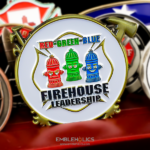
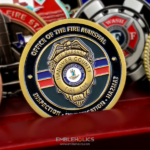
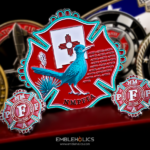
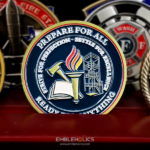
This coin was made for a volunteer-driven nonprofit that provides real-time wildfire information through an app. It carries a flame on each face in different colors, and the color difference is doing real work rather than decorating the design.
Two Flames That Mean Different Things
The detail that makes this coin worth looking at is that the two flames are not the same flame.
One face carries the organization’s logo over a flame. The other carries a flame marked with an Rx emblem. In wildland fire, Rx denotes prescribed fire: a burn deliberately set and managed to reduce fuel loads and lower the risk of a catastrophic fire later. It is the opposite of the fire the organization exists to warn people about.
So the coin puts the unwanted fire on one face and the intentional fire on the other, and distinguishes them by color. That is a piece of domain knowledge built into a design, and it will read instantly to anyone in the wildland fire community while passing unnoticed by everyone else.
It is also a good lesson in how to use color meaningfully. Most coins use color decoratively: this element is red because red looks good there. Using two colors to encode a distinction gives the design a second layer that costs nothing extra to produce. The requirements are only that the distinction is real, that the audience already knows the convention, and that the coin does not depend on the viewer getting it.
If you are looking for the firefighting side of wildland fire rather than the information side, see a wildland firefighter challenge coin.
A Coin for Volunteers Rather Than Employees
This organization runs on volunteers, and that changes what a coin is for.
There is no paycheck, so recognition is the compensation. That is not a sentimental observation, it is the practical reality of volunteer organizations, and it means a physical object carries more weight than it would in a company where people are paid.
Volunteers are geographically scattered. People contributing to a wildfire information service are spread across every area it covers, which in this case runs to dozens of states. Most will never meet each other, so the coin is one of very few things they have in common.
And there is no uniform or building to put on it. The organization exists as a service rather than a place, which is why the coin leans on the logo and the flame devices rather than on a headquarters or a patch.
Membership organizations, mutual aid groups and online volunteer networks all share that shape of problem. For the firefighting equivalent, see a volunteer firefighter coin.
Gold With a Line Pattern
The base is gold with a glossy finish, and a fine circular line pattern runs behind the devices on both faces. Specialty metal paints pick out the logo, the flames and the rims.
The line pattern is the element doing the most work and the one most people would leave out. A coin with a central device on an empty gold field looks unfinished, because polished gold with nothing on it reads as blank rather than as restrained. A fine concentric pattern fills the field, gives the eye somewhere to rest and makes the central device stand forward without needing extra height or color.
It is also the hardest part to strike well. Fine lines cut too shallow disappear under plating, and lines spaced too closely fill in during the strike. On any design that depends on a line pattern, a physical proof is worth asking for, because a screen renders lines the die cannot hold. Our page on engraving and finish options covers the processes.
One note on the rims: minimal lettering etched around the edge keeps the official name on the coin without crowding either face. It is the same solution used on formal institutional coins, and it works for the same reason.
Marking Work That Prevents Things
There is a recognition problem specific to prevention work, and this organization sits squarely in it.
A warning that arrives in time produces an evacuation that goes smoothly, a fire that is reported early, a neighborhood that was ready. None of those are events. The measure of success is the absence of a disaster, which is impossible to photograph and difficult to celebrate.
That is precisely the case where a coin earns its place. It is a physical acknowledgment of work whose output is something that did not happen, and there is very little else that serves the same purpose. The same applies to emergency management, public health, safety engineering and dispatch. See our Emergency Management Challenge Coin and El Paso 911 Challenge Coin.
Order a Coin for Your Organization
Professional artwork is free with unlimited revisions, and nothing goes into production until you approve a digital proof. The challenge coin minimum is 50 pieces, standard production runs about 45 to 50 days after final artwork approval, rush production is available on many projects, and shipping within the continental United States is included. Embleholics is veteran-owned, SDVOSB and registered in SAM.gov.
Two things worth telling us. If a color or a symbol on your coin carries a specific meaning in your field, say so, because we will design around it rather than treating it as decoration. And if the design uses a fine line pattern, ask for a physical proof, since that is the one element a screen always flatters. See more coins for organizations.
Frequently Asked Questions
What is a wildfire challenge coin?
It is a coin made for an organization working in wildfire response, prevention or information. This one belongs to a volunteer-driven nonprofit providing real-time wildfire alerts, and it carries flame devices in two colors to distinguish unwanted fire from prescribed fire.
What does Rx mean on a fire coin?
Rx denotes prescribed fire, a burn deliberately set and managed to reduce fuel loads and lower the risk of a severe wildfire later. It is standard shorthand in the wildland fire community, which is why it reads immediately to that audience and goes unnoticed by everyone else.
Can color be used to mean something on a coin?
Yes, and it is underused. Most coins use color decoratively, but using two colors to encode a real distinction adds a second layer of meaning at no extra production cost. It works when the distinction is genuine and the audience already knows the convention.
What should a volunteer organization put on a coin?
Whatever the volunteers share, which is usually the mission rather than a place. Volunteer organizations typically have no uniform, no building and no single location, so the logo and the devices that stand for the work carry the identity on their own.
Why does a coin need a background pattern?
Because a central device on an empty metal field looks unfinished rather than restrained. A fine pattern fills the field, gives the eye somewhere to rest, and makes the central device stand forward without needing more height or more color.
Can fine line patterns be struck on a coin?
They can, with care, and they are the most demanding element to get right. Lines cut too shallow vanish under plating and lines spaced too closely fill in during the strike. Ask for a physical proof on any design that depends on one.
How do you recognize work that prevents problems?
With something physical, because there is no event to point at. Prevention work succeeds when nothing happens, which cannot be photographed or easily celebrated. A coin is one of very few objects that acknowledges an outcome defined by absence, which is why emergency management, public health and dispatch teams use them.
How many coins should a volunteer nonprofit order?
The challenge coin minimum is 50, and sizing above your active volunteer count is usually worthwhile, since volunteer organizations gain members continuously rather than in intakes. A second order pays setup again on a die that has already been made.
More Firefighters Projects