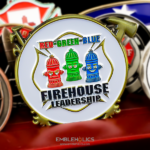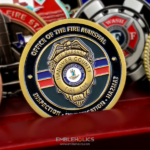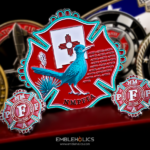
Wildland firefighting is a separate discipline from structural firefighting, with its own training system, its own qualifications and its own set of symbols, and a coin that borrows the municipal fire department vocabulary gets it wrong. This one was made for the Washington Wildland Fire Academy, which prepares entry-level wildland firefighters through courses meeting National Wildfire Coordinating Group standards. The brief asked for something minimalist: a round gold coin carrying inscriptions and lettering and almost nothing else.
Wildland symbols are not structural symbols
The Maltese or Florian cross, the helmet front, the engine number and the maltese-shaped badge all belong to the structural fire service. They are the right vocabulary for a city department and the wrong one for a hand crew. Reaching for them on a wildland coin is the most common mistake we see, and wildland firefighters notice immediately. For the structural vocabulary, see What to Put on a Fire Department Challenge Coin.
What the wildland service actually uses:
- The pulaski. The combined axe and adze hand tool, and the closest thing wildland firefighting has to a universal emblem. It reads instantly to anyone in the discipline and means nothing to anyone outside it, which is exactly right for a crew coin.
- Terrain and fuel. Timber, a ridgeline, a fire front moving uphill. Wildland fire happens in landscape, and landscape is what distinguishes these coins visually from structural ones.
- Crew and resource identity. Hand crew, engine, helitack, hotshot, smokejumper. The resource type is a real identity within the service and belongs on a crew coin.
- Nomex yellow and green. The colors of the work, and far more evocative to a wildland firefighter than fire-engine red.
For an academy coin specifically, restraint is appropriate. Graduates have not yet earned a crew identity, so a coin that leans on hotshot or smokejumper imagery would be claiming something the recipients have not done. The academy’s name, the standard, and the date are the honest content, which is part of why the minimalist brief on this coin was the right call.
Designing a coin that is almost entirely lettering
A coin with no imagery has nowhere to hide, and it is harder to get right than a busy one. Every decision that would normally be absorbed by artwork becomes visible: letter spacing, the weight of the type, where lines break, how much empty field sits around the text.
Four things carry a text-only coin:
- Hierarchy. One line has to be the biggest. An academy name, a qualification and a date set at similar sizes produce a coin with no entry point, and the eye slides off it.
- Relief height, not just size. Raising the primary line higher than the secondary lines separates them in a way that size alone cannot, and it is what gives a plain coin depth under indoor light.
- Field texture. A sandblasted or matte field behind polished raised lettering creates the contrast that artwork would otherwise supply. On a text coin this is not optional.
- Real empty space. The instinct on a plain coin is to fill the gaps, usually with a motto in small type. Resisting that is what makes the design look intentional rather than unfinished.
We will set the lettering at actual size and show it to you before anything is struck, because type that looks balanced on a screen frequently is not balanced at coin scale.
Coins for qualification and academy graduation
Wildland qualification is incremental and documented, which makes it well suited to coins. Firefighters work through training and experience requirements toward qualifications recorded on an incident qualification card, and each step is a genuine, verifiable milestone rather than a nominal one.
That suggests two different products:
An academy coin is given at graduation, marks completion of a course, and should be reorderable for every class that follows. Keep the year off the die and the same design serves indefinitely. If you want to mark the class, engrave the year rather than striking it, or add it to the packaging.
A qualification or crew coin belongs to the agency or the crew rather than the academy, is given when someone reaches a position, and can carry the resource identity an academy coin should not. These are usually smaller runs and more elaborate designs.
A note on interagency work
Interagency is the defining feature of wildland fire, and it has a design implication. Federal, state, tribal and local agencies work the same incidents under common standards, and an academy drawing students from several of them should not put any single agency’s shield on the coin. A coin carrying one agency’s emblem quietly tells students from the others that it is not quite theirs. The academy’s own identity, and the standard everyone trained to, belong to all of them.
Ordering a wildland coin
Tell us whether the coin is for an academy, a crew, or a qualification, and whether more than one agency is involved. Those two answers settle the imagery and the agency question before any drawing starts. If you want a minimalist design, say so early: it is a legitimate choice rather than a budget one, and it needs its own kind of attention. We are a veteran-owned shop in Port Orchard, Washington, and the Pacific Northwest fire community is close to home for us. You can see more firefighter challenge coins we have produced, or send your details through the free quote form.
Frequently Asked Questions
What is a wildland firefighter challenge coin?
It is a coin for firefighters working wildland rather than structural fire, given at academy graduation, on reaching a qualification, or by a crew to its members. Because wildland firefighting is a separate discipline with its own training system and symbols, these coins use a different visual vocabulary from municipal fire department coins.
Should a wildland coin use the fire service cross?
No. The Maltese or Florian cross, the helmet front and the engine number belong to the structural fire service, and using them on a wildland coin reads as a mistake to anyone in the discipline. The pulaski, terrain and fuel imagery, crew or resource identity, and the yellow and green of the work are the right vocabulary.
What is a pulaski and why is it on wildland coins?
A pulaski is the combined axe and adze hand tool used for cutting fireline, and it is the closest thing wildland firefighting has to a universal emblem. It identifies the discipline instantly to anyone who works in it, which makes it the most useful single symbol available for a wildland crew or academy coin.
Should an academy coin show hotshot or smokejumper imagery?
Not usually. Those are earned crew identities, and an academy coin goes to people who have completed entry-level training rather than joined a crew. Using that imagery claims something the recipients have not yet done. The academy’s name, the standard trained to, and the occasion are the honest content for a graduation coin.
How do you make a coin with only lettering on it work?
Through hierarchy, relief and restraint. One line has to be clearly the largest, the primary line should sit at a greater relief height than the rest rather than just a larger size, and the field behind polished lettering needs a matte or sandblasted texture to contrast against. Leaving empty space genuinely empty, rather than filling it with a small motto, is what makes the design read as intentional.
Should an interagency academy put an agency shield on the coin?
No. An academy drawing students from federal, state, tribal and local agencies should carry its own identity and the common standard rather than any single agency’s emblem, which would quietly exclude everyone else in the class. Interagency cooperation is the defining feature of wildland fire and the coin should reflect it.
Can we reorder the same academy coin for future classes?
Yes, provided the year is not struck into the die. A coin carrying the academy name and the occasion can be reordered indefinitely from the same tooling. If you want each class marked, engrave the year after striking or put it on the packaging, which keeps the die reusable.
More Firefighters Projects