Taps is the bugle call that closes military burial honors. A coin built around it is a memorial piece rather than a unit coin, which changes who it is given to, how it is designed and how it should be written about.
What Taps Is
Taps is sounded at the end of the day, at flag ceremonies, and at military funerals, where it is the last of the burial honors. It began as a signal that the day was over and lights were to be put out, and it is now most widely known for the funeral.
The call took its present form in July 1862. Union Brigadier General Daniel Butterfield, camped at Harrison’s Landing in Virginia after the Seven Days’ battles, was unhappy with the existing lights-out call and worked out a replacement with his brigade bugler. It spread through the army from there and became standard.
One point of language is worth getting right, because the people this coin is for will notice. The instrument is a bugle, and the person sounding it is a bugler. A trumpet is sometimes used, but the call belongs to the bugle, and the figure on a coin like this is a bugler rather than a trumpet player.
What to Do When Taps Is Played
This is the part most people want to know and are reluctant to ask.
Uniformed personnel salute. The salute is held for the duration of the call.
Civilians remove headgear and place the right hand over the heart. If removing headgear is not practical, holding it over the heart is the usual alternative.
Everyone faces the source of the call, or the flag or casket if there is one, and stands still until it finishes.
Twenty-four notes, usually under a minute. There is no response and nothing is said afterwards.
Why a Silhouette Is the Right Treatment
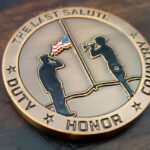
The front of this coin is a silhouette: a bugler with an officer saluting in front of him, both as solid shapes rather than modelled figures.
That is a deliberate choice and a good one, for three reasons.
A silhouette has no face to get wrong. A modelled portrait at coin size either succeeds or produces something slightly off, and slightly off is worse than nothing on a memorial piece. A silhouette avoids the question entirely.
It is nobody in particular. A coin given to many people should not look like a portrait of one of them. A silhouette reads as the role rather than the person, which is what a memorial coin needs.
It survives being small. A shape with a clean outline reads at any size. The bugle held up and away from the body, the angle of the saluting arm, the line of the cap: those are what identify the scene, and all of them are in the outline rather than in the detail.
The one thing a silhouette design has to get right is the gap between the two figures. Two solid shapes that touch become one shape, so the overlap has to be resolved deliberately, either with clear space between them or with a change of relief height so one reads as standing in front of the other.
One Painted Element on a Bare Face
The coin is monochrome apart from the flag, which is the only painted element on it.
Paint where the color is what identifies the thing. A flag without its colors is not a flag. Everything else here, the figures, the lettering, the field, is carried by relief and engraving on bare metal.
The effect is that the flag is the brightest thing on the coin without needing an outline, a border or anything else to set it off. Paint the whole face and the color becomes the background, and then nothing is being emphasized. On a memorial coin that restraint matters more than usual: a quiet piece with one point of color reads as serious, and a fully painted one reads as a souvenir.
See plating options for how the base metal changes how much work a single painted area has to do.
Text on a Memorial Coin
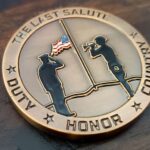
The reverse carries a verse from Psalm 23. Scripture, a name, a date, a short line of remembrance: these are the usual contents of a memorial coin’s second face, and they share one constraint.
Legibility comes before everything else. There is a floor on struck letter height, below which the counters in letters like a, e and o fill in and a line of text turns into a band. On a face whose whole purpose is a piece of text, that floor sets the length. The fix for too many words is fewer words or a larger coin, never smaller type.
Two practical notes. Recessed lettering holds its shape better than raised lettering at small sizes, which is why engraved text suits a face like this. And a quotation should be checked against its source rather than against whatever version is in circulation, because a misset word on a struck coin cannot be corrected afterwards.
Who a Taps Coin Is For
A memorial coin is given rather than sold, and usually given quietly: to a family at a service, to an honor guard, to a bugler, to the members of a funeral detail, or kept by a veterans organization for the purpose.
Two things follow from that. The run is small, which means the cost per coin matters far less than on a unit order and the money is better spent on the piece itself. And the design should not be tied to one year, one service or one name unless it is meant for exactly that occasion, because a coin held for this purpose gets used again.
See also a memorial coin for a fire service, a veterans organization coin, and a combat veterans coin.
Order a Memorial Coin
Free professional artwork, unlimited revisions and a digital proof before anything is produced. Free shipping within the continental US, a 50-coin minimum, and most orders complete 45 to 50 days after artwork approval, with rush production available. Embleholics is veteran-owned, an SDVOSB, and registered in SAM.gov.
If the coin carries a name, a date or a quotation, send the exact wording with the quote request and we will set it on the proof for you to check before anything is struck.
See more commemorative challenge coins and military challenge coins.
Finished Coin (Front)
Finished Coin (Back)
Frequently Asked Questions
What is a Taps challenge coin?
A Taps challenge coin is a memorial piece built around the bugle call sounded at military funerals, rather than a unit or command coin. It is usually given to families, honor guards, buglers and funeral details rather than issued to a unit.
What is Taps?
Taps is the bugle call sounded at the end of the day, at flag ceremonies and at military funerals, where it is the last of the burial honors. It is twenty-four notes long and usually takes under a minute.
Who wrote Taps?
The call took its present form in July 1862, when Union Brigadier General Daniel Butterfield worked out a replacement for the existing lights-out call with his brigade bugler at Harrison’s Landing, Virginia. It spread through the army from there and became standard.
What do you do when Taps is played?
Uniformed personnel salute and hold the salute for the duration of the call. Civilians remove headgear and place the right hand over the heart, or hold the headgear over the heart, and everyone faces the source of the call and stands still until it finishes.
Is Taps played on a bugle or a trumpet?
The call belongs to the bugle and the person sounding it is a bugler, though a trumpet is sometimes used in practice. On artwork and in writing, bugle and bugler are the correct terms.
Why use a silhouette instead of a detailed figure?
A silhouette has no face to get wrong, reads correctly at any size, and represents the role rather than a particular person, which is what a coin given to many people needs. A modelled portrait at coin size risks looking slightly off, and on a memorial piece that is worse than no detail at all.
Should a memorial coin be fully painted?
Usually not. One painted element on an otherwise bare face, such as a flag, becomes the brightest thing on the coin and keeps the piece quiet. A fully painted memorial coin tends to read as a souvenir rather than as something made for the occasion.
Can a verse or quotation go on a challenge coin?
Yes, and the length is set by legibility rather than by preference. Struck lettering has a minimum height below which it stops being readable, so a long quotation needs either fewer words or a larger coin, and the exact wording should be checked against its source before the proof is approved.
How many memorial coins should be ordered?
Most memorial orders start at the 50-coin minimum, because the coins are presented individually rather than issued. Organizations that keep them for this purpose tend to reorder the same design, which is a reason to keep the coin general rather than tied to one service or one name.
More Veterans Projects