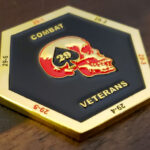
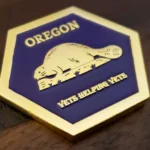
A veterans organization designs its coins under different rules from a serving unit, because there is no uniform regulation and no command approval chain. The membership decides, and that freedom produces coins that look like nothing a serving command would issue. This one was made for Vets Helping Vets of Oregon to recognize the combat veterans among its members: a hexagonal coin with a skull and ace of spades engraved on one face, a beaver on the other, and minimal lettering across both faces and the edge.
A veterans group answers to its members
The design latitude is the defining difference. A serving unit’s coin has to sit within official heraldry, pass a command’s judgment, and work when handed to a visiting officer. A veterans organization’s coin only has to satisfy its own members, who are usually the people designing it.
In practice this shows up in three ways. Imagery gets darker and more direct, because the membership has earned the right to it and does not need to explain it to anyone. Humor and irreverence appear where a serving unit would be cautious. And local identity gets much stronger, because a veterans group is rooted in a place in a way a deployable unit is not.
This coin does all three. The skull and ace of spades is imagery that carries a specific weight for combat veterans and sits awkwardly on an official coin. The beaver places the organization in Oregon unmistakably. Neither would have survived a command review, and neither needed to.
The one caution worth stating. A coin designed by a small group within a larger membership can land differently with the rest of it. If the organization spans several eras of service, it is worth circulating the design before striking rather than after. Not a regulation, just a practical step that avoids a conversation nobody enjoys.
Lettering on the edge
Putting text on the rim of the coin itself is an underused option, and this coin uses it. The edge is a surface most designs ignore entirely, and for a coin with a deliberately spare front and back, it provides somewhere to put a motto, a name or a date without crowding either face.
What to know before specifying it:
- It is a separate operation. Edge lettering is applied to the finished coin rather than being part of the main die, which makes it a per-coin cost rather than a one-time tooling cost.
- Keep it short. The edge of a coin is a narrow band and there is less of it than the circumference suggests once you allow for legible letter height. A motto or an organization name will fit. A sentence will not.
- Thickness matters. A thin coin has very little edge to work with. If edge lettering is part of the plan, say so early, because it can influence the thickness you should be ordering.
- It rewards a plain design. Edge text is a quiet detail that people find rather than see, which works best when the faces are restrained enough for it to feel like a discovery.
Hexagons and other geometric shapes
A hexagon is a good middle option between a circle and a complex outline. It is clearly not a standard coin, it costs relatively little to cut because the profile is straight-edged with no fragile points, and the flat sides give lettering and artwork something to align to in a way a circle does not.
Geometric shapes also preserve usable area. One of the hidden costs of an irregular or figurative outline is lost flat surface. A hexagon, octagon, square or shield keeps almost as much working area as a round coin of the same width, which matters when a design has to carry imagery on both faces.
And they suit a restrained design. On a coin with a single engraved image per face and almost no text, the outline is doing a lot of the identifying work. A straight-edged shape reads as considered; a circle would have made the same artwork look like a default.
A note on combat veteran status
This page is about coins, not eligibility, and the distinction matters. What qualifies someone as a combat veteran for a particular benefit depends on the program, and the criteria differ between Department of Veterans Affairs programs, state programs and individual organizations’ own membership rules. Service records, hostile fire pay, campaign and expeditionary awards and deployment locations can all form part of it.
If you are checking your own status or eligibility for benefits, go to the VA or to an accredited veterans service officer rather than to a coin manufacturer. Most veterans service organizations have an officer who does this for free. For our purposes, the only question that matters is who your organization considers a combat veteran, because that is who the coin is for and that is the number we need.
Ordering a coin for a veterans organization
Tell us your membership number and who the coin is going to. A coin for every member and a coin recognizing a subset within it are different orders, and the second is usually much smaller. If you want edge lettering, raise it in the first message, since it affects the thickness and the per-coin price. We are veteran-owned ourselves, based in Port Orchard, Washington. You can see more coins we have made for veterans organizations, including the Combat Vets Association coin and the American Legion coin, or send your design through the free quote form.
Finished Coin (Front)
Finished Coin (Back)
Frequently Asked Questions
How is a veterans organization coin different from a unit coin?
There is no uniform regulation and no command approval chain, so the membership decides. That produces coins with darker or more direct imagery, more humor, and much stronger local identity than a serving unit would issue. The trade-off is that the responsibility for how the design lands sits with the organization, which is why circulating it before striking is worth doing.
Can you put lettering on the edge of a coin?
Yes. Edge lettering is applied to the finished coin rather than cut into the main die, so it is a per-coin cost rather than a one-time tooling charge. Keep the text short, because the usable band is narrower than the circumference suggests once letters are large enough to read, and mention it early since it can affect the coin thickness you should order.
Is a hexagonal coin expensive?
No, it is one of the more economical ways to leave a circle behind. The profile is straight-edged with no fragile points, so it avoids the fragility that drives cost on irregular shapes, and unlike a figurative outline it preserves almost all the usable flat area of a round coin of the same width.
Why choose a geometric shape over a round coin?
Because on a restrained design the outline does much of the identifying work. A single engraved image per face with almost no text can look like a default on a circle and like a deliberate choice on a hexagon. The flat sides also give artwork and lettering something to align to, which a circle does not.
Who counts as a combat veteran?
It depends on the program. Criteria differ between Department of Veterans Affairs programs, state programs and individual organizations’ own membership rules, and can involve service records, hostile fire pay, campaign or expeditionary awards and deployment locations. For questions about your own status or benefits, speak to the VA or an accredited veterans service officer, which most veterans organizations provide free of charge.
Should a veterans coin use strong or dark imagery?
It is the organization’s call, and many do. Imagery that would not pass a command review is entirely legitimate on a coin that answers only to its own membership. The practical advice is to show the design to a cross-section of the membership before striking, particularly where the organization spans several eras of service, since reactions can differ more than the designers expect.
How many coins should a veterans organization order?
It depends whether the coin is for every member or for a subset. A membership-wide coin should be sized against the current roll plus growth, since it can be reordered from the same die as long as no date is struck into it. A coin recognizing a particular group within the organization, as this one does, is usually a much smaller run.
More Veterans Projects