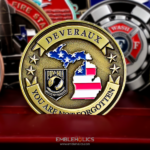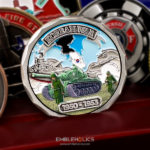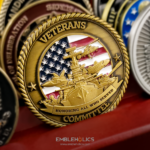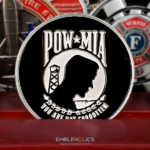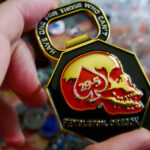
A veterans riding association coin belongs to a numbered local chapter rather than to the national organization. It is funded by the chapter’s own members, sold as often as it is given, and it usually carries artwork the chapter already owns rather than something designed from scratch.
Who Are Veteran Riding Associations?
Veteran riding organizations are national bodies made up of numbered state and local chapters, open to veterans across all branches who ride. The Combat Veterans Motorcycle Association, the American Legion Riders and the Patriot Guard are among the largest, and there are chapters in every state.
One point of language is worth getting right, because members care about it and outsiders get it wrong constantly. CVMA describes itself as an association, not a motorcycle club. The distinction is meaningful in that world, and using the organization’s own term is the first sign that whoever you are dealing with has paid attention.
Structurally these organizations work the way lodges, posts and flotillas do: a national body sets the identity, and the chapters are where the activity and the spending happen.
Why Riding Chapters Order Coins
Chapters are numbered, local and self-funded. A chapter has its own number, its own area, its own officers and its own money, raised from dues and events. That makes it the buyer, and it makes the 50-coin scale the right one rather than a national-level quantity.
Coins are frequently sold rather than given. At rallies, at chapter meetings, at charity events. For a self-funded organization a coin is both an identity object and a way of raising money for the causes the chapter supports, which means stock moves and gets reordered.
Membership turns over, so orders recur as new members come in.
And they have a calendar rather than a date. This is what separates riding associations from almost every other client in the gallery. Most organizations have one occasion a year that might justify a coin. A riding chapter has a season:
- Memorial rides, which are the core of what many of these organizations do
- Funeral escorts and honour missions
- Rallies and national or state runs
- Charity rides for veteran causes, which frequently sell coins as part of the fundraising
- Chapter anniversaries and charterings
- New member welcomes, which happen throughout the year rather than in an intake
That density of occasions is why a chapter coin is a working object rather than a commemorative one, and why it is worth designing something that will still be right in three years rather than tying it to one event.
See also an American Legion Riders chapter coin and, for the post side of the same community, Legion post coins.
Why Patch Artwork Translates Well to Coins
Here is the thing most customers get backwards, and riding associations benefit from it more than anyone.
Patch artwork usually needs less adaptation for a coin than a corporate logo does.
The reason is what a patch already has to do. A back patch is read across a car park, on a moving rider, in poor light, at an angle. That forces a particular kind of design: bold shapes, strong outlines, high contrast, a limited palette, and a silhouette that holds together at a glance. Decades of that pressure have produced a visual language built entirely out of the qualities that survive being shrunk.
A corporate logo has had the opposite pressure. It was designed to be reproduced at high resolution on a screen and a letterhead, so it can afford thin strokes, subtle gradients, tight letter spacing and detail that depends on being seen large. Every one of those is a problem at coin size.
So a chapter arriving with its existing patch artwork is usually in a better starting position than a company arriving with its brand guidelines.
What still has to change:
Colour count. Patches can carry more colours cheaply than enamel can. A palette may need consolidating, and the usual approach is to keep the colours that carry meaning and drop the ones that were shading.
Fine text. Rockers and banners on a patch can hold small lettering because thread has a texture that helps it read. Struck metal does not, so small text either grows or goes.
Anything relying on the fabric. Stitch texture, thread direction and the raised edge of an embroidered border all do work on a patch that has no equivalent in metal. Those effects have to be replaced with relief, engraving or plating rather than translated directly.
Coins made to resemble patches outright, with stitch edges and all, are a separate approach covered on our page about coins made to look like patches.
About This CVMA Coin
The Combat Veterans Motorcycle Association is an organization of combat veterans from all branches who ride, and its motto is Vets Helping Vets.
The coin is octagonal rather than round. The front carries the association’s skull device, embossed, in gold and red over a black field. The reverse carries a phoenix sculpted over a mountain, with the motto above it. The piece also works as a bottle opener.
The octagon is a well-judged choice. An eight-sided outline is unusual without being a novelty shape, so it stands out in a stack of round coins while still reading as a serious object. It also gives the design something a circle cannot: straight edges to set lettering against. Text along a flat edge sits naturally and stays readable, where the same text curved around a disc has to be distorted to follow the arc.
The two faces divide the work sensibly. The front is graphic, a bold device in three colours against black, which is patch logic applied directly to metal. The reverse is sculptural, with the phoenix modelled in relief so it catches light rather than sitting flat. One face to be recognized, one to be looked at.
For more on shapes, see our custom shapes work, and for how the opener is built into a design, see our page on bottle opener coins.
Can We Use Our Chapter’s Emblem on a Coin?
Most chapters can, but the authorization has to come from the organization rather than from us, and there is a specific point for this audience.
Chapter artwork is often owned nationally rather than locally. The colours, the logo and the association’s devices generally belong to the national organization, which licenses their use to chapters under its own rules. A chapter may therefore need national approval as well as its own officers’ agreement before putting that artwork on merchandise, and the rules around selling items carrying the emblem are frequently stricter than the rules around giving them away.
Clear it through your chapter’s officers and your national organization before you order, and send us artwork your organization is authorized to supply. We produce from what the customer provides and we do not grant permission on anyone’s behalf.
Design a Coin for Your Chapter
Send us your patch artwork or a clear photograph of it. As set out above, that is usually a strong starting point and often needs less work than people expect.
Professional artwork is free with unlimited revisions, and nothing goes into production until you approve a digital proof. Minimum quantities for bottle openers and other products differ from the challenge coin minimum, so ask when you request a quote. Standard production runs about 45 to 50 days after final artwork approval, rush production is available on many projects, and shipping within the continental United States is included. Embleholics is veteran-owned, SDVOSB and registered in SAM.gov. See more commemorative challenge coins or request a free quote.
Frequently Asked Questions
What is a veterans riding association challenge coin?
A veterans riding association challenge coin is made for a chapter of an organization such as the Combat Veterans Motorcycle Association, the American Legion Riders or the Patriot Guard. It is ordered and funded at chapter level and usually carries the chapter’s existing patch artwork.
Can an individual chapter order its own coins?
Yes, and that is how nearly all of these coins are produced. Chapters are numbered, local and self-funded, with their own officers and their own money, so the order is placed at chapter level rather than by the national organization.
Can chapters sell coins at events to raise funds?
Many do, at rallies, chapter meetings and charity rides, both to cover the order and to support the causes the chapter rides for. Check your national organization’s rules first, since restrictions on selling items carrying the association’s emblem are often stricter than on giving them away.
Can our patch artwork be used on a coin?
Yes, and patch artwork is usually a strong starting point. Provided your organization authorizes the use, send the artwork file or a clear photograph of the patch and the design can be built from it.
Does patch artwork need redrawing for a coin?
Usually less than people expect. Patch design already uses bold shapes, strong outlines and high contrast so it reads at a distance, and those are the qualities that survive at coin size. What normally changes is the colour count, small lettering, and any effect that depended on stitch texture.
Can a coin be made in an octagonal shape?
Yes. An octagon is a straightforward custom shape and a practical one, because the straight edges give you somewhere to set lettering without curving it. It also stands out among round coins without looking like a novelty item.
Can a chapter coin also work as a bottle opener?
Yes. The opener is built into the outline from the design stage rather than cut into a finished coin, so it needs to be part of the plan from the start. Shapes with a straight edge, such as an octagon, accommodate it well.
What is the minimum order for chapter coins?
Minimum quantities differ between products, and bottle openers are quoted separately from challenge coins, so ask when you request a quote. Larger quantities lower the cost per piece, which matters for chapters intending to sell coins at events.
More Veterans Projects