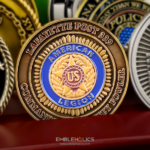
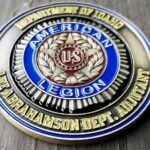
An American Legion challenge coin is almost always ordered by a single numbered post rather than by the national organization. The post pays for it out of its own funds, a volunteer officer runs the order, and the design belongs to that post rather than to the Legion as a whole.
How American Legion Posts Order Coins
The American Legion is a veterans service organization chartered by Congress, made up of local posts across the country. There are thousands of them, each with its own number, its own town and its own character, and that is the fact that matters most for anyone thinking about coins.
A post is the buyer. Not the national organization, not the department. A post with a hundred and forty members in a small town decides it wants coins, and somebody on the executive committee ends up organizing it.
The money is the members’ own. Legion posts are self-funded. A coin is paid for out of dues, out of the canteen, out of a fundraiser, or out of a line in a budget that a volunteer treasurer has to defend at a meeting. That makes quantity a genuine decision rather than an administrative one, and it is why so many posts sell coins to members rather than giving them away.
A volunteer places the order. The post commander, the adjutant, the finance officer or whoever volunteered. They are doing it alongside a job or a retirement, usually for the first time, and they will not know what they do not know. Straight answers matter more than options.
Reorders follow membership. As members join and older members pass, a post that produced a coin once tends to produce another.
The same pattern runs through the rest of the veterans service community: VFW posts, DAV chapters, AMVETS posts, Marine Corps League detachments and Vietnam Veterans of America chapters all buy this way. Membership organizations across other sectors do too, as our page on how membership organizations fund their coins describes.
What Occasions Do Posts Mark With Coins?
Post anniversaries and centenaries. The strongest occasion, and the one this coin was made for. A post chartered in a given year knows its hundredth anniversary is coming decades ahead, which makes this the most plannable coin order in existence. Fiftieth, seventy-fifth and hundredth anniversaries all get marked, and a centenary in particular tends to get a better coin than the post would normally buy, because it happens once.
Officer installations and handovers. New post commanders and adjutants, marked the same way a change of command is marked in the services.
Memorial and remembrance events. Memorial Day and Veterans Day ceremonies, and post memorial services for members who have died.
Fundraising. A coin sold at events to support post programs, which is both an identity object and a revenue item.
Recognition for long-serving members. Continuous membership milestones, and members who have carried the post for decades.
District and department conventions. Where posts meet each other, and where a good coin gets noticed by the officers of forty other posts.
Can a Post Use the American Legion Emblem?
This is the question most post officers have and almost none ask.
The American Legion is a federally chartered organization, and its name and emblem carry legal protection. The emblem is not public property and it is not free for general use, including on merchandise. A post is part of the Legion, but being part of the organization is not the same as being authorized to reproduce its emblem on a manufactured product.
Our position is the same as it is for any protected mark. We produce from artwork the customer is authorized to supply, and the authorization is the customer’s to obtain. We are a manufacturer rather than an authority on emblem use, and we do not grant permission on anyone’s behalf.
The practical advice for a post officer: check with your department before you order. Departments deal with this regularly and will tell you what is permitted and what artwork to use. It is a short phone call, and it is much better made before the die is cut than after the coins arrive.
If the answer is no, or if it takes longer than your timeline allows, a post has plenty to work with: the post number, the town, the charter year, service branch insignia and memorial imagery are all yours to use.
What Goes on a Post Challenge Coin?
The post number. The single most important element, because it is what distinguishes one post from thousands of others. It should be the largest piece of text on the coin.
The town and state. Posts are local, and the place is half the identity.
The charter or founding year. Particularly on an anniversary coin, where the two dates together tell the whole story.
The Legion emblem, where authorized per the section above.
Service branch insignia. Post memberships span every branch and several wars, and branch emblems are a common way to acknowledge that.
Memorial imagery, most often the Battlefield Cross. This is the field memorial for a fallen service member, formed from the boots, the inverted rifle and the helmet, and it is one of the most recognizable memorial symbols in American military life. Anyone in a Legion post will know it on sight, which is why it needs no explanation on the coin itself and no decoration around it.
For related work, see another Legion post coin and a Legion adjutant’s commemorative coin.
About This Post 404 Centenary Coin
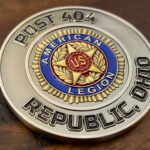
This coin was made for American Legion Post 404 of Republic, Ohio, marking one hundred years of the post.
The design is deliberately clean. No overpowering patterns, no inessential elements. The Legion emblem sits on one face and an eagle above the Battlefield Cross on the other, each encircled by bold lettering. The finish is brushed brass, with the lettering and logo painted.
The restraint is the right decision and it is worth understanding why, because it is a decision about time rather than taste. A centenary coin is made to be looked at in twenty years. It goes into a display case at the post, into members’ drawers, into the hands of people who join long after the anniversary is over. Design fashions move, and a coin loaded with texture, gradients and current styling will look dated well before it stops being handled. A coin carrying a number, a place, two dates and a memorial symbol, cleanly struck on brushed brass, will look the same in 2050 as it does now.
Brushed brass helps for the same reason. It is a finish with a long association in this community, it photographs well, and it ages without looking neglected.
For the wider category, see our commemorative challenge coins, and for coins made specifically to remember, our page on memorial and remembrance coins.
Design a Coin for Your Post
The minimum order is 50 coins, which is worth knowing up front when a post is paying from its own funds. Most posts order somewhat above it, because the cost per coin falls and because a coin that sells at post events tends to run out faster than expected.
Professional artwork is free with unlimited revisions, and nothing goes into production until you approve a digital proof. You do not need artwork to start. A photograph of the post’s charter, a sketch, or a description is enough. Standard production runs about 45 to 50 days after final artwork approval, rush production is available on many projects, and shipping within the continental United States is included. Embleholics is veteran-owned, SDVOSB and registered in SAM.gov.
Finished Coin (Front)
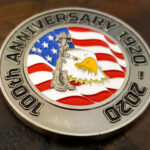
Finished Coin (Back)
Frequently Asked Questions
Can an American Legion post order its own challenge coins?
Yes, and that is how nearly all Legion coins are produced. Individual numbered posts order their own designs, funded from post money rather than from the national organization, with a volunteer post officer placing the order.
Can a post use the American Legion emblem on a coin?
The American Legion is federally chartered and its name and emblem are legally protected, so a post should check with its department before ordering rather than assuming membership grants permission. We produce from artwork the customer is authorized to supply and do not grant permission on anyone’s behalf.
What goes on a Legion post challenge coin?
A post coin usually carries the post number as the largest element, the town and state, the charter or founding year, service branch insignia, and memorial imagery such as the Battlefield Cross. The Legion emblem appears where the post is authorized to use it.
What is the Battlefield Cross?
The Battlefield Cross is the field memorial for a fallen service member, formed from a pair of boots, an inverted rifle and a helmet. It is one of the most widely recognized memorial symbols in American military life and appears frequently on veterans organization coins.
Can posts sell coins to their members to raise funds?
Yes, and many do. Selling coins at post events, meetings and ceremonies is a common way to cover the order and support post programs. Posts planning to sell usually order above the minimum, since the cost per coin falls with quantity and stock tends to move faster than expected.
Do you make coins for VFW and other veterans organizations?
Yes. VFW posts, DAV chapters, AMVETS posts, Marine Corps League detachments and other veterans service organizations order coins on the same basis as Legion posts, usually at the local chapter level and funded by the membership.
How far ahead should a post order for an anniversary?
Allow at least three months. Standard production runs about 45 to 50 days from final artwork approval, with artwork development before that, and emblem permission may take additional time. Anniversaries are known years ahead, so there is rarely a reason to leave it late.
What is the minimum order for post coins?
The minimum order for custom challenge coins is 50 coins. For a post that usually covers the active membership with some left for events and new members, and ordering somewhat above the minimum lowers the cost per coin.
More American Legion Projects