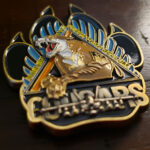
This coin is cut to the outline of a cougar’s paw, with the cougar itself machined in colored relief inside it. It was made for a Navy squadron whose nickname is the Cougars, and the shape and the artwork are doing two different jobs.
When the Coin Should Be the Animal
A great many units, departments and teams have an animal as their identity. Wolves, bears, eagles, hawks, cougars, gators, bulldogs. Sooner or later every one of them asks whether the coin can be the animal, and there are four things worth knowing before it is drawn.
A part of the animal usually beats the whole. This is the most useful rule on the page. A whole animal in profile is mostly empty space between the legs, with a tail and ears as thin projections that bend and catch on pockets. A paw, a head, a claw or a talon is compact, closed and strong. The same logic applies to birds: a single talon or a spread wing works where an entire eagle does not. For a dog’s paw used the same way, see our Police K9 Unit Challenge Coin.
The silhouette alone rarely identifies the species. A cougar’s paw and a bear’s paw are close to the same outline, and most mammal paws are. If the shape has to say which animal, either choose one with a genuinely distinctive profile or do what this coin does and let the outline say “big cat” while the artwork inside says “cougar”.
Shape and artwork should answer different questions. The outline says what kind of thing this is. The face says which one. Making both do the same job wastes one of them, which is what happens when a round coin carries a picture of an animal and nothing else.
Animals need relief, not line work. Fur, muscle and bone are forms rather than outlines. An animal drawn as a flat shape with a dark outline looks like a sticker at coin size. Sculpted, it has a brow, a jaw and a shoulder.
Animals that shape well: paws, claws, talons, heads in profile, shells, horns and fins. Animals that shape badly: anything with legs, tails, antlers or spread limbs, unless you are prepared to thicken them considerably. For the general mechanics, see custom shaped challenge coins.
Machining the Relief
The cougar on the face was illustrated and then machined as a contoured relief rather than struck flat and painted.
The difference matters for an animal more than for almost any other subject. A crest is geometry and survives being rendered flat. An animal is anatomy, and anatomy reads through light and shadow. Machining the relief gives the head actual curvature, so the brow line, the muzzle and the set of the shoulder are described by the surface rather than drawn onto it.
Color over relief works differently from a fully enameled face. On this coin the color sits in the recesses while the raised surfaces stay exposed, so the contour remains visible through the color. A fully enameled face floods the whole area and flattens the modeling underneath. That is the distinction between a colored relief and a colored coin, and it is worth specifying which you want. Our page on machined relief and color covers the options.
A Nickname Worth Building On
“VAQ-139” is a routing code. “The Cougars” is an identity. The designation belongs in the lettering and the nickname gets the shape.
If your unit has an animal nickname, that animal is almost certainly its strongest design asset. It is the element that will still mean something to a member thirty years later, long after the squadron designation has become a thing they have to explain. For more on animals as unit identity, see a mascot challenge coin.
The Squadron
VAQ-139 became operational in 1983, flying the EA-6B Prowler, and operates from Naval Air Station Whidbey Island in Washington. The squadron later transitioned to the EA-18G Growler, which it flies today.
Its mission is airborne electronic attack: degrading, disrupting and deceiving an adversary’s radar and communications so that other aircraft can operate. Whidbey Island is the home of the Navy’s electronic attack community, which is why several squadrons in that field are based there. For more on that mission and the coins made for it, see an electronic attack squadron coin, and for another Cougars piece, this squadron coin.
Order a Shaped Coin for Your Unit
Professional artwork is free with unlimited revisions, and nothing goes into production until you approve a digital proof. The challenge coin minimum is 50 pieces, standard production runs about 45 to 50 days after final artwork approval, rush production is available on many projects, and shipping within the continental United States is included. Embleholics is veteran-owned, SDVOSB and registered in SAM.gov.
Two things to bring. If your unit has an animal, tell us and we will show you which part of it makes the better outline, because the whole creature is rarely the right answer. And expect the shape and the artwork to do different jobs, since that is what makes a shaped coin read rather than simply look unusual. Request a free quote to start.
Frequently Asked Questions
What is an animal shaped challenge coin?
It is a coin cut to the outline of an animal or part of one, rather than a round coin with an animal pictured on it. This piece is cut to a cougar’s paw, with a machined relief of the cougar inside the outline, made for a squadron nicknamed the Cougars.
Can a coin be cut into the shape of an animal?
Yes, and it is one of the more effective uses of a custom outline because animals are recognized by silhouette. The practical constraint is projections: legs, tails, antlers and spread wings are fragile and catch on pockets, so a compact part of the animal usually works better than the whole.
Is a whole animal or part of one better as a coin shape?
Part of one, in almost every case. A whole animal in profile is mostly empty space between fragile projections, while a paw, head, claw or talon gives you a compact closed outline with no weak points. The same applies to birds, where a talon or a wing beats an entire eagle.
Will people recognize the animal from the shape alone?
Often not, because most mammal paws and many animal silhouettes look alike in outline. The reliable approach is to let the shape establish the general kind of animal and let the artwork inside identify the species, which is exactly how this coin works.
What is colored relief on a challenge coin?
It is sculpted relief with color applied into the recesses, leaving the raised surfaces exposed so the contour stays visible. It is different from a fully enameled face, which floods the whole area with color and flattens the modeling underneath. For animals, colored relief preserves the form.
Do thin parts like tails and ears break?
They bend rather than snap, and they catch on pocket linings, which is the more common complaint. Anything that extends past the main body of the coin needs either extra thickness or a softened profile, and that is a judgment made at the artwork stage rather than after the die is cut.
Should a unit use its nickname or its designation on a coin?
Use the nickname for the artwork and the designation for the lettering. A designation is a routing code that members eventually have to explain; a nickname is an identity that still means something decades later. If your unit has an animal nickname, that animal is usually its strongest design asset.
Does a cut-out shape cost more than a round coin?
Yes, because the outline has to be cut rather than simply struck, and an irregular profile usually needs to be specified thicker to resist bending. Packaging is also quoted separately, since standard capsules and sleeves are made for round coins.
More Navy Projects