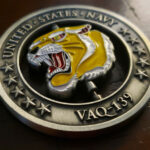
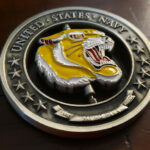
A spinner coin has a part that actually moves, which makes it a small piece of engineering rather than a design choice. This one was made for Electronic Attack Squadron 139, the Cougars, an EA-18G Growler squadron at Naval Air Station Whidbey Island, Washington. The field of the coin is cut away around a sculpted cougar’s head, and the head is mounted on pivots at the top and bottom so it turns in the centre of the frame.
How a spinner coin is built
The principle is simple and the execution is not. A spinner is two parts: an outer frame with an opening cut through it, and an inner element held in that opening by a pivot at each end so it can rotate freely.
Four things have to be right:
- The pivot points. Top and bottom, aligned on a single axis. If they are even slightly out of line the inner element binds instead of spinning, which is the most common failure.
- Clearance. The gap between the spinning element and the frame has to be wide enough that nothing catches but narrow enough that the coin does not look unfinished. That tolerance is tight and it is the part that most rewards experience.
- Frame strength. Cutting a large opening through the middle of a coin removes a lot of its rigidity. The remaining frame has to be wide enough and thick enough to hold its shape, or it flexes and the pivot alignment goes with it.
- Balance of the spinning element. A head-shaped element is heavier at one end than the other, so it will settle rather than spin freely unless the mass is managed. That is a sculpting decision made before anything is cut.
Done properly, the mechanism is invisible. On this coin the pivots sit at the top and bottom of the opening and read as part of the design rather than as hardware, which is the standard to aim for. A spinner where the pivot looks like a rivet has lost half the effect.
What a spinner costs, and when it is worth it
A spinner is among the more expensive things you can do to a coin, and the cost is in assembly rather than in metal. The frame and the inner element are produced separately and then assembled by hand, one coin at a time. That is a per-coin labour cost that does not improve much with volume, unlike die work.
It is worth it when the movement means something. A squadron mascot that turns to face you, a propeller or rotor that spins, a compass rose, a globe: these use the mechanism to say something. A spinner added because it is impressive, with nothing in the design that benefits from turning, is paying a lot for a gimmick.
It is not the right choice for every audience. A spinner is a conversation piece and reads as such, which suits a squadron, a mess or a recruiting command. For a formal presentation coin given to very senior officers or foreign counterparts, the same budget is usually better spent on weight, two-tone plating and proper packaging.
Other moving and interactive coins
Spinners are the best known but not the only option. If the idea of movement appeals, these are the alternatives and roughly where they sit on cost.
- Cutouts. No moving parts, but light passes through and the opening becomes part of the design. Much cheaper than a spinner and still distinctive.
- Multi-piece coins. Two or more pieces that fit together or separate, sometimes split between people. Assembly cost similar to a spinner.
- Bottle openers. The most common functional coin, and the cheapest, since it is a shape in the die rather than an assembly.
- Dangles and attachments. A smaller element hung from the main coin. Adds a little movement for a modest cost.
If you want movement on a budget, a cutout gives most of the visual interest for a fraction of the price. If you want the thing to actually turn, nothing substitutes for a spinner.
About the squadron
Electronic Attack Squadron 139, the Cougars, is based at Naval Air Station Whidbey Island, Washington, and flies the EA-18G Growler on electronic attack missions. The squadron became operational on 1 July 1983, originally flying the EA-6B Prowler, and transitioned to the Growler as the Prowler left service. Its earlier operational history includes missions in the Arabian Gulf and contingency planning in the lead-up to Operation Desert Storm.
The cougar head is the reason this coin works. A spinner needs an inner element that is worth looking at from both sides and that reads instantly at small size, and a strong animal head is close to ideal. A squadron whose mascot is an abstract device or a long name would have had a harder time justifying the mechanism.
Whidbey Island is close to us. Embleholics is a veteran-owned shop in Port Orchard, Washington, and the Whidbey squadrons are regional neighbours, so a good share of our naval aviation work comes from that community.
Ordering a spinner coin
Tell us what you want to spin and why. If the answer is a mascot head, a rotor, a compass or anything else that gains from turning, a spinner is a good investment. If it is just for effect, we will say so and suggest a cutout instead, which costs far less and looks nearly as striking. Quantities matter more than usual here, because the assembly is per coin, so give us a realistic number early. You can see more Navy challenge coins, including the other VAQ-139 coin we produced, or send your artwork through the free quote form.
Finished Coin (Front)
Finished Coin (Back)
Frequently Asked Questions
What is a spinner challenge coin?
A spinner coin has an inner element mounted on pivots inside an opening cut through the coin, so that part physically rotates. It is built as two pieces, a frame and a spinning element, assembled by hand. Done well the pivots read as part of the design rather than as visible hardware.
Why do spinner coins cost more?
Because the cost is in assembly rather than in metal or die work. The frame and the inner element are produced separately and then put together one coin at a time, which is a per-coin labour charge that does not fall much with volume the way tooling costs do. Give us a realistic quantity early, since it affects the quote more than it would on a standard coin.
What makes a spinner fail?
Pivot misalignment, most often. If the top and bottom pivots are even slightly off a single axis the inner element binds rather than turning. The other causes are too little clearance between the element and the frame, a frame left too narrow or thin to stay rigid once a large opening is cut through it, and an unbalanced spinning element that settles instead of spinning.
When is a spinner worth it?
When the movement means something. A mascot head that turns to face you, a rotor, a propeller, a compass rose or a globe all use the mechanism to say something. A spinner added purely because it is impressive, where nothing in the design benefits from turning, is an expensive gimmick.
Is a spinner right for a formal presentation coin?
Usually not. A spinner is a conversation piece and reads as one, which suits a squadron, a mess or a recruiting command very well. For a coin presented to senior officers or foreign counterparts, the same budget generally does more spent on weight, two-tone plating and proper packaging.
What are the cheaper alternatives to a spinner?
A cutout gives most of the visual interest for a fraction of the cost, since light passes through the opening and the shape becomes part of the design with no assembly involved. Bottle openers are cheaper still, because they are a shape in the die rather than an assembly. Dangles and attachments add a little movement for a modest cost, while multi-piece coins sit at similar cost to a spinner.
What is VAQ-139?
Electronic Attack Squadron 139, nicknamed the Cougars, is a US Navy squadron at Naval Air Station Whidbey Island, Washington, flying the EA-18G Growler on electronic attack missions. It became operational on 1 July 1983 flying the EA-6B Prowler and transitioned to the Growler as the Prowler left service.
More Navy Projects