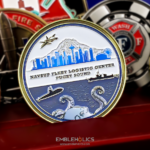
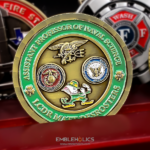
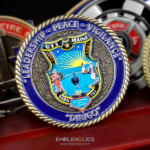
The crew wanted to commemorate one specific thing: the ship’s first arrival in Japanese waters on her maiden deployment. A Japanese torii gate is engraved on one side to mark it. The rest of the coin carries a great many detailed reliefs and graphic elements, including small ones that needed precise designing and machining. It was made for the ship’s Chief Petty Officer’s Mess.
Marking a Port Visit on a Coin
Deployment coins are common. A coin marking one arrival is a narrower idea and often a better one.
A port visit is a specific memory. A deployment is months long and hard to put on a coin without resorting to dates. An arrival is a single moment everybody aboard shares, and it has an image attached to it: the coastline, the harbor, the first thing people saw.
A local symbol does it in one element. A torii gate says Japan to anyone, without a word of text, a map or a flag. Choosing the symbol the host country uses for itself is more effective than naming the place.
A first visit outranks a routine one. A maiden deployment or a first call at a port is a one-time event for the ship, which makes it worth a coin where the fifth visit would not be.
And it fixes the coin in time without a date. The event is specific, so the coin records it, but the design does not have to carry a year to do so. That matters if the piece will be issued over a period rather than handed out once. See When to Order Coins for a Deployment or Change of Command.
The same idea works for any posting with a recognizable local symbol: a torii, a castle, a bridge, a mountain, a distinctive skyline. See also an embassy challenge coin, which leads with the host nation’s own visual language.
Engraving a Torii Gate
A torii is one of the better architectural subjects for a coin, and the reasons are structural.
It is almost pure silhouette. Two uprights, a curved upper lintel and a straight lower one. There is no surface detail to lose, which means it reproduces at any size without simplification.
The proportions are what make it recognizable. The overhang of the top rail beyond the posts, and the curve of it, are the features people read. Get those right and nothing else matters; get them wrong and it reads as a goalpost.
It frames whatever sits behind it. A torii is an opening, so anything placed within it is deliberately framed. That is a useful compositional device and it is why the gate works better with something behind it than standing alone.
And engraving suits it better than relief. A torii is a structure of straight and curved lines, which is what recessed line work produces. Sculpting it in relief tends to make it look like a model rather than a gate.
One note of care. A torii marks the entrance to a shrine and carries religious meaning in Japan. Using it to commemorate a visit is ordinary and respectful; it is worth being deliberate rather than treating it as a generic Japan icon.
A Lot of Detail on a Small Surface
The brief asked for a one of a kind coin with a lot of details and elements, including small ones. That is the hardest instruction to execute and the page is honest about it: the small elements needed precise designing as well as precise machining.
Four things keep a dense coin readable.
A size hierarchy. If every element is the same size nothing leads and the eye has nowhere to start. One element has to be clearly dominant, with the rest clearly secondary.
Separation rather than reduction. When elements compete the instinct is to shrink them. The better fix is to move them apart, because a small detailed device is worse than a larger one with space around it.
Simplify the worst offenders. Some internal detail will not survive the strike whatever you do. Deciding which lines to drop is better than keeping them all and letting the die decide.
And proof at actual size. A design this dense can read beautifully at full screen and turn to noise at an inch and a half. That is exactly what the proof stage exists to catch.
A Chiefs Mess Coin on a Small Ship
The coin belongs to the CPO Mess, the lounge for the ship’s roughly fifteen chiefs, situated directly aft of the Bosun’s Locker and the Forward Enlisted Head.
Fifteen chiefs is a small mess, and that changes the arithmetic in a useful way. A 50 piece minimum covers the mess three times over, which means the surplus is the point: coins for chiefs who rotate through over the following years, and coins to present to visitors and counterparts from other ships. A mess coin on a small ship is mostly a presentation piece by volume, even though it belongs to the mess.
See also a chiefs mess challenge coin on a carrier, and a submarine chiefs mess coin.
About the Ship
USS Miguel Keith (ESB-5) is a Lewis B. Puller-class expeditionary mobile base. She was originally in service with a USNS prefix and later commissioned, as her sister ships were, so that combatant commanders would have greater operational flexibility with the ESBs under the laws of armed conflict. As of late 2021 she was one of three such ships in service.
On her maiden deployment to the United States 7th Fleet she left Hawaii and anchored off the Japanese coast near Nagasaki, at the US naval base in Sasebo. That arrival is what the torii commemorates.
Order a Deployment or Port Visit Coin
Professional artwork is free with unlimited revisions, and nothing goes into production until you approve a digital proof. The challenge coin minimum is 50 pieces, standard production runs about 45 to 50 days after final artwork approval, rush production is available on many projects, and shipping within the continental United States is included. Embleholics is veteran-owned, SDVOSB and registered in SAM.gov.
Two suggestions. If you want to mark a place, choose the symbol that country or city uses for itself rather than a flag or a map, because a local landmark says it in one element and says it better. And if the design is dense, judge the proof at actual coin size rather than enlarged on screen, since that is the only way to know whether the small elements actually read. Request a free quote to begin.
Frequently Asked Questions
What is a port visit challenge coin?
It is a coin marking a ship’s arrival at a particular place rather than a whole deployment. A port call is a single shared moment with an image attached to it, which makes it a sharper coin subject than months at sea.
Why mark one arrival rather than the deployment?
Because a deployment is hard to depict without resorting to dates, where an arrival has a recognizable local symbol available. A first visit or maiden deployment is also a one-time event, which a routine port call is not.
How do you show a country on a coin?
With the symbol that country uses for itself rather than a flag or a map. A torii gate, a castle, a bridge or a distinctive skyline all say the place in one element and say it more memorably than naming it.
Does a torii gate reproduce well in metal?
Very well. It is almost pure silhouette, with two uprights and two rails and no surface detail to lose. The proportions matter, though: the overhang and curve of the top rail are what make it read as a torii rather than a goalpost.
Should a torii be engraved or sculpted?
Engraved. It is a structure of straight and curved lines, which is what recessed line work produces. Sculpting it in relief tends to make it look like a scale model rather than a gate.
How much detail can one coin carry?
More than people expect, with a size hierarchy. One element has to dominate and the rest be clearly secondary, elements that compete should be moved apart rather than shrunk, and some internal detail has to be dropped deliberately rather than left to the die.
How should a dense design be proofed?
At actual coin size, not enlarged on a screen. A busy design can read beautifully at full screen and turn to noise at an inch and a half, and catching that is what the proof stage is for.
Is 50 coins too many for a small mess?
No, the surplus is useful. A mess of fifteen gets coins for members who rotate through over following years and a stock to present to visitors and counterparts from other ships, which is most of what a small ship’s mess coin is used for.
More Navy Projects