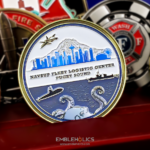
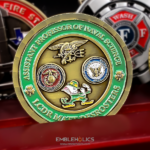
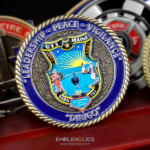
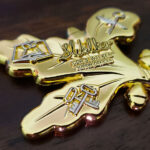
This coin from USS Abraham Lincoln is not a ship coin. It was made for one of the carrier’s supply officers and it is cut to the shape of a gold oak leaf, which is the device of the Navy Supply Corps. That makes it a different kind of object from a hull-and-motto ship coin, and it brings a question with it that is worth getting right, because in the Navy a gold oak leaf means two separate things.
This Is an Insignia, Not a Ship Coin
Coins shaped like a rank or corps device belong to a person rather than to a command. They are given on a promotion, at a change of duty, on leaving a ship, or simply as a department’s coin for the people in that specialty.
The shape does the identifying, which means the design can skip almost everything a unit coin needs. No hull profile, no unit number, no mission statement. Anyone in the Navy reads an oak leaf immediately. What the coin still has to do is say where it came from, and on an insignia-shaped piece that goes on the reverse, because the front has no flat field to spare.
What a Gold Oak Leaf Means in the Navy
Two things, and that is the whole of the problem.
It is the Navy Supply Corps device. The corps insignia is an oak leaf sprig of three leaves and three acorns gathered at the stem. Its history runs back a long way: pursers wore an embroidered cornucopia in 1830, which became gold embroidered oak leaves and acorns in 1841, then a silver oak sprig in 1864, and the pattern was refined in 1905. It became gold rather than silver in 1919, which is why a Supply Corps oak leaf is gold today.
It is also a rank insignia. A gold oak leaf is the rank device of a Lieutenant Commander, and a silver oak leaf is the rank device of a Commander. The same convention applies across the services, where gold is a Major and silver a Lieutenant Colonel.
So a gold oak leaf on a Navy officer can mean the corps they serve in or the rank they hold, and nothing about the leaf itself tells you which.
Which Oak Leaf You Want
This is the practical consequence, and it is a one-line decision that changes what the coin says.
For the Supply Corps, use the sprig. Three leaves, three acorns, joined at the stem. The acorns are what make it unmistakably the corps device rather than a rank device, and leaving them off is the most common way this design goes wrong.
For rank, use the single plain leaf. One leaf, no acorns, in gold for a Lieutenant Commander or silver for a Commander.
If the coin is meant to mark both, which is often the case for a supply officer being promoted, say so, because the usual answer is the corps sprig as the coin’s outline with the rank indicated on the reverse rather than trying to make one shape carry both meanings.
Shaping a Coin Like an Insignia
Insignia are unusually good source material for a coin outline, and for a reason worth knowing: they were designed to work small. A device meant to sit on a collar has already been through the process of being reduced until only the essential shapes survive, which is the same process a coin design has to go through. Most artwork has to be simplified for a coin. An insignia arrives pre-simplified.
Three things still need attention.
A coin is bigger than the insignia. A collar device is around an inch. A coin is often larger, and a shape designed for one inch can look sparse when it is blown up, so an insignia-shaped coin usually needs texture, veining or a border that the real device does not have.
Leaves and stems are thin. A leaf has a pointed tip and a narrow stem, and the notches between lobes are inside corners. Radius every inside curve, thicken the stem, and keep the tip from coming to a true point.
There is no flat field. An organic outline leaves nowhere comfortable for a block of text, which is why the ship name, the inscription and any date belong on the reverse. See custom shaped challenge coins.
When Plating Is Information
On most coins the metal is a style decision. On this one it is content.
The Supply Corps device is gold because the corps changed it from silver to gold in 1919, and a gold oak leaf is a Lieutenant Commander where a silver one is a Commander. Plate this coin in silver and you have not given it a different look, you have changed what it says about the person holding it.
That is the same principle that governs color on a coin. Where a device has an official color, the finish is carrying information and cannot be chosen for appearance. Where it does not, the finish is free. Insignia, flags, ribbons and corps devices fall in the first group, and almost everything else falls in the second. See challenge coin plating options.
A Coin for One Officer
A piece made for an individual runs into the minimum order, which is 50 coins. Three routes work.
The department orders them as its own coin, so the supply department has a coin and the officer being recognized gets the first one. The order is combined with another run for the same command. Or the minimum is simply accepted, because a coin like this gets given away steadily over the years rather than sitting in a drawer.
About USS Abraham Lincoln
USS Abraham Lincoln (CVN 72) is the fifth Nimitz-class aircraft carrier, built at Newport News Shipbuilding, launched on 13 February 1988 and commissioned on 11 November 1989. She is the third United States Navy ship named for Abraham Lincoln, her nickname is Abe, and her motto is Shall Not Perish, taken from the closing line of the Gettysburg Address.
That motto is worth noting for anyone designing a coin from this ship. A namesake whose own words supply the motto gives you an inscription with real weight behind it, and it needs no explanation to anybody. See a USS Nimitz coin, a Supply Corps coin, or a Navy supply challenge coin.
Order an Insignia-Shaped Coin
Tell us which device you want the coin cut to, and whether it represents a corps, a rank or both. Say what should go on the reverse, because on an insignia shape that is where all the text lives.
Professional artwork is free with unlimited revisions, the minimum order is 50 coins, and nothing goes into production until you approve a digital proof. Standard production runs about 45 to 50 days after final artwork approval, rush production is available on many projects, and shipping within the continental United States is included. Embleholics is veteran-owned, SDVOSB and registered in SAM.gov. See more Navy challenge coins.
Finished Coin (Front)
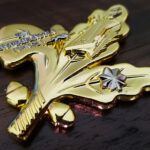
Finished Coin (Back)
Frequently Asked Questions
What does the oak leaf mean in the Navy Supply Corps?
The Navy Supply Corps device is an oak leaf sprig of three leaves and three acorns joined at the stem. Its line of descent runs from the cornucopia worn by pursers in 1830, through gold embroidered oak leaves and acorns in 1841 and a silver oak sprig in 1864, to the pattern refined in 1905, which became gold rather than silver in 1919.
What rank does a gold oak leaf indicate?
In the Navy a gold oak leaf is the rank device of a Lieutenant Commander and a silver oak leaf is the rank device of a Commander. The same convention runs across the other services, where a gold oak leaf is a Major and a silver one a Lieutenant Colonel.
How do you tell a Supply Corps oak leaf from a rank oak leaf?
By the acorns. The Supply Corps device is a sprig of three leaves with three acorns gathered at the stem, while the rank device is a single plain leaf with no acorns. On a coin shaped like an oak leaf, including the acorns is what makes it unmistakably the corps device, and leaving them off is the most common error.
Can a challenge coin be shaped like a rank or corps insignia?
Yes, and insignia make unusually good coin outlines because they were designed to work at small size and have already been simplified down to their essential shapes. Watch the thin sections: radius the inside curves between lobes, thicken any stem, and avoid a true point at the tip.
Why does an insignia-shaped coin need the text on the reverse?
Because an organic outline leaves no flat field on the front. A leaf, a wreath or a winged device has no comfortable block of space for lettering, so the command name, the inscription and any date go on the back, where the surface is uninterrupted.
Why does plating color matter on an insignia coin?
Because the metal is carrying information rather than style. A gold oak leaf and a silver oak leaf mean different ranks, and the Supply Corps device is specifically gold. Plating the coin in the other metal does not change its appearance so much as change what it says. The same rule applies to any device with an official color, including flags, ribbons and corps insignia.
What is USS Abraham Lincoln’s motto?
Shall Not Perish, taken from the closing line of Abraham Lincoln’s Gettysburg Address. The carrier’s nickname is Abe.
How many US Navy ships have been named Abraham Lincoln?
CVN 72 is the third United States Navy ship to carry the name. She is the fifth Nimitz-class aircraft carrier, launched on 13 February 1988 and commissioned on 11 November 1989 at Newport News Shipbuilding.
More Navy Projects