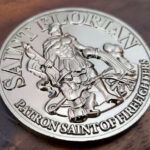
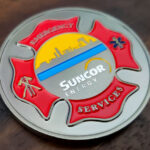
An industrial fire brigade is an emergency response team employed by a plant, refinery, or site rather than by a town, and its coins sit in a different place from a municipal department’s. This one was made for Suncor Energy’s Emergency Services, the response organization at the Canadian energy company’s own facilities. The brief asked for something classic that read as a real coin: Saint Florian engraved in relief on the front, the company insignia in color on the back, and a polished metal finish everywhere else.
A plant brigade is not a fire department, and the coin shows it
The identity problem is specific to industrial response, and it shapes the design. A municipal firefighter’s coin has an obvious vocabulary to draw on: the department crest, the city seal, the engine number, the station. An industrial brigade has none of those. What it has instead is a corporate employer whose logo was designed for annual reports and fuel stations, not for a recognition piece handed to someone who fights fires for a living.
The solution most industrial brigades land on is to split the two. One face belongs to the trade and one to the employer. On this coin the trade takes the front, through Saint Florian, and the company insignia takes the back. That ordering matters: a coin that leads with the corporate logo reads as company merchandise, and a coin that leads with the trade reads as recognition. The same elements in the other order produce a noticeably different object.
Keep the corporate brand rules in view. Company logos usually come with a brand standard that specifies colors, clear space, and what may not be done to the mark. A coin is an unusual enough application that most brand guides do not cover it, so it is worth getting the communications or brand team to sign off on the reverse before striking rather than after. This is the step industrial orders skip most often.
Saint Florian, and the cross everyone calls Maltese
Saint Florian is the patron saint of firefighters, and the most widely recognized emblem in the trade after the cross itself. He was a Roman army officer who died around 304 AD, and he is traditionally shown in Roman military dress pouring water from a jug onto a burning building. That iconography is why he works so well on a coin: the figure, the vessel, and the water are a complete scene that needs no caption, and it carries across both municipal and industrial response.
The eight-pointed cross on fire service badges is usually called a Maltese cross, and it is more accurately a Florian cross. The two are related but not identical: the Maltese cross has straight arms meeting at points, while the version on most fire department insignia has curved, scalloped arms. Nobody in the fire service will object to either name, but if a design calls for the badge cross specifically, it is worth knowing which shape is actually being asked for, because the two look clearly different at coin size.
Saint Florian in relief needs depth rather than line work. A figure with drapery, armor, and a water jug has a lot of internal detail, and at coin size that detail has to come from sculpted planes, not engraved lines. Engraved lines at that scale fill with polish compound and disappear. We cover related ground on the Fireman’s Prayer coin, where the problem is text volume rather than figure detail.
What industrial brigades use coins for
The uses overlap with municipal departments but not completely. Certification and qualification milestones are more prominent, because industrial response involves site-specific training that municipal departments do not run. Mutual aid recognition is also common, since plant brigades work alongside the local municipal department and often want something to exchange with them.
- Certification and qualification coins, marking completion of site-specific or specialist training such as confined space, hazardous materials, or industrial firefighting qualifications.
- Mutual aid coins, exchanged with the municipal departments and neighboring plant brigades a site responds alongside.
- Years of service and retirement coins, which in an industrial setting often span a career at one site.
- Incident coins, marking a specific response. These need the same care as any dated piece, and the same caution about naming individuals.
A note on ordering from outside the United States
If your site is in Canada or elsewhere, raise it in the first message. Our free shipping offer applies within the United States, so an order shipping across a border is quoted differently and may involve customs paperwork. None of that is an obstacle, and we have produced coins for clients outside the US, but it is better established at the quote stage than discovered at the end. Ask us and we will set out the shipping cost and timeline with the rest of the quote.
Ordering a brigade coin
Bring the brigade or company insignia, a decision on which face leads, and confirmation that the brand team is comfortable with the logo on a coin. If you want Saint Florian or a Florian cross, tell us the size you have in mind, because figure detail and cross arm shape both depend on it. We will show both faces at actual size before anything is struck. You can see more firefighter challenge coins we have produced, including the Chicago Fire Department coin, or send artwork through the free quote form.
Finished Coin (Front)
Finished Coin (Back)
Frequently Asked Questions
What is an industrial fire brigade challenge coin?
It is a recognition coin for an emergency response team employed by a plant, refinery, or industrial site rather than by a municipality. The design challenge is specific: an industrial brigade has no city seal, department crest, or station number to draw on, only a corporate employer’s logo, so the coin usually combines a trade emblem with the company mark.
Should the company logo go on the front or the back?
The back, in almost every case. A coin that leads with the corporate logo reads as company merchandise; one that leads with a trade emblem such as Saint Florian or a Florian cross reads as recognition of the work. The same two elements in the opposite order produce a noticeably different object, and the people receiving it notice.
Who is Saint Florian and why is he on firefighter coins?
Saint Florian is the patron saint of firefighters, a Roman army officer who died around 304 AD. He is traditionally depicted in Roman military dress pouring water from a jug onto a burning building, which makes a complete and instantly readable scene at coin size. He is used across both municipal and industrial fire service insignia.
Is the fire service cross a Maltese cross or a Florian cross?
Technically a Florian cross, though almost everyone calls it Maltese. A true Maltese cross has straight arms meeting at points; the version on most fire department badges has curved, scalloped arms. The names are used interchangeably in the fire service, but the two shapes look clearly different at coin size, so it is worth confirming which one a design actually calls for.
Do we need brand approval to put our company logo on a coin?
Usually yes, and it is the step industrial orders most often skip. Corporate brand standards specify colors, clear space, and permitted treatments of the mark, and a challenge coin is an unusual enough application that most brand guides do not address it directly. Getting the communications or brand team to sign off on the reverse before striking avoids a reprint.
What do industrial brigades use coins for?
Certification and qualification milestones are the most common, covering site-specific training such as confined space, hazardous materials, and industrial firefighting. Mutual aid coins for exchange with the local municipal department and neighboring plant brigades are also widespread, along with years of service, retirement, and incident coins.
Can you ship coins outside the United States?
Yes, though it is quoted differently. Our free shipping offer covers the United States, so an international order carries a shipping cost and may involve customs paperwork. Mention your location in your first message and we will include the shipping cost and timeline in the quote rather than raising it at the end.
How much detail can a figure like Saint Florian hold on a coin?
More than you would expect, but only if the detail is sculpted rather than engraved. Drapery, armor, and the water jug have to be built from relief at different depths so light defines them. Fine engraved lines at coin scale fill with polishing compound and vanish, which is why a figure that looks good as line art often needs redrawing before it can be struck.
More Firefighters Projects