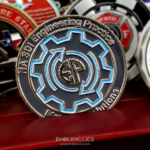
This coin marks a specific numbered engine build rather than a program or a team. It was made for an aerospace client who asked for a classic, vintage treatment instead of the modern styling they normally use, which is the most interesting decision on the piece.
A Coin for One Serial Number
Most commemorative coins mark something broad: a unit, a deployment, a year, a milestone. This one marks one object, identified by its number.
That is a distinct category and it suits engineering organizations better than almost anyone, because engineering runs on serial numbers. A specific airframe, a specific engine, a specific vehicle, a specific build. The number is how the people who worked on it refer to it, and it is frequently more meaningful to them than the program name.
Three things make a serial-number coin work:
The number has to be legible and prominent. It is the whole point of the piece. On a coin marking a program the designation can be supporting text; on a coin marking one build it is the subject.
The run matches the team, not the organization. The people who built that specific unit are a defined group, often a few dozen, which puts the order near the minimum rather than above it.
And it dates itself deliberately. A program coin tries to stay current. A build coin is fixed to one moment, which is why a traditional treatment suits it better than a contemporary one.
If you want the coins themselves individually numbered as well, that is a separate option covered on our page about numbered challenge coins.
Why a Cutting Edge Client Asked for Vintage
This is the part worth the page. The client normally works in a modern visual language, and for this coin they asked for something classic instead.
That looks like a contradiction and it is not.
A commemorative object is not a brand asset. A company’s design system exists to make it look current, which is the right ambition for a product and the wrong one for a keepsake. A coin marking a build will be in someone’s drawer in thirty years, and the contemporary styling of any given year ages faster than anything else about it.
Traditional coin design has conventions holding it up. A rim, a border, a centered device, serif lettering and a struck relief have been refined over centuries, and they produce an object that reads as substantial without needing to be clever. A contemporary graphic treatment has to carry itself on composition alone, and the common failure is a coin that looks like a slide from a presentation.
And the contrast is itself the statement. A traditionally styled coin marking a piece of genuinely advanced hardware says this work belongs in a long line of engineering rather than standing outside it. For a company whose subject is the future, borrowing the visual language of the past is a confident move rather than a timid one. For a full-color modern SpaceX design, see our Crew Dragon Demo-2 Coin and SpaceX Starlink 10 Coin.
Our other work for the same client goes the other way, and the comparison is instructive. See a minimalist coin design and an engine milestone coin.
Gold and Enamel
The base is a shiny gold-colored plating with enamel color applied for the imagery.
Gold is the obvious choice for a classic treatment and the easiest to get wrong. A broad flat area of gold plating reflects light evenly and reads as thin, which is the opposite of the intended effect. The same plating broken up by relief, by recessed enamel and by a bordered rim reads as substantial. The plating has not changed; the geometry has.
Enamel over gold also needs its colors chosen with the metal in mind. Warm tones sit close to the gold and lose separation from it, while cooler colors hold their own against it. That is a palette decision rather than an artwork one, and it is worth settling before the design is finalized rather than discovering it on the proof. Our page on plating and enamel options sets out the combinations.
What the Engine Is
The Raptor is the engine family SpaceX developed for its Super Heavy booster and Starship vehicle. It burns methane with liquid oxygen, and it uses full-flow staged combustion, a cycle that had been studied for decades before it reached operational flight.
SN1100 identifies one unit within that production line. For the people who built it, that number is the project. See more of our SpaceX work.
Order an Aerospace Coin
Professional artwork is free with unlimited revisions, and nothing goes into production until you approve a digital proof. The challenge coin minimum is 50 pieces, standard production runs about 45 to 50 days after final artwork approval, rush production is available on many projects, and shipping within the continental United States is included. Embleholics is veteran-owned, SDVOSB and registered in SAM.gov.
Two things worth deciding early. Whether the coin marks a program or a specific build, because that changes both the run size and what takes the center of the design. And whether you want contemporary or traditional styling, since a keepsake and a brand asset are not the same object and the right answer is often not the one in your design system. See more corporate challenge coins.
Coin Front

Coin Back

Frequently Asked Questions
What is an aerospace challenge coin?
It is a custom coin made for an aerospace company, program or engineering team, marking a vehicle, an engine, a launch or a build. Aerospace organizations order them frequently, often for a specific numbered piece of hardware rather than for the program as a whole.
Can a coin mark one specific build or serial number?
Yes, and it suits engineering teams particularly well, because a serial number is how the people who built something refer to it. The number needs to be prominent rather than supporting, and the run is usually sized to the build team rather than the organization.
Should a coin match our brand’s design system?
Not always, and this is worth thinking about. A design system exists to make a company look current, which is right for a product and wrong for a keepsake that will sit in a drawer for thirty years. Contemporary styling ages faster than anything else about a coin.
Why would a modern company choose a vintage coin design?
Because traditional coin design has conventions holding it up. A rim, a border, a centered device and struck relief produce an object that reads as substantial without having to be clever. A contemporary graphic treatment has to carry itself on composition alone, and the usual failure is a coin that looks like a presentation slide.
How do you stop a gold coin looking cheap?
Break the gold up with relief, recessed enamel and a bordered rim rather than leaving broad flat areas of plating. Flat gold reflects evenly and reads as thin; the same plating over sculpted geometry reads as solid. The finish is identical and only the surface shape changes.
Which enamel colors work over gold plating?
Cooler colors hold their separation from gold, while warm tones sit close to it and lose definition. It is a palette decision worth settling before the artwork is finalized, since a color that looked distinct on screen can merge with the metal on the finished piece.
Can the coins themselves be individually numbered?
Yes, that is a separate option from marking a numbered build. Individual serialization is applied after striking and lets each coin carry its own number, which suits limited runs where the pieces are allocated to named recipients.
How many coins would a build team order?
Usually near the 50-piece minimum, since the people who worked on one specific unit are a defined group rather than a whole organization. Ordering somewhat above the team size is normal, to cover later additions and a few retained for the record.
More Corporate Projects