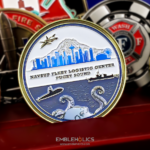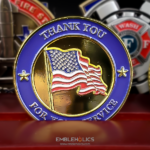
A deployment challenge coin marks a named operation or a unit’s tour. It is usually ordered before the unit redeploys and given to everyone who served on it, including attached personnel who came from somewhere else.
Why Units Order Coins for a Deployment
A deployment is one of the few things in military service with a hard beginning, a hard end and a fixed group of people in between. That is exactly the shape an object needs in order to mean something later.
Ribbons and awards mark service, but they follow rules about who qualifies. A coin does not. It can go to the augmentee who arrived for four months, the civilian who worked alongside the unit, the interpreter, the contractor, the liaison from another service. Anyone who was there can be given one, and on a deployment that is usually a wider group than any award covers.
The other reason is dispersal. A unit that deploys together does not come home and stay together. People rotate, transfer, separate and retire, and within two years the group that shared the tour no longer exists in one place. The coin is issued while everyone is still in the same location, and it is what survives afterwards.
The timing is the practical point, and it catches people out. Deployment coins are usually ordered during the deployment, not after it, because they have to be in hand for presentation before everyone scatters. That means the order is frequently placed from downrange, against a redeployment date that may move, and lead time becomes the constraint rather than the design. If you are planning one, work backwards from the date the unit leaves theatre rather than the date it gets home.
What Occasions Do Deployment Coins Mark?
- Pre-deployment and send-off. Ordered before the unit leaves, sometimes given at a family send-off event.
- End of tour. The most common, presented in theatre before redeployment.
- Homecoming and redeployment. Given after return, often at a unit event with families present.
- Task force stand-up. Marking the formation of a task force assembled from several units.
- Task force disestablishment. Marking the end, usually with the dates of the whole period.
- Mid-tour recognition. Commanders’ coins given during the deployment rather than at the end of it.
- Augmentees and attached elements. Coins for people who deployed away from their parent unit and would otherwise have nothing from the tour.
Other named operation coins in the gallery include another named operation coin and Horn of Africa deployment coins.
What Is Operation Inherent Resolve?
Operation Inherent Resolve was the military campaign of the US-led Global Coalition to Defeat ISIS, launched in 2014 at the request of the Iraqi government. Its military component was the Combined Joint Task Force, drawing contributions from more than thirty nations.
The coalition’s military mission in Iraq concluded in September 2025, transitioning to a bilateral security partnership.
The coin on this page was made during the operation, for a unit deployed on it.
What Goes on a Deployment or Operation Coin?
Deployment coins have a recognizable design vocabulary, and most of it exists to answer the same question: who, where and when.
The operation name and emblem usually carry the front, with unit and task force insignia alongside. Country and regional maps appear constantly, because geography is the shorthand for where the tour happened and it reads instantly.
Dates matter more here than on any other kind of coin. A unit coin is timeless; a deployment coin is specifically about a period, and the months or years of the tour are often the element people look for first when they pick one up years later.
Mottos, callsigns and coalition flags where authorized fill the reverse. Finishes run subdued and antiqued rather than bright, matching the equipment and the setting rather than a ceremony.
About This Operation Inherent Resolve Coin
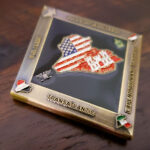
This coin was ordered by an Army Corps of Engineers unit deployed on the operation, and the format they asked for is the most interesting thing in the gallery.
They wanted a rectangular coin built like a picture frame: the design carried entirely on the border, with the centre treated as the opening.
That is a genuinely good idea, and it is worth saying why. A frame is what you put a photograph of people in. A deployment coin is about the people you deployed with. The format makes the point without a word of explanation, and it is the sort of thing a customer arrives at rather than a designer proposes.
It is also harder to make than a round coin, for two reasons that compound.
A rectangle has corners. A circle is forgiving because the eye has no reference for where the curve should sit. Four right angles and four straight edges are shapes everybody already knows, so any inconsistency in a corner radius or an edge line is immediately visible.
A border design has to read as a ring. On a normal coin, elements sit in a field and the eye moves inward to a centre. On this one there is no centre, so every element has to work in sequence around a loop, holding its own weight while leading to the next. The insignia and the map of Iraq had to be balanced against each other around the frame rather than arranged within it.
Coins for Engineers, Logisticians and Support Elements
The client here was an engineer unit, which is worth pointing out because coin marketing rarely acknowledges that these units exist.
Engineers, logisticians, medical personnel, signal, contracting, transportation and civilian staff deploy on the same operations as combat units, for the same length of time, under the same conditions. They come home with the same tour behind them. Almost every coin site writes as though a deployment is an infantry experience.
These units order coins on the same cycle and for the same reasons, and they often care more about the design carrying their own branch identity, precisely because it usually gets left out. Our gallery includes Army engineer coins alongside joint and coalition command coins and the wider range of custom Army challenge coins.
Design a Coin for Your Deployment
Artwork is free and revisions are unlimited, which matters when the approving officer is in a different time zone and reviewing proofs between other things.
Rush production is available, and this is the case where it matters most. Redeployment dates move, and a coin that arrives after the unit has dispersed has missed its purpose entirely. Tell us the date the unit leaves theatre when you get in touch, not the date it gets home, and we will tell you honestly whether it can be made.
Orders start at 50 coins, shipping within the continental United States is included, and most orders are complete in 45 to 50 days after artwork approval.
Embleholics is veteran-owned, based in Port Orchard, Washington, and registered in SAM as a Service-Disabled Veteran-Owned Small Business under UEI F3AGRUW5RT53. Request a quote and you will hear back within 24 hours.
Frequently Asked Questions
What is a deployment challenge coin?
A deployment challenge coin marks a named operation or a unit’s tour. It usually carries the operation name, unit insignia, a map of the region and the dates of the deployment, and is given to everyone who served on it.
When do units usually order deployment coins?
Usually during the deployment rather than after it, so the coins are in hand for presentation before the unit disperses. Orders are often placed from theatre, which makes lead time the main constraint.
What is Operation Inherent Resolve?
Operation Inherent Resolve was the military campaign of the US-led Global Coalition to Defeat ISIS, launched in 2014 at the request of the Iraqi government. The coalition’s military mission in Iraq concluded in September 2025.
What goes on a deployment coin?
Operation names and emblems, unit and task force insignia, country or regional maps, the dates of the tour, mottos and coalition flags where authorized. Subdued and antiqued finishes are more common than bright plating.
Can a coin be made in a rectangular or frame shape?
Yes. A coin can be produced as a rectangle, including a frame format where the design sits on the border and the centre is treated as an opening. The shape is confirmed at proof stage before tooling is cut.
Can attached and civilian personnel receive a unit’s deployment coin?
Yes, and this is one of the main reasons units order them. Unlike awards, a coin has no eligibility rules, so augmentees, civilians, contractors and liaison personnel who served with the unit can all be included.
How quickly can coins be produced for a redeployment date?
Most orders are complete in 45 to 50 days after artwork approval, and rush production is available. Tell us the date the unit leaves theatre rather than the date it returns, since the coins need to be presented before people disperse.
What is the minimum order?
The minimum order on coins is 50. Shipping within the continental United States is included, and artwork with unlimited revisions is free.
More Military Projects