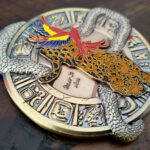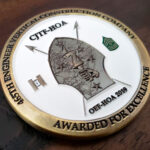
The design represents collaboration between two continents, with each one shown through its own symbols. Graphics are engraved on both faces, color is printed onto the surfaces of the ornaments, and the inscriptions run around the edge rather than across the faces. It was made for the 45th Engineer Vertical Construction Company, assigned to the Combined Joint Task Force Horn of Africa.
Designing a Coin About Two Places
A coin representing a partnership between countries or continents is a specific design problem, and the common solutions mostly fail.
Splitting the face in half rarely works. Two halves read as two coins stuck together, and someone always ends up on the left. A partnership coin needs the two elements interacting rather than sharing a border.
Two flags side by side is the weakest option. It is the first idea everyone has, it says nothing beyond the fact of the pairing, and flags are dense with fine detail that strikes poorly at the size two of them would have to be.
Symbols travel better than names. A recognizable form from each place reads instantly to people from both, where text requires a shared language. On a coin that will be handed to counterparts who may not read English, that is a practical requirement rather than an aesthetic one.
And one face each is a clean alternative. If the two elements genuinely will not combine, giving each its own face is more honest than forcing them together, and it uses the coin’s two sides properly.
See also military challenge coins.
Combined Joint Task Force Horn of Africa
CJTF-HOA is the standing task force responsible for United States military activity across East Africa, based at Camp Lemonnier in Djibouti. Much of its work is partnership rather than combat: training with African partner militaries, supporting regional security efforts and running engineering and civil projects alongside host nation forces.
That is why a coin about two continents makes sense here rather than being a generic gesture. The task force’s purpose is the partnership, so a coin built around it describes the mission instead of decorating it.
A vertical construction company is a good illustration. Vertical construction means buildings rather than roads and airfields, so these are the soldiers who put up structures: schools, clinics, barracks and facilities that stay behind after the unit leaves. It is among the most visible forms of partnership work there is, and the people doing it work directly with local counterparts for the length of a project.
Inscriptions on the Edge
Moving text to the rim is an underused option, and it changes what a coin can hold.
It frees both faces entirely. Text is the main competitor for space on any coin. Taking it to the edge leaves the faces to the artwork, which matters most on a design carrying detailed imagery from two sources.
It rewards handling. Edge text is not visible when the coin is lying flat. Someone has to pick it up and turn it, which makes the inscription a discovery rather than a label.
And it is a currency convention. Edge lettering comes from minted coinage, so it carries an association with real money that nothing on the faces can provide.
The limits are real. The rim is a narrow, curved band, so capacity is a short phrase rather than a sentence, the lettering has to stay shallow because the edge is the thinnest part of the coin, and a thicker blank gives more room to work with. Those are worth settling at quote stage rather than after artwork. Edge lettering also works on ring designs; see our Afghanistan NATO Army Challenge Coin.
Printed Color Over Engraved Metal
Color printed onto the ornament surfaces, over engraving rather than instead of it, is a hybrid approach with a particular advantage.
Engraving alone relies on shadow, which is subtle and depends on how the light falls. Color alone sits flat and hides the metalwork. Printing color onto engraved surfaces keeps the depth and the line work while adding the contrast that makes a design readable at arm’s length.
The thing to watch is registration, meaning how precisely the color lands on the engraved area. A slight misalignment is visible where color meets a cut edge, so this technique depends on the alignment being right rather than close. It is a proof stage check and it is the first thing to look at on a coin built this way.
See engraving, enamel and finish options.
Order a Deployment or Coalition Coin
Professional artwork is free with unlimited revisions, and nothing goes into production until you approve a digital proof. The challenge coin minimum is 50 pieces, standard production runs about 45 to 50 days after final artwork approval, rush production is available on many projects, and shipping within the continental United States is included. Embleholics is veteran-owned, SDVOSB and registered in SAM.gov.
Two suggestions for a coalition or partnership piece. Order generously, since a coin given to host nation and partner counterparts leaves the unit at a rate a unit-only coin never does. And keep everything on it openly releasable information about the organization, because a coin that circulates internationally is not something you can recall. Request a free quote to begin.
Frequently Asked Questions
How do you design a coin representing two countries?
Use a recognizable symbol from each place and let them interact rather than splitting the face in half. Symbols read instantly to people from both sides, where text requires a shared language.
Why not put two flags side by side?
It says nothing beyond the fact of the pairing, someone always ends up on the left, and flags carry dense fine detail that strikes poorly at the size two of them would need.
Can inscriptions go on the edge of a coin?
Yes. Edge lettering frees both faces for artwork, rewards handling since the text is only visible when the coin is turned, and carries an association with minted currency.
How much text fits on a coin’s edge?
A short phrase rather than a sentence. The rim is narrow and curved, the lettering has to stay shallow because the edge is the thinnest part, and a thicker blank gives more room.
What does Combined Joint Task Force Horn of Africa do?
It is the standing task force for United States military activity in East Africa, based at Camp Lemonnier in Djibouti. Much of its work is partnership: training with African partner militaries and running engineering and civil projects.
What is a vertical construction company?
An engineer unit that builds structures rather than roads and airfields. Its projects are schools, clinics, barracks and facilities that remain in place after the unit leaves.
Can color be printed over engraving?
Yes, and it combines the strengths of both. Engraving keeps the depth and line work while printed color adds the contrast that makes a design readable from a distance.
What should be checked on a coin that prints color over engraving?
Registration, meaning how precisely the color lands on the engraved area. A small misalignment shows clearly where color meets a cut edge, so it needs to be right rather than close.
More Joint Forces Projects