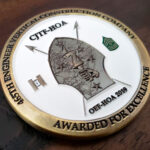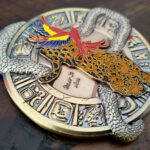
A Joint Task Force challenge coin usually has a second job, which is to be given to people who are not American. Joint Task Force-Bravo operates at Soto Cano Air Base as a guest of its Honduran hosts, and its medical element works alongside partner nation health ministries across Central America. A coin from a unit in that position will spend most of its life on shelves in other countries’ offices, so it is designed for an audience that has no reason to know what any US military acronym means. This one is a sculpted jaguar and a painted bird on one side and an engraved Honduran ship on the other, in brushed brass.
A Coin That Will Be Given to Another Country’s Officers
Most unit coins are handed to other Americans in uniform, who can decode anything on them. A coin from a task force working with partner nations is handed to foreign military officers, health ministry staff, local officials and civilian doctors. That changes the brief in four specific ways.
- Acronyms do not travel. JTF-B, MEDEL and USSOUTHCOM are meaningless to a ministry of health official in a partner nation. A coin covered in US military abbreviations is unreadable to half the people receiving it.
- Nothing operational. A coin that circulates among foreign nationals is a coin that has left your control entirely, which rules out anything about capability, posture or movement.
- Imagery has to carry the meaning. With acronyms stripped out, the design has to communicate without text, which is exactly why this coin is built from a jaguar, a bird and a ship.
- It will be displayed, not pocketed. A coin given across a protocol handshake gets put in a cabinet or on a desk in someone else’s building, often for years. It is a long-lived object representing your country, so it is worth the diameter and the finish.
It is also worth remembering that this runs both ways. Partner nation officers present their own coins and medallions in return, so a task force coin is one half of an exchange rather than a one-directional gift.
Honoring the Host Without Appropriating It
Using the host country’s imagery is the right instinct. The important distinction is between a country’s natural heritage and a country’s state symbols, because the two are governed differently.
Wildlife, landscape and flora are safe. A jaguar, a macaw, a volcano, a pine forest. These belong to a place without belonging to a government, so nobody has to authorize them and nobody can be offended by them. The scarlet macaw is Honduras’s national bird, which makes a brightly colored bird on a Honduran coin read as a compliment rather than as a liberty.
State symbols need clearing. A national flag, a coat of arms, a national or presidential seal, or the insignia of the host nation’s armed forces are instruments of that state. A foreign military reproducing them on merchandise is a protocol question, not a design decision, and it should go through your own command’s protocol or public affairs staff and the host nation’s liaison before the artwork stage.
That is the reason a design like this one works. The animals say Honduras unmistakably and claim nothing. If you want a national emblem on a coin given to partner nations, ask first, and expect the answer to take time.
Paint What Color Tells You Something About
On this coin the jaguar and the bird are painted and everything else, including the ship, is left as bare brushed brass. That split follows a rule worth adopting.
Use paint where color is information. Not where it is decoration.
A scarlet macaw is defined by its color. Strip the red, yellow and blue out of it and you have a generic parrot shape. A jaguar’s spotted coat is the thing that identifies the animal. Color on those two subjects is doing the same work as the drawing itself.
A ship is not like that. A hull, a mast and rigging are identified entirely by shape, and painting them adds nothing the outline was not already saying. Leaving the ship in engraved brass costs the design nothing and gains it a quiet face, which is also what lets the painted animals be the first thing anyone looks at.
The same test applies to most coin subjects. Flags, animals, flowers, fruit, service ribbons and anything with an official color scheme need their color. Buildings, vehicles, aircraft, ships, tools, lettering and most insignia outlines do not. For the finishes available, see challenge coin plating options.
What Works on a Joint Unit’s Coin
A joint task force draws its people from more than one service, so no single service device is correct for everyone on it. Three things are, and they are the ones to build with.
The combatant command’s emblem, which everyone assigned to the task force genuinely shares. The task force’s own emblem, if it has one, which is the only device that belongs to the unit itself. And the place, which is the thing every member of a forward-based task force has in common no matter which uniform they wear.
On a coin that will also be given to partner nations, the third of those is the most useful, because it is the only one of the three a foreign recipient will recognize without explanation. See a combined joint task force coin and a CENTCOM resident agency coin for two other approaches to the same problem.
Order a Coin for Your Task Force
Send your command or task force emblem and tell us what host nation or regional imagery you want used. Say whether the coin will be presented to partner nation personnel, because that decides how much text the design can carry and which elements need clearing first.
Professional artwork is free with unlimited revisions, and nothing goes into production until you approve a digital proof. Standard production runs about 45 to 50 days after final artwork approval, rush production is available on many projects, and shipping within the continental United States is included, with overseas, APO and FPO delivery quoted separately. See APO and FPO shipping. Embleholics is veteran-owned, SDVOSB and registered in SAM.gov.
Frequently Asked Questions
What is a Joint Task Force challenge coin?
A Joint Task Force challenge coin is a coin for a unit drawing personnel from more than one military service under a single commander. Because no one service’s insignia is correct for everyone assigned, these coins are usually built around the combatant command’s emblem, the task force’s own emblem, or the place the task force operates from.
What is Joint Task Force-Bravo?
Joint Task Force-Bravo is a United States Southern Command task force based at Soto Cano Air Base in Honduras. It works with partner nations across Central America, South America and the Caribbean on regional security cooperation, humanitarian assistance and disaster relief, and partner capacity building.
What does MEDEL stand for?
MEDEL is the Medical Element of Joint Task Force-Bravo. It partners with ministries of health across Central America to provide medical care including preventive medicine, physical therapy, trauma care and dental services.
Can a challenge coin use another country’s flag or coat of arms?
Not without clearing it first. A national flag, coat of arms, national or presidential seal, or host nation military insignia are instruments of that state, so a foreign military reproducing them on merchandise is a protocol matter rather than a design choice. Route it through your own command’s protocol or public affairs staff and the host nation liaison before the artwork stage, and allow time for the answer.
What host nation imagery is safe to use on a coin?
Wildlife, landscape and plants. A jaguar, a macaw, a volcano or a forest belongs to a place without belonging to a government, so nothing needs authorizing and nothing can be taken as a liberty. Using a country’s national animal or national bird in particular reads as a compliment to its hosts.
Should acronyms appear on a coin given to foreign partners?
Keep them off, or keep them small and secondary. Unit and command abbreviations mean nothing outside the US military, so a coin presented to partner nation officers, officials and civilian medical staff should carry its meaning in imagery rather than in letters.
Which elements of a coin should be painted?
The ones where color is information rather than decoration. Animals, flags, flowers and anything with an official color scheme need their color to be identifiable, because a scarlet macaw without its red is just a parrot shape. Ships, buildings, vehicles, tools and lettering are identified by shape alone, so leaving them in bare or engraved metal loses nothing and gives the painted elements somewhere quiet to stand out against.
Can a joint unit coin use one service’s insignia?
It can, but it will be wrong for most of the unit. A joint task force has personnel from several services, so a single service emblem excludes everyone else assigned. The devices that work for everyone are the combatant command’s emblem, the task force’s own emblem, and the location.
More Joint Forces Projects