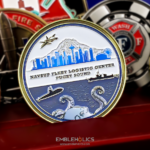
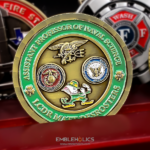
A Navy recruiting challenge coin is the one coin in this gallery that is not given for anything. Every other coin here marks something the recipient did. A recruiting coin is handed over at the moment somebody decides, before training, before a uniform fits, before there is anything to commemorate. NTAG Houston’s version is a brass coin with handles set around the rim so the whole piece reads as a ship’s helm, with the Houston skyline engraved on the reverse.
A Coin That Marks a Decision, Not an Achievement
That inversion matters, because it rules things out that would be obvious choices on any other coin.
- Nothing the recipient has not done yet. No warfare devices, no deployment references, no rank, no ship. A coin that depicts a career the person has not started reads as presumptuous to anyone who has served and means nothing to the person holding it.
- It has to point forward. Unit coins look back at a lineage. A recruiting coin is about what comes next, which is why symbols of direction, course and setting out work better than symbols of accomplishment.
- It is often the first physical thing the Navy gives someone. There is no ribbon, no insignia and no certificate yet. The coin is it, which is more weight than a coin usually carries.
- It frequently ends up with a parent. Recruits leave for training with very little, so the coin is commonly handed to a mother or father at the swearing-in and kept at home. Design it knowing a civilian will own it.
That last point is the one most often missed. For a contrast, see how a coin given at the end of training is handled in academy graduation challenge coins.
Who Actually Receives It
Prospects and their families. New enlistees at a swearing-in. High school counselors, teachers and coaches. Employers and civic partners at job fairs. Other recruiters.
Most of those people have never served, which has one firm consequence: the coin has to be self-explanatory. Even the command’s own abbreviation does not help a high school counselor, so a recruiting coin should carry a device anyone can read and spell out whatever text it needs in plain words rather than initials.
A Helm Instead of a Round Coin
Putting handles on a round coin so it becomes a ship’s wheel is a better idea than it first appears, for two independent reasons.
The first is meaning. A helm is about taking the course, which is exactly what the person receiving the coin has just done. It is one of very few nautical devices that is about a decision rather than about a capability, and that makes it unusually well suited to a recruiting command.
The second is geometry. A ship’s profile is five or six times longer than it is tall, so it fits a round coin badly and needs the design worked around it. A helm is natively circular. It is the one major nautical subject whose natural proportions are already a coin’s proportions, so nothing has to be cropped, tilted or shrunk to make it fit.
Radial Handles Distribute the Load
Anything projecting from a coin is usually the first thing to bend, and handles placed evenly around a rim are the exception to that rule.
A single projection concentrates every force that reaches it through one join, so it bends in one predictable direction and that join is the coin’s weakest point. Handles spaced around the full circumference behave differently. There is no single most-vulnerable point, no direction the piece prefers to bend in, and any force applied to one handle is partly carried by the rim into the others.
Three things still have to be right, and all three are decided before tooling.
- Keep the reach short. The further a handle extends, the more leverage anything catching it has, and a long handle gives back the advantage the symmetry bought you.
- Keep the join wide. Each handle meets the rim at a point, and a broad join spreads the load where a narrow neck concentrates it.
- Keep the rim at full thickness. On a design like this the rim is now a structural ring carrying load between handles, so it cannot be thinned to make room for them.
One practical consequence worth asking about early: a coin with projections will not sit flat in a standard coin capsule, stack neatly, or drop into an off-the-shelf display case. If the coin is going into packaging or a presentation box, raise it at the quote stage rather than after the strike. See custom shaped challenge coins for how these outlines are tooled.
Engraving the City Rather Than Sculpting It
The Houston skyline on the reverse is engraved, which is the right decision on this particular coin and the wrong one on some others.
Engraving cuts below the surface. Sculpted relief rises above it. That single difference decides whether an element is a subject or a backdrop, regardless of how much detail it contains. Raise a skyline and it becomes the thing the coin is about. Cut it and it recedes, holding its detail without competing.
Here the subject is the helm and its handles, which are the highest points on the piece. A sculpted skyline would have fought them. An engraved one sits behind and does what a city on an NTAG coin should do, which is say which of the Navy’s recruiting groups this is, since what distinguishes one from another is territory rather than mission.
About NTAG Houston
Navy Talent Acquisition Groups recruit enlisted sailors and prospective officers for the United States Navy. They were formerly Navy Recruiting Districts and were redesignated as the Navy moved to a talent acquisition model. NTAG Houston is one of the groups covering the country, under Navy Recruiting Command, which is headquartered at Millington, Tennessee.
See also a Navy Recruiting Command coin and more Navy challenge coins.
Order a Coin for Your Recruiting Command
Send your command insignia and tell us what local element you want on the reverse. If you want handles or any other projecting feature, say so at the start, because it affects the tooling and the packaging.
Professional artwork is free with unlimited revisions, the minimum order is 50 coins, and nothing goes into production until you approve a digital proof. Standard production runs about 45 to 50 days after final artwork approval, rush production is available on many projects, and shipping within the continental United States is included. Embleholics is veteran-owned, SDVOSB and registered in SAM.gov.
Frequently Asked Questions
What is a Navy recruiting challenge coin?
A Navy recruiting challenge coin is a coin given by a Navy Talent Acquisition Group to prospects, new enlistees and community partners. Unlike a unit coin, it is presented before the recipient has served, so it is designed to look forward rather than to commemorate anything, and it avoids devices such as warfare insignia or rank that the recipient has not earned.
What is a Navy Talent Acquisition Group?
A Navy Talent Acquisition Group, or NTAG, recruits enlisted sailors and prospective commissioned officers for the United States Navy. NTAGs were formerly Navy Recruiting Districts and were redesignated as the Navy adopted a talent acquisition model. They operate under Navy Recruiting Command, which is headquartered at Millington, Tennessee.
Who receives a recruiting coin?
Prospects and their families, new enlistees at a swearing-in, high school counselors, teachers and coaches, employers and civic partners at events, and recruiters themselves. Most recipients have never served, so the coin needs to be understandable without any military knowledge and should spell out text rather than relying on abbreviations.
What should be left off a recruiting coin?
Anything representing service the recipient has not performed. Warfare devices, rank, deployment or campaign references and specific ships all belong to careers that have not started yet, and including them reads as presumptuous to anyone who has served while meaning nothing to the person being handed the coin.
Can handles or spokes be added to a round coin?
Yes, and a ship’s helm is the most common version. The handles are part of the tooled outline rather than attached afterwards, so the shape has to be planned from the start, with short reaches, wide joins to the rim and the rim kept at full thickness.
Are handles around a rim stronger than a single projection?
Yes. A single projection channels every force through one join, so it has a predictable weakest point and bends in one direction. Handles spaced around the whole circumference share the load through the rim, so there is no single vulnerable point and no preferred direction of failure. Each handle still needs to be short with a broad join.
Will a coin with handles fit a capsule or display case?
Not a standard one. Projections stop a coin sitting flat, stacking or dropping into an off-the-shelf capsule or case, so if the coin is going into packaging or a presentation box that needs to be raised at the quote stage rather than discovered after the strike.
Should a city skyline be engraved or sculpted on a coin?
Engraved if it is a background, sculpted if it is the subject. Engraving cuts below the surface so the element recedes and keeps its detail without competing, while raised relief makes it the thing the coin is about. On a coin whose subject is something else, a sculpted skyline will fight it for attention.
More Navy Projects