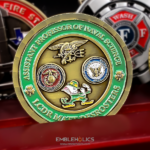
The front sets a map in front of a compass, framed by a border of laurel leaves and stars, worked in an etched style. The back is engraved rather than etched, carrying the USN logo with additional elements and an inscription. The base metal has a copper colored coating. This USN Recruiting Command coin was made for Navy Recruiting Command.
Etching on One Face and Engraving on the Other
Using two different cutting treatments across the two faces is a subtle decision and an effective one.
The faces separate without needing different content. Etching produces shallow recessed line work that reads as drawing. Engraving cuts deeper with more defined edges and reads as carving. Side by side the difference is obvious even when the subjects are related.
Each suits different artwork. Fine, flowing detail like a laurel border or a compass rose sits better in shallow etching. Bold forms and lettering hold up better in deeper engraving. Matching the technique to the content is better than applying one depth to everything.
And it gives the reverse its own character. The usual problem with the back of a coin is that it feels like leftover space. A different treatment makes it a deliberate counterpart rather than an afterthought.
The requirement is that both faces need the same finish and plating so the coin still reads as one object. Two cutting depths is a variation; two finishes as well would be two different coins stuck together.
See engraving, etching and finish options.
Navy Recruiting Command
Navy Recruiting Command is responsible for bringing people into the Navy, which means it is the organization most sailors encounter before they are sailors at all. Its districts and recruiting stations cover the entire country, operating from offices in towns with no other Navy presence.
That geography explains the map and compass on the front. A command whose work is spread across every state and whose business is finding people has a genuine reason to use navigation imagery, where another organization would be reaching for it. A map says the reach, a compass says the search, and together they describe the mission without a line of explanation.
Recruiting is also unusual among Navy commands in that it is almost entirely shore duty in civilian communities. Recruiters work in storefronts and high schools, interact mostly with people who have no military background, and represent the service to the public in a way few other sailors do. A coin from a command like that gets handed to teachers, parents and applicants as much as to other sailors, which argues for a design that explains itself to someone outside the Navy.
See also a Navy recruiting challenge coin.
A Laurel and Star Border
Framing a face with a decorative border is an old device, and it solves a real problem.
A central image on an open field can look adrift, with no relationship to the rim. A border closes the composition, gives the central element something to sit inside, and stops the eye drifting off the edge. It also uses the outer ring of a coin, which is otherwise the least productive area on the whole face.
Laurel and stars are the conventional vocabulary for this in American official design, and the convention is worth following rather than inventing something. Laurel means honor and achievement, stars carry the national association, and both are familiar enough that nobody has to interpret them.
Two practical points. A border has to be consistent all the way around, since any irregularity is immediately visible on a repeating pattern. And it eats into the usable area, so the central artwork has to be planned at the smaller size rather than designed full face and shrunk afterward.
Copper Coating
A copper colored finish is a less common choice than gold, silver or antique bronze, and it has a particular character.
Copper is warm, distinctly so, and it reads as older and more handmade than gold. Where gold signals formality and award, copper signals craft. It also darkens with handling in a way bright plating does not, so a copper coin develops a patina that makes the recessed line work more legible over time rather than less.
That second point is why it pairs well with a coin built on etching and engraving. The recesses collect the darkening, the high points stay brighter, and the contrast that line work depends on increases with use. A piece designed this way is better in five years than on the day it arrives.
The thing to confirm is whether the copper is plated or a coating over a different base, since that determines how it wears at the edges over a long period. It is a question worth asking at quote stage.
See antique vs polished finishes.
Order a Recruiting or Command Coin
Professional artwork is free with unlimited revisions, and nothing goes into production until you approve a digital proof. The challenge coin minimum is 50 pieces, standard production runs about 45 to 50 days after final artwork approval, rush production is available on many projects, and shipping within the continental United States is included. Embleholics is veteran-owned, SDVOSB and registered in SAM.gov.
Two suggestions. If a coin will be handed to people outside the service, make sure the imagery works without insider knowledge, since a recruiting command’s coins reach teachers, parents and applicants as often as other sailors. And if the design uses a decorative border, plan the central artwork at the reduced size from the start rather than shrinking a full face design into the remaining space. Request a free quote to begin.
Frequently Asked Questions
What is the difference between etching and engraving on a coin?
Etching produces shallow recessed line work that reads as drawing. Engraving cuts deeper with more defined edges and reads as carving. Fine flowing detail suits etching, while bold forms and lettering hold better in engraving.
Can one coin use both techniques?
Yes, and using one per face is effective. The two sides separate visually without needing different subject matter, and the reverse gains its own character instead of feeling like leftover space.
Should the two faces share a finish?
Yes. Two cutting depths is a variation that holds together, but two different platings as well makes the piece read as two coins joined rather than one object.
Why use a map and compass on a recruiting coin?
Because the command operates in every state and its business is finding people. A map states the reach and a compass states the search, which describes the mission without explanation.
What does a decorative border do on a coin?
It closes the composition so the central image does not look adrift, and it uses the outer ring, which is otherwise the least productive area of the face.
What should be watched on a bordered design?
Consistency all the way around, since any irregularity in a repeating pattern is immediately visible, and the reduced central area, which has to be designed for rather than shrunk into.
How does a copper finish differ from gold?
Copper is warmer and reads as craft rather than formality. It also darkens with handling, so recessed line work gains contrast over time instead of staying static.
Why does copper suit an engraved coin?
Because the darkening collects in the recesses while the high points stay brighter. The contrast that line work depends on increases with use, so the coin improves rather than wears.
More Navy Projects