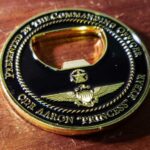
A fleet replacement squadron is the schoolhouse, and its coins work differently from an operational squadron’s. This one was made for Airborne Command and Control Squadron 120, the Greyhawks, which trains naval aviators, naval flight officers and naval aircrewmen on the E-2 Hawkeye and the C-2 Greyhound before they join the fleet. The commanding officer awards it. The brief asked for something classy and minimalist that also works as a bottle opener, in black and gold.
A schoolhouse squadron has a different coin problem
An operational squadron coins a roughly stable group of people. A training squadron coins a new set every few weeks, forever. That single difference drives most of the decisions.
- Volume is continuous, not one-off. Classes complete year after year, so the coin is a standing supply rather than a single run. Order against annual throughput rather than against the current class, because the per-unit price improves considerably at larger quantities and the die cost is paid once either way.
- The design must never expire. No dates, no class numbers, no commanding officer’s name on the die. Anything specific turns a reorderable coin into a series of small runs with repeated setup costs.
- It has to mean something to someone receiving their first one. Students completing an FRS syllabus are often getting a command coin for the first time. The coin is their introduction to the practice, which is an argument for a clean, well-made piece rather than an in-joke they are not yet part of.
- Add class specifics outside the die. If you want to mark a particular class, engrave it after striking or put it on the packaging. The die stays general and the coin stays reorderable.
Training commands are among the best customers for a standing coin, precisely because the demand is predictable. A squadron that knows roughly how many students it graduates a year can order accordingly and stop thinking about it.
A bottle opener in the centre
Putting the opener in the middle of the coin is the harder of the two options, and it is a real constraint on the layout. An opener at the edge leaves both faces clear; an opener in the centre takes the part of the coin the eye goes to first, and everything else has to work around it.
What that means in practice:
- The design becomes a ring. With the centre occupied, artwork and lettering live in the annulus between the opening and the rim. That band is narrower than people expect, so content has to be reduced rather than rearranged.
- Detail has to be crisp, because it is small. Pushing everything outward means working at a smaller scale than the coin’s diameter suggests, which is why this design went for fine engraving rather than bold relief.
- The opening needs metal around it. The notch takes leverage, so the surround has to be solid and the coin thicker than standard. That is a cost and a constraint, not an option.
- Minimalism stops being a style choice. On a centre-opener coin there is no room for a busy design, so a restrained brief and the format agree with each other. The Greyhawks coin wanted minimalist and needed minimalist.
Black and gold, and why it suits small detail
Black plating with gold relief is the highest-contrast combination available, which is exactly what fine detail on a small working area needs. The black recesses hold shadow and the gold raised areas catch light, so engraved line work reads at a scale where a single-tone coin would turn into a grey blur.
It also wears sensibly. Black plating on a coin that doubles as a tool will take marks on the high points over time, and on a two-tone coin that reads as patina rather than damage, because the gold is already the raised element. A uniformly bright coin shows the same wear as scratches.
About the squadron
Airborne Command and Control Squadron 120, the Greyhawks, is the fleet replacement squadron for the E-2 Hawkeye and the C-2 Greyhound. It trains naval aviators, naval flight officers and naval aircrewmen on both aircraft before they report to operational squadrons, which makes it the common starting point for most of the community.
That shared origin is worth designing for. Everyone in the Hawkeye and Greyhound community passed through the same schoolhouse, so an FRS coin is one of the few pieces that an entire community recognizes regardless of which squadron someone ended up in. Related work includes the VAW-126 Hawkeye squadron coin.
Ordering a coin for a training command
Tell us your annual graduation numbers rather than your current class size. That is the figure the quantity should be built from, and it usually produces a much better price per coin than people expect. Keep dates and names off the die and add class detail by engraving or packaging if you want it. If you want a bottle opener, say whether it goes in the edge or the centre, because that decision shapes the whole layout. You can see more Navy challenge coins we have produced, or send your artwork through the free quote form.
Frequently Asked Questions
What is a fleet replacement squadron coin?
It is a coin from the training squadron that qualifies aircrew on a particular aircraft before they join operational squadrons. Because an FRS graduates class after class indefinitely, its coin is a standing supply rather than a one-off run, and it needs a design that never goes out of date.
How should a training command size its coin order?
Against annual throughput rather than the current class. The die cost is paid once whatever the quantity, and the per-unit price improves considerably at volume, so ordering for a year or more of graduations is substantially better value than ordering class by class. Training commands have unusually predictable demand, which makes this easy to plan.
Should a training coin carry the class number?
Not on the die. Anything specific, whether a class number, a date or a commanding officer’s name, turns a reorderable coin into a series of small runs with repeated setup charges. If you want to mark a class, engrave it after striking or put it on the packaging, which keeps the die general.
Where should a bottle opener go on a coin?
The edge if you want both faces clear, the centre if the tool is the point. A centre opener takes the part of the coin the eye goes to first and forces the design into a ring between the opening and the rim, which is narrower than it looks. Either way the coin has to be thicker than standard, with solid metal around the notch to take the leverage.
How much design fits around a centre bottle opener?
Less than the diameter suggests. With the middle occupied, everything lives in the band between the opening and the rim, which means working at a smaller effective scale and reducing content rather than rearranging it. Fine engraving tends to work better than bold relief in that space, and a minimalist brief and this format suit each other.
Why use black and gold on a coin?
Because it is the highest-contrast pairing available, which small detail needs. The black recesses hold shadow while the gold raised areas catch light, so engraved line work reads at a scale where a single-tone coin would blur. It also ages well on a coin that doubles as a tool, since wear on the high points reads as patina rather than as scratches.
What is VAW-120?
Airborne Command and Control Squadron 120, nicknamed the Greyhawks, is the US Navy’s fleet replacement squadron for the E-2 Hawkeye and C-2 Greyhound. It trains naval aviators, naval flight officers and naval aircrewmen on both aircraft before they report to operational squadrons, making it the common starting point for most of that community.
More Navy Projects