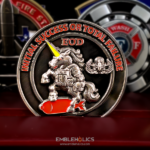
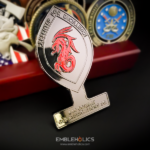
This coin uses dark gray and black as its only background colors, with gold for the insignia and lettering and a single blue accent on the reverse. That is a restricted palette by any measure, and it is the most reliable one in coin design.
Why Gold on Black Is the Safest Pairing
There is a reason this combination keeps appearing on coins for investigative and law enforcement organizations, and it is not only that it looks serious.
Gold is a plating, not a paint. That is the structural advantage. Where a design calls for gold, the metal itself is left exposed and plated, so the gold areas are the coin rather than something applied on top of it. They cannot chip, fade or wear off the way a painted area can, and they catch light in a way no paint reproduces.
Black does the opposite job and does it well. A dark fill is the most forgiving color on a coin. Small variations in fill depth, minor contamination and slight unevenness all disappear against black where they would be glaring against white or a pale color.
Together they give maximum contrast with minimum risk. Metallic gold against a dark recessed field is the highest contrast available on a coin, which means fine detail and small lettering stay legible. A design that would be marginal in two similar colors becomes comfortable in this pairing.
And it ages better than a colorful coin. A multicolored coin looks its best new. A gold and black coin picks up a little patina in the recesses and most people think it improves. For an organization whose coins get carried rather than shelved, that matters.
The single blue accent on the reverse is doing a specific job. On an otherwise monochrome coin, one color draws the eye exactly where the designer wants it. Add a second accent and that effect is halved; add a third and it is gone. Restraint here is not a cost saving, it is the mechanism. See plating and finish options.
Patterned Backgrounds Instead of Color
Both faces of this coin carry detailed patterned backgrounds rather than flat fields, and that is how a restricted palette avoids looking empty.
When you take color away, you have to replace it with something or the coin reads as unfinished. Texture is what fills that gap. A field that is lined, stippled, cross hatched or sunburst cut catches light differently from the smooth raised elements on top of it, which creates visual separation without using a single additional color.
It also solves a practical problem. A large flat recessed area on a coin tends to show every imperfection in the fill. Breaking that area up with a machined texture hides small variations and gives the surface something to do.
The one thing to watch is competition. A background pattern has to stay subordinate to what sits on top of it. Cut it too deep or at too large a scale and it stops being a background and starts fighting the insignia. The usual rule is that the pattern should be visible when you look for it and invisible when you are reading the device.
A Shape That Is Not a Circle
The coin is cut to an irregular, organic outline rather than struck as a disc, which is a deliberate choice for an organization that wanted something distinctive.
Two things to know if you want the same. An irregular outline has no symmetry to help you, so the balance of the design has to be judged by eye rather than measured, and that makes the proof stage more important than usual. And any outline with narrow sections has a fragility point there, so the artwork stage is where those get thickened slightly. See custom shaped challenge coins.
About the Agency
The Air Force Office of Special Investigations is a field operating agency headquartered at Andrews Air Force Base, Maryland, and has been the Air Force’s felony level investigative service since 1948. It reports through the Inspector General’s office and identifies, investigates and neutralizes criminal, terrorist and espionage threats.
Its units operate independently of the commands they support, which is the structural point of the organization and part of why its people tend to identify strongly with the agency rather than with a base. That is usually a good sign that a coin will be valued. See also an AFOSI detachment coin, an HSI special agent coin and a special investigations unit coin.
Order a Gold and Black Coin
Professional artwork is free with unlimited revisions, and nothing goes into production until you approve a digital proof. The challenge coin minimum is 50 pieces, standard production runs about 45 to 50 days after final artwork approval, rush production is available on many projects, and shipping within the continental United States is included. Embleholics is veteran-owned, SDVOSB and registered in SAM.gov.
One thing worth deciding early. If you want gold, decide whether you want it as plating on exposed metal or as a painted gold, because they do not look alike. Plated gold is the metal itself and has depth; painted gold is flat and reads as yellow. Most people asking for a gold coin mean the former. And for official agency insignia, the approved artwork and the authorization both come from the agency. Request a free quote to begin.
Frequently Asked Questions
What is a gold and black challenge coin?
It is a coin that uses gold plating on exposed metal for its insignia and lettering against a dark recessed background. The pairing is common in law enforcement and investigative work because it gives maximum contrast with minimum production risk.
Why is gold on black so widely used on coins?
Because gold is plating rather than paint, so it cannot chip or fade, and black is the most forgiving fill color on a coin. Together they produce the highest contrast available, which keeps fine detail and small lettering legible.
Is gold on a coin plated or painted?
It can be either, and they do not look alike. Plated gold is the coin’s own metal, so it has depth and catches light. Painted gold is a flat fill that reads as yellow. Most people asking for a gold coin mean plating.
Does a dark coin hide production flaws?
Yes. Small variations in fill depth, minor contamination and slight unevenness all disappear against a dark field where they would be obvious against white or a pale color. It is the most forgiving background a coin can have.
Why use only one accent color?
Because on an otherwise monochrome coin, a single color draws the eye exactly where you want it. A second accent halves that effect and a third removes it. The restraint is the mechanism rather than a way of saving money.
What is a patterned background on a coin?
It is a machined texture, such as lines, stippling, cross hatching or a sunburst, cut into the recessed field behind the main elements. It catches light differently from the raised parts, which creates separation without adding any color.
Why add texture instead of more color?
Because a restricted palette needs something to replace the missing color or the coin looks unfinished, and texture does that for free. It also breaks up large flat recessed areas, which are where fill imperfections show most.
Can a coin have an irregular, non-geometric shape?
Yes. The two things to plan for are that an asymmetric outline has to be balanced by eye rather than measured, which makes the proof stage more important, and that any narrow section of the outline is a fragility point and should be thickened slightly in artwork.
More Air Force Projects