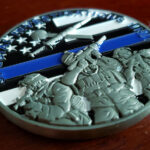
Black and blue as the dominant colors, chosen because they are the colors of law enforcement. A smooth edge with no machined pattern. And on the front, a smooth engraved relief of the unit’s own officers, with a great deal of complex detail. It was made for the Winter Haven Police Department’s Special Investigations Unit.
Coins for a Specialized Investigative Unit
A narcotics or special investigations unit is one of the better coin candidates inside a police department, and the reasons are specific to how the work runs.
It is a small team doing distinct work. A department coin represents everybody. A narcotics unit is a handful of detectives with their own caseload, their own tactics and a specialty nobody else in the building has. That is where a coin carries weight.
The work is long-form. Investigative cases run for months rather than shifts, which produces a different kind of shared history from patrol. Teams that have worked one case together for a year have something a coin can mark.
They work across agencies. Narcotics work is routinely multi-agency: task forces, federal partners, neighboring jurisdictions. Those are exactly the relationships where a coin gets handed over, and a unit that works with outside agencies has a real use for one rather than a theoretical one.
And recognition is otherwise limited. Much of the work is not public, and a long investigation rarely produces a ceremony. A coin is one of the few ways to mark it.
See also a narcotics task force bottle opener coin, a gold and black challenge coin and an HSI special agent coin.
Smooth Relief Instead of Line Work
The officers on the front are rendered in smooth engraved relief, which is a different technique from the sharp line engraving most coins use, and worth understanding as an option.
Line engraving produces a drawing. Discrete cut lines, filled or left as shadow, reading as an illustration. It suits logos, maps, vehicles and architecture.
Smooth relief produces a form. Instead of cut lines, the surface rises and falls continuously, so shapes are defined by gradual changes in height rather than by outlines. It suits figures, faces and anything organic, because bodies do not have outlines in reality.
For a group of figures that distinction matters. Line-engraved human figures tend to look like a cartoon or a diagram. Smooth relief lets shoulders overlap, lets one figure sit behind another, and lets light fall across the group the way it would on a sculpture.
The cost is that it is harder to execute and less forgiving. A line can be cut cleanly or not. A continuous surface has to be modeled correctly at every point, and if the depth hierarchy is wrong the whole group looks swollen rather than sculpted. It is also a technique that depends on finish: a matte or softly brushed surface shows the modeling where a mirror polish throws light across it and flattens it.
Black and Blue, and Nothing Else
Two colors, chosen for what they mean rather than how they look.
That is worth stating plainly because it is the right order of operations. A palette chosen on appearance produces a coin that looks good. A palette chosen because the colors already mean something to the people receiving it produces a coin that looks like theirs.
The pair also works technically. Black is the most forgiving fill on a coin, hiding small variations that would show against a pale color, and it gives sculpted relief somewhere dark to cast shadow into, which is exactly what a figure group needs. Blue then carries the identity against it.
And two colors leaves the detail room to work. On a coin whose front is a complex relief, extra colors would add boundaries competing with the modeling. Restricting the palette lets the relief do the work.
A Smooth Edge as a Contemporary Choice
The edge carries no machined pattern, which the unit chose deliberately.
Reeded, diamond and rope edges read as traditional, which is why they appear on so much military and commemorative work. A plain edge reads as modern. Neither is better; they are different registers, and a unit choosing a contemporary look should not then default to a classical edge out of habit.
There is a practical argument too. On a coin whose front is a detailed sculpted relief, a patterned edge adds a second zone of texture around the rim and the piece starts to look busy at the edges while the artwork works in the middle. A clean rim keeps the frame quiet.
About the Department
The Winter Haven Police Department has 91 sworn officers and 33 civilians. Its Special Investigations Unit handles complaints of controlled substance violations, prostitution and related crimes, with narcotics detectives working closely alongside general crime detectives.
The department is CALEA accredited and has held state accreditation from CFA since 2002. Its community programs include D.A.R.E., Police Explorers, Neighborhood Watch and crime prevention work.
See more police challenge coins.
Order a Coin for Your Unit
Professional artwork is free with unlimited revisions, and nothing goes into production until you approve a digital proof. The challenge coin minimum is 50 pieces, standard production runs about 45 to 50 days after final artwork approval, rush production is available on many projects, and shipping within the continental United States is included. Embleholics is veteran-owned, SDVOSB and registered in SAM.gov.
Two things worth deciding at the quote stage. If the design includes human figures, ask for smooth relief rather than line engraving, and pair it with a matte or brushed finish rather than a polish, since a mirror surface flattens the modeling. And choose your colors from what your agency already uses rather than from what looks good; a coin in the department’s own colors reads as the department’s. Request a free quote to begin.
Frequently Asked Questions
What is a narcotics unit challenge coin?
It is a coin made for a narcotics or special investigations unit within a police department. These are small teams with their own caseload and tactics, which is the level at which a coin carries more weight than a department-wide piece.
Why do investigative units order coins?
Because the work is long-form and largely not public. Cases run for months, rarely produce a ceremony, and routinely involve other agencies. A coin marks the shared history and gives the unit something to hand to outside partners.
Can people’s faces be engraved on a challenge coin?
Yes, and smooth relief suits figures better than line engraving. Instead of cut outlines, the surface rises and falls continuously, which lets shoulders overlap and light fall across the group the way it would on a sculpture.
What is the difference between line engraving and smooth relief?
Line engraving produces a drawing from discrete cut lines and suits logos, maps and vehicles. Smooth relief produces a form from continuous changes in height and suits figures, faces and anything organic, since bodies do not have outlines in reality.
Is smooth relief harder to produce?
Yes, and less forgiving. A line is either cut cleanly or not, but a continuous surface has to be modeled correctly at every point. If the depth hierarchy is wrong the figures look swollen rather than sculpted.
What finish suits a sculpted figure group?
Matte or softly brushed. Those scatter light so the modeling reads from any angle, where a mirror polish throws light across the surface and flattens the very depth the technique depends on.
How should we choose a coin’s colors?
From what your agency already uses rather than from what looks good on screen. A palette chosen on appearance produces a coin that looks good; one chosen because the colors already mean something produces a coin that looks like yours.
Should the edge be patterned or plain?
Plain reads as contemporary and patterned reads as traditional, so it follows the register of the rest of the design. A plain edge is also the better choice when a face carries a detailed relief, since a patterned rim competes with it.
More Police Projects