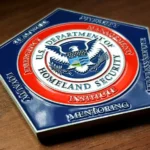
Federal law enforcement coins work differently from municipal police coins, and this one shows why. It was made for HSI CBP Southwest Customs Revenue and Port Investigations, an office working customs and port investigations along the southwest border. Rather than a round coin, it is built in two parts: a sculpted scorpion wrapping its tail around a separate round centre, with the office insignia embossed on one face and a carved graphic on the other.
A sculpted figure wrapped around a coin
This is a construction rather than a shape, and it is worth understanding as its own option. A custom shaped coin is cut to one outline. This design keeps a conventional round coin as its core and adds a sculpted creature around the outside, so you get the usable flat area of a circle plus a silhouette that is anything but circular.
What it solves: the usual cost of a figurative outline is lost working area, because an irregular shape leaves little flat surface for insignia and lettering. Wrapping the figure around a round centre sidesteps that entirely. The insignia sits in a proper circular field with a rim, exactly as it would on a standard coin, and the character lives outside it.
What it costs:
- A more complex die. The sculpted element and the round centre are cut as one profile, and the sculpting is the expensive part.
- Fragility at the extremities. A scorpion has a tail, legs and pincers, all of which are thin projections. These need thickening and, where possible, folding back against the body or the coin’s edge so they are supported rather than sticking out.
- Size. A figure wrapped around a usable centre means the overall piece is larger than a standard coin. That is metal, and metal is cost.
It suits regional or unit mascots particularly well. Where a group has an animal that means something locally, this construction lets the animal be the coin’s silhouette without giving up any of the room the official insignia needs.
What makes a federal agency coin different
A municipal department’s coin circulates in one city. A federal office’s coin circulates across the country and often across agencies. That changes several things.
The office is one of many. Federal agencies work through field offices, resident agencies and task forces, so a coin usually represents a specific office rather than the agency as a whole. That is the right level: the agency has its own seal and its own coins, and an office coin should say which office.
Joint work is the norm. Federal investigations routinely run across agencies, which is why so many of these coins carry two or three sets of initials. If a coin represents a joint office or task force, agree which agency owns which face before artwork starts rather than shrinking two seals side by side until neither reads.
Official seals need permission. Federal agency seals are protected, and their use is controlled by the agency rather than being at an individual office’s discretion. Confirm through your own agency’s channels before ordering, and keep the approval. The same principle applies as with a police badge on a coin: the approval is cheap and the reprint is not.
Keep operational detail off it. No case references, no office addresses, no names, no unit strengths. A coin from an investigative office will be handed to people outside it, and anything on it travels.
Regional imagery for a federal office
A scorpion for a southwest border office is doing the same work a pineapple does for a Hawaii command. Federal officers transfer between districts over a career, and the coin that gets kept is usually the one tied to a place rather than to an org chart. A regional creature or landmark gives the coin an identity that survives the transfer.
Choose something the office actually claims. Regional imagery works when it is what the people there already use for themselves, in their email signatures, on their shirts, on the wall. Picking a symbol because it looks like the region, when nobody in the office uses it, produces a coin that feels imposed.
Ordering a coin for a federal office
Tell us the office, whether more than one agency is involved, and whether your seal use has been cleared. That last one is the item that holds orders up. If you want a sculpted figure around a round centre, send us the creature and we will show you the profile with the fragile points already adjusted, before any die work. You can see related federal work including the HSI Cocoa Beach and Orlando coin and our wider range of Homeland Security challenge coins, or send your details through the free quote form.
Finished Coin (Front)

Finished Coin (Back)

Frequently Asked Questions
What is a federal law enforcement challenge coin?
It is a coin for a federal investigative or enforcement office, such as an HSI, CBP, FBI or Marshals office, rather than for a municipal police department. These coins usually represent a specific field office, resident agency or task force rather than the agency as a whole, since the agency has its own seal and its own coins.
Can a coin have a sculpted figure wrapped around it?
Yes, and it is a useful construction. Keeping a conventional round coin as the core and sculpting a creature around the outside gives you the full usable flat area of a circle for insignia and lettering, while the silhouette is anything but circular. It costs a more complex die and a larger overall piece, and thin extremities such as tails and legs need thickening and supporting.
How is that different from a custom shaped coin?
A custom shaped coin is cut to a single outline, which means the usable flat area shrinks as the shape gets more irregular. A wrapped design keeps a round field intact at the centre and adds the figure outside it, so nothing is lost from the working area. For designs that need to carry an official seal at proper size, the wrapped approach is often the better one.
Do we need permission to use a federal agency seal on a coin?
Yes. Federal agency seals are protected and their use is controlled at agency level rather than left to an individual office’s discretion. Clear it through your own agency’s channels before ordering and keep the approval on file. It is the step that most often delays these orders.
What should a joint or multi-agency office put on a coin?
Decide which agency owns which face before artwork begins. The common failure is shrinking two or three seals side by side on one face until none of them reads. One face each, or a host-and-guest arrangement where one agency takes the front and the other appears in the rim, both work better than crowding.
Is there anything that should not go on a law enforcement coin?
Case references, office addresses, individual names and unit strengths. A coin from an investigative office circulates well beyond that office over its life, and anything struck into it travels with it. Agency and office identity, regional imagery and a motto are the appropriate content.
Why use a regional animal rather than the agency seal?
Because federal officers transfer between districts over a career, and the coin that gets kept tends to be the one tied to a place rather than an org chart. Regional imagery gives a coin an identity that survives the move. It works best when it is something the office already uses for itself rather than a symbol chosen because it looks regional.
More Homeland Security Projects