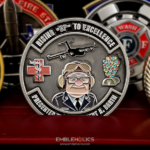
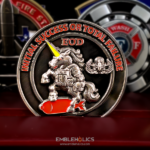
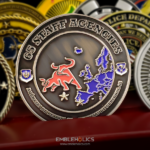
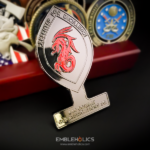
The detachment wanted few colors and a bright surface. The result is a shiny chrome-like layer across the piece, with the AFOSI insignia engraved on the front and a wolf mascot on the reverse.
What a Chrome Finish Does
Chrome is the brightest finish available on a coin and the most immediate. It is also the one with the clearest set of trade-offs, so it is worth knowing both halves before specifying it.
It is unmistakably modern. Brass, antique bronze and nickel all read as traditional. A bright mirror surface reads as contemporary, which for an investigative agency wanting to look current rather than ceremonial is exactly the point.
It maximizes contrast against engraving. A recessed line on a mirror surface reads as near-black against near-white, which is the greatest difference a coin can produce without any paint at all. On a design that is mostly engraving and very little color, that contrast is doing all the work.
It makes a coin feel more substantial than it is. A reflective surface reads as solid and dense. The same coin in a matte finish feels lighter, even though it weighs the same.
And the costs:
It shows every fingerprint. Immediately, and from the moment it leaves the capsule. A chrome coin handed over at a ceremony has marks on it before the recipient sits down. For some pieces that is fine; for a presentation coin that will be examined in the hand, it is worth knowing.
It flattens sculpted relief. This is the important one. A mirror surface throws light across contours, so modeled forms lose their shadows and read as shiny rather than as three dimensional. Chrome suits engraved line work and flat devices; it works against anything that depends on depth.
And scratches are visible. A matte or brushed surface absorbs handling marks. A mirror shows them.
See plating and finish options and antique vs polished finishes.
Restricting the Colors
The detachment asked for a restrained look with few colors, which is the right pairing with chrome.
A bright mirror surface is already a strong visual statement. Load enamel onto it and the two compete, because the metal is reflecting light while the paint is absorbing it, and the coin ends up with two different kinds of surface fighting across the same face.
Keeping the color count low lets the chrome be the finish rather than a background. The engraved areas supply the dark tones, the mirror supplies the light ones, and any paint is a deliberate accent rather than a field.
This is the same logic as the gold and black pairing on the agency’s other coin, approached from the opposite direction: there, a dark field with metallic highlights; here, a bright field with dark recesses. Both work because one element dominates and the other accents. See a gold and black challenge coin.
A Detachment Mascot
The reverse carries a wolf, which is a detachment’s own device rather than anything official.
That division between the faces is a good pattern for any sub-unit coin. The front carries the agency insignia, which is fixed, controlled and the same for every detachment. The reverse carries whatever the detachment has adopted for itself, which is the part that makes the coin theirs.
A wolf is also a sound choice in metal. The head is built from large planes, a long muzzle, a strong brow, angular ears, and those are shapes that hold at coin size where fine detail would not. Rendered in bare chrome with the detail engraved rather than sculpted, it reads from the line work, which suits the finish.
One note. On a chrome coin an animal is better engraved than sculpted, for the reason above: a mirror surface flattens modeled relief. If you want a sculpted mascot, choose a matte, brushed or antiqued finish instead and accept a less bright coin. It is a genuine either-or.
About the Agency
The Air Force Office of Special Investigations is a field operating agency headquartered at Andrews Air Force Base, Maryland, reporting to the Inspector General in the Office of the Secretary of the Air Force. Under federal statute it conducts independent criminal investigations, counterintelligence and protective operations worldwide, outside the normal military chain of command.
Congress suggested its creation in 1948 to consolidate Air Force investigative work, and Secretary W. Stuart Symington established it on a model drawn from the FBI. Detachments operate independently of the commands they support, which is the structural point of the organization and part of why its people identify with the detachment and the agency rather than with a base.
That independence is also why detachment-level coins make sense here. A detachment is a small, self-contained team with its own identity, which is the condition under which a coin means something. See also a narcotics unit challenge coin and more Air Force challenge coins.
Order a Chrome Coin
Professional artwork is free with unlimited revisions, and nothing goes into production until you approve a digital proof. The challenge coin minimum is 50 pieces, standard production runs about 45 to 50 days after final artwork approval, rush production is available on many projects, and shipping within the continental United States is included. Embleholics is veteran-owned, SDVOSB and registered in SAM.gov.
Two things to decide before artwork. Whether the design relies on engraving or on sculpted relief, because chrome suits the first and works against the second, and that choice is more fundamental than the finish itself. And for official agency insignia, the authorization and the approved artwork both come from the agency; we produce from what the customer supplies. Request a free quote to begin.
Frequently Asked Questions
What is a chrome challenge coin?
It is a coin finished with a bright mirror-like plating. It is the most reflective option available, reads as contemporary rather than traditional, and gives engraved line work the strongest possible contrast without using any paint.
Why choose chrome over brass or antique finishes?
Because it looks modern. Brass, bronze and antique finishes read as traditional and ceremonial, where a mirror surface reads as current. It also makes a coin feel denser and more substantial than the same piece in matte.
Does a chrome coin show fingerprints?
Yes, immediately and permanently through handling. A chrome coin presented at a ceremony will have marks on it within moments. That is acceptable on many pieces but worth knowing for a coin that will be examined in the hand.
Does chrome work with sculpted relief?
No, it works against it. A mirror surface throws light across contours, so modeled forms lose the shadows they depend on and read as shiny rather than three dimensional. Chrome suits engraved line work and flat devices.
What finish should a sculpted coin have?
Matte, brushed or antiqued. Those scatter light so the modeling reads from any angle. Choosing between a bright coin and a sculpted one is a genuine either-or rather than something that can be had both ways.
Should a chrome coin have much color?
Little. A mirror surface reflects light while enamel absorbs it, so a heavily painted chrome coin ends up with two kinds of surface competing across the same face. Keep paint as a deliberate accent rather than a field.
Why put an agency insignia on one face and a mascot on the other?
Because the insignia is fixed and identical across every detachment, while the mascot is what the detachment adopted for itself. One face identifies the organization and the other makes the coin that unit’s.
Is a wolf a good subject for a coin?
Yes. The head is built from large planes, a long muzzle, a strong brow and angular ears, which hold at coin size where fine detail would soften. On a chrome finish it should be engraved rather than sculpted.
More Air Force Projects