A partnership challenge coin carries two organizations on one design. It usually pairs a company with the agency, state, or partner it works with. Both sides hand it out to mark shared work. Occasions range from a vendor contract or joint venture to a long public partnership.
Who Orders Partnership Challenge Coins?
Partnership coins come out of working relationships where two organizations share the credit. The process starts the same way as custom corporate challenge coins, with a second organization’s identity added to the design.
Vendors and their government customers order a vendor partnership coin when a contract is signed. Contractors and the agencies they support do the same. Companies in a joint venture use a joint venture challenge coin to mark the new entity. Sponsors order them alongside the organizations they fund.
Companies with a long record of work for one state or city order them too. A public-private partnership coin marks years of service to a public customer and goes to staff on both sides.
The occasions repeat across all of these relationships:
- A contract signing or award marks the formal start of the work.
- A system going live closes out a long build for engineers and agency testers alike.
- Milestones inside a multiyear program give both teams a reason to recognize progress before final delivery.
- Anniversaries, often at five or ten years, suit a contract partnership coin carrying both names and the dates.
- Joint events put both organizations in the same room, and a shared coin makes a natural gift.
Agencies often mark these same occasions with their own coins on the government side of a contract.
How Do You Put Two Organizations on One Coin?
Putting two identities on one coin creates a design problem. Neither organization wants to look like the junior partner, and a coin offers limited room. Four approaches handle it well.
One identity per face. Each organization takes a full side of the coin, so neither shares space with the other. The coin on this page works this way, with the state on one face and the company on the other.
A shared shape or border. An outline or rim that belongs to neither party can hold both. A border ring carrying both names works, and so does a coin cut to a meaningful outline. Custom shaped challenge coins suit this well, since the shape itself can say something about the partnership.
Equal visual weight. Two logos on one coin rarely look balanced at equal size, because a wordmark and a flag are different objects. A dense full-color flag pulls the eye harder than a thin wordmark in one color. Designers adjust size, color, and placement by eye until both read with similar presence.
Choosing the front. Whichever identity sits on the front reads as a statement about the relationship. That makes it a diplomatic decision as much as a design one. Settle it with both parties before artwork starts. Common answers include:
- Leading with the customer
- Leading with whichever organization is presenting the coin
- Producing two versions with the faces swapped, so each side hands out its own
Whose Permission Do You Need?
A coin carrying two organizations’ marks needs approval for each. The company authorizes its own logo. The state authorizes its flag or seal, and most states restrict their use by statute. A company partner cannot grant permission for the state’s marks, even on a coin with its own logo. A state agency cannot approve a company’s trademark either.
Seals often carry tighter rules than flags because they signify official government action. When a design includes both, check whether the state approves them through one process or separate ones.
Anyone ordering a coin with a company logo, state flag, or state seal needs the authority to approve each mark. That authority comes from the organization itself or from someone acting with its permission. Embleholics produces coins from artwork the customer is authorized to supply. The design team flags any mark that could raise a question before production begins.
Embleholics’ state and civic coins follow the same rule. Any coin carrying a state flag or seal needs the state’s approval.
About This Motorola and Arkansas Coin
Motorola Solutions makes communications systems for public safety and government use. This coin marks the working relationship between Motorola Solutions and the State of Arkansas.
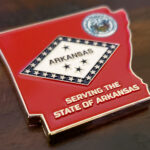
The coin is cut to the outline of Arkansas. The state flag sits on one face and the company logo on the other.
The design carries these elements:
- Front. The Arkansas flag in full color fills the state’s outline. The state seal sits in the upper right corner, with “Serving the State of Arkansas” lettered along the bottom.
- Reverse. The reverse carries the Motorola Solutions logo.
The shape settles the equal-weight problem. The outline belongs to Arkansas, so the state’s identity holds the whole object. Motorola still has a full face to itself, and neither organization sits beneath the other. For a company serving a whole state, the state shaped challenge coin shows the work’s reach at a glance.
A state outline takes care to produce. Arkansas has mostly straight northern, western, and southern borders. Its eastern side follows the Mississippi River and runs jagged, with small points and inlets. A coin cut to that shape has to meet several demands:
- Each point and inlet has to survive cutting and polishing without rounding off.
- The edge has to hold the same profile all the way around.
- The flag’s white diamond, blue border, and stars have to stay legible at coin size.
- The seal and lettering have to fit inside without crowding the corners or the eastern edge.
Design a Coin for Your Partnership
Embleholics can build a coin around a contract award, a joint venture, or years of work with a public partner. Every order includes:
- Free professional artwork
- Unlimited design revisions
- A digital proof before production begins
- Free shipping within the continental United States
- A 50-coin minimum
- Completion within 45 to 50 days of artwork approval for most orders, with rush production available
Partnership coins are usually ordered as one batch and split between the two organizations, so agree on the split before artwork starts. Embleholics is veteran-owned and registered as a Service-Disabled Veteran-Owned Small Business in SAM.
Ready to mark a partnership? Request free coin artwork with both organizations’ logos.
Frequently Asked Questions
What is a partnership challenge coin?
A partnership challenge coin carries two organizations on one design, typically a company and a government agency or public partner. Both present it to mark a contract or milestone.
Can a coin carry two companies’ logos?
Yes. Each company can take its own face, or both logos can sit inside a shared border. They can also sit side by side at balanced visual weight.
Can a company and a government agency share a challenge coin?
Yes. Companies and their government customers commonly share a coin to mark a contract award, a launch, or an anniversary. Each organization’s mark needs its own approval.
Whose permission do you need to put a state flag on a coin?
Permission has to come from the state, since most states restrict use of their flag by statute. A company partner cannot grant that permission on the state’s behalf.
How do you give two organizations equal weight on one coin?
Balance visual presence by eye, adjusting size, color, and placement until both identities read with similar strength. A full-color flag and a thin wordmark draw attention differently at equal size.
Can a coin be made in the shape of a state?
Yes. A coin can be cut to a state’s outline, like the Motorola and Arkansas partnership coin. It carries the Arkansas flag inside the state’s shape and the Motorola Solutions logo on the reverse.
Who pays for a partnership coin, and how is it split?
Usually one organization places a single order and the coins are divided after production. The partners decide how to share the cost and should settle it before artwork begins.
What is the minimum order?
The standard minimum order is 50 coins. Partnership orders are usually sized so each organization gets enough coins for its own staff, partners, and guests.
More Corporate Projects