A program office coin marks a stage in the life of a defense acquisition program rather than a deployment or a command tour. It commemorates a specific achievement, such as a milestone reached, a contract awarded, or a ship delivered, and is presented to the government team whose work made that achievement possible.
What Is a Program Executive Office?
A Program Executive Office, or PEO, is a government office that manages a portfolio of related acquisition programs. Each program within that portfolio is run by its own program office, led by a program manager and staffed by engineers, contracting officers, logisticians, and financial managers.
A program office handles the day-to-day work of getting a platform built. It writes requirements into contracts, manages the relationship with the shipbuilder or prime contractor, tracks cost and schedule, and oversees testing, delivery, and support once the platform enters service. The PEO sits above these offices, setting direction across the portfolio and reporting up the Navy’s acquisition chain.
Both sit on the government side of the contracting relationship. The fleet is the customer. Sailors operate what the program delivers, while the program office works with industry for years before a platform ever reaches the waterfront and long after it does.
Program Executive Office Attack Submarines, or PEO SSN, is the Navy office responsible for acquiring and sustaining the Navy’s attack submarines, including the Virginia-class program.
Why Program Offices Order Challenge Coins
Program offices mark a wide range of occasions with coins, and most of them come straight out of acquisition work.
- Milestone decisions are the most common. Passing Milestone B or C, clearing a critical design review, or getting through a major program review marks a formal checkpoint. Contract awards are another, recognizing the government and industry people who spent months or years negotiating to reach an agreement. Delivery and acceptance ceremonies mark the moment a platform officially changes hands from the shipbuilder to the Navy.
- Program stand-up and closeout are natural bookends. One marks the day a new office forms, the other the end of years of work once a program’s mission is complete. Industry days and joint events with contractors come up regularly, bringing government and industry teams into the same room.
- Rotation is the most personal occasion of all. Program office staff serve a few years, then move to their next assignment, and the program keeps going without them. An acquisition program can run for decades, so very few people see it from first contract to final delivery. When someone leaves, the coin you hand them is often the only physical record that they were on the program during the years that mattered. Their name won’t appear on the platform, and the milestones they pushed through will be credited to the program as a whole.
If you’re the program manager or deputy placing the order, the dates and people worth marking are ones you already know. A coin built around them is the record that outlasts the assignment.
Coins for Both Sides of a Contract
A single ceremony, a contract award or a delivery event, often produces coins on both sides of the table. The government program office commissions one, and the prime contractor commissions another, each marking the same occasion from their own side of the relationship. The two coins rarely look alike.
- The program office version usually carries the platform and the milestone
- The contractor version often carries the company name and the same date, sized for the industry team that built it.
We build coins for both sides of this relationship. Our defense contractor coins work sits alongside the program office coins we design, since both audiences show up to the same milestones and ceremonies, sometimes on the same day. A program office that already knows how a contractor’s coin turned out has a useful reference point going into its own design.
What Goes on a Program Office Coin?
Program office coins draw on a consistent set of design elements, many of them shared with other custom Navy challenge coins.
- Program and office emblems, where the office has authorized their use.
- Hull and platform silhouettes, tying a coin to a specific vessel type.
- Program names and numbers, identifying a specific effort
- Milestone dates, marking a specific event or ceremony
- Mottos, where a program or office has one.
- Rope and traditional rims, common across Navy program coins.
- Restrained finishes, generally preferred over bright colors or unusual shapes.
Most program office coins use several of these elements together. A milestone date next to a platform silhouette tells a fuller story, and the emblem, where authorized, anchors the coin to a specific office.
About This PEO Attack Submarines Coin
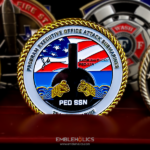
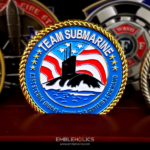
PEO SSN asked for something classic: a round coin, with a rope pattern on the rims, inscriptions encircling the field, and embossed submarines centered on both faces.
- One face carries a submarine silhouette seen bow-on, set against an American flag background, with two gold koi figures facing each other beneath it and “PEO SSN” lettered at the base.
It also carries a signature and title reading “RADM Jon Rucker, PEO SSN,” identifying the Program Executive Officer for Attack Submarines.
- The other face carries a different submarine view, surfacing at an angle against the same flag motif. It’s bordered by “Team Submarine” around the top and “ASST SECNAV (RD&A), Naval Sea Systems Command” around the bottom, identifying the program’s place within the Navy’s broader acquisition structure.
With no color beyond the flag motif and no unusual shape to lean on, spacing and proportion carry the entire design. Balance here means the visual weight matches across both faces, the inscriptions meet evenly as they travel around the circle, and each central image is sized so the rope rim frames it rather than crowding it.
A coin this plain has nowhere to hide an uneven layout, so the proportions have to be right.
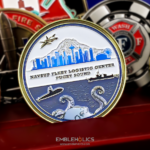
Fleet commands often favor the same classic approach, as seen in these submarine squadron coins and Navy logistics command coins.
Can We Use a Program or Command Emblem on a Coin?
Using an official program or command emblem on a custom coin generally requires that the person ordering has the authority to approve its use, whether that’s the office itself or someone acting with its permission.
We work from artwork the customer is authorized to supply, and our design team will flag anything that looks like it might raise a question before production begins.
If you’re ordering on behalf of a program office or command, it’s worth confirming with your own public affairs or legal office that your emblem is cleared for this kind of use.
Design a Coin for Your Program Office
Whether you’re marking a milestone, a contract award, or a rotation, we can help you build a coin around it.
- Free professional artwork
- Unlimited design revisions
- A digital proof before production begins
- Free shipping within the continental United States
- 50-coin minimum
- Most orders complete 45 to 50 days after artwork approval, with rush production available
We’re veteran-owned and registered as a Service-Disabled Veteran-Owned Small Business in SAM, a status many program offices require of their suppliers.
More examples of government contract work show the range of federal offices and suppliers served.
Tell us about your program, and request free coin artwork to get started.
Finished Coin (Front)
Finished Coin (Back)
Frequently Asked Questions
What is a Program Executive Office?
A Program Executive Office, or PEO, is a government office that manages a portfolio of related acquisition programs. Each program is run by its own program office, and the PEO sets direction and reports up the Navy’s acquisition chain.
What does PEO SSN stand for?
PEO SSN stands for Program Executive Office Attack Submarines. It is the Navy office responsible for acquiring and sustaining the Navy’s attack submarines, including the Virginia-class program.
What is a program office challenge coin?
A program office challenge coin marks a stage in an acquisition program, such as a milestone, contract award, or delivery, rather than a deployment or a command tour.
What occasions do program offices mark with coins?
Common occasions include milestone reviews, contract awards, delivery and acceptance ceremonies, program stand-up or closeout, industry days with contractors, and personnel rotations out of a program office.
What goes on a program office coin?
Common elements include program and office emblems, hull or platform silhouettes, program names and numbers, milestone dates, mottos, and traditional rope rims, often combined rather than used alone.
Can a customer use their own program emblem on a challenge coin?
Generally, yes, as long as the person ordering has the authority to approve the emblem’s use. Artwork must come from something the customer is cleared to supply.
Can a government program office buy challenge coins directly?
Yes. Program offices can order through standard federal procurement methods, and Embleholics is registered as a Service-Disabled Veteran-Owned Small Business in SAM.
What is the minimum order for a program office challenge coin?
The standard minimum order for a program office challenge coin is 50 coins, with rush production available for orders on a tighter timeline.
More Navy Projects