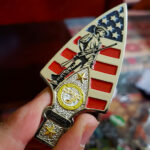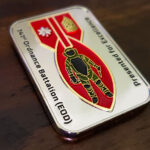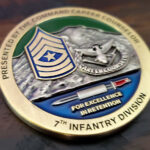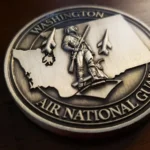
An Air National Guard unit answers to a state and to the federal service at the same time. Its coin usually carries both: the squadron’s federal designation on one face, and the state’s own imagery on the other, because neither identity is the whole story.
Why Guard Coins Are Different
No other kind of military unit has two chains of command, and it changes what belongs on a coin.
A Guard squadron answers to a governor and to the Air Force. It trains at a state facility and deploys under federal orders. Its members mostly hold civilian jobs and serve part-time, and many of them spend an entire career in the same unit, a short drive from the town they grew up in.
Four things follow from that.
Two identities, both legitimate. The federal squadron designation is real and so is the state. A Guard coin that drops either one is telling half the story, which is why the double-sided treatment described below is so common in this community.
State imagery does real work rather than decorating. On an active duty coin, a state outline or a state animal is a flourish. On a Guard coin it is half the unit’s identity. That is why Guard designs lean so heavily on state outlines, state flags, state animals and state mottos, and why those elements deserve the same prominence as the squadron patch rather than being tucked into a border.
The membership is local and long-serving. People stay in the same unit for twenty years because the unit is near their home and their civilian job. That makes the squadron’s identity unusually durable and the coin unusually likely to be kept rather than traded.
They order like a small unit. A squadron is the ordering level, the quantity is modest, and the person organizing it is fitting it around a full-time job somewhere else.
The same applies to Army National Guard units, state defense forces, Guard wings and squadrons, joint force headquarters, and Guard recruiting and retention offices. For another unit in the same component, see our Air National Guard coin.
Splitting the Faces: Unit and State
The cleanest answer to the dual-identity problem is also the simplest. Give the unit one face and the state the other.
Neither element has to be shrunk to accommodate the other. Neither is subordinate. Somebody who served in the unit recognizes both halves instantly, and somebody who did not can still read the coin, because each face has one job.
It works better than the alternative, which is combining both on a single face. That can be done, but it needs one element to be clearly made the background and the other clearly the subject. A squadron emblem and a state device at similar sizes on the same face gives the eye two focal points and no hierarchy, and the result reads as a committee decision rather than a design.
What State Imagery Works on a Coin?
The state outline, either as an element on the face or as the shape of the coin itself. It is the most efficient piece of state identity available, because it needs no text and is recognized instantly by anyone from that state.
State animals, flowers and trees. A bear, a bison, a cardinal, a palmetto. These read beautifully at coin size because they are simple, bold forms, and they carry the state without any lettering.
Terrain and landmarks. Mountains, coastline, a desert horizon, a recognizable peak. These work best as engraved backgrounds rather than as the subject, because terrain is detailed and will fight a foreground device for attention.
State mottos and nicknames.
State flags and seals, where authorized, which is covered below.
One thing to know about relative difficulty. An outline and an animal are the two easiest state elements to reproduce, because both are silhouettes. A detailed state seal is usually the densest object on a coin face, with fine lettering and small internal devices, and it either needs real space or needs simplifying. If the seal is not essential, an outline and an animal will say the same thing more clearly. More on cutting a coin to a state’s shape is on our page about state outlines on a coin.
Can We Use State and Federal Insignia on a Coin?
A Guard coin sits between two permission regimes, and it is worth knowing which is which.
Federal elements — the squadron emblem, the wing patch, Air Force marks — follow the same approval route as any unit insignia. Clear them through your chain of command.
State elements belong to the state. A state outline is a geographic shape and not a protected emblem, so it raises no permissions question on its own. A state seal is a different matter and is frequently restricted by state law. A Guard unit is an instrument of the state, which puts it in a different position from a private organization, but that is not the same as there being no requirement.
The practical route: clear federal elements through your chain of command, and ask your state’s joint force headquarters or state public affairs about any official state imagery before the artwork is finalized. Send us artwork your organization is authorized to supply. We produce from what the customer provides and we do not grant permission on anyone’s behalf. More on official state imagery is on our page about state seals and civic identity.
About This 146th Coin
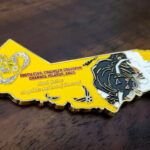
This coin was made for the 146th Civil Engineer Squadron, part of the 146th Airlift Wing, California Air National Guard, at Channel Islands Air National Guard Station in Oxnard, California.
The coin is cut to the outline of California. The front carries a raging bull with the squadron insignia embossed above it and the unit’s slogan below, on a yellow painted background. The reverse carries an engraved bear, an aircraft and California mountain scenery, finished in brushed brass with paint used on one detail only — the bear’s teeth.
The structure is the textbook answer to the dual-identity problem. The front is the unit. The reverse is the state. Squadron insignia, mascot and slogan on one side; bear, terrain and aircraft on the other; and the whole piece cut to the state’s own outline so the shape reinforces both.
The second decision is quieter and just as good. One painted detail on an otherwise bare metal face is a deliberate device, not an economy. The reverse is engraved brushed brass throughout, and the only color on it is on the bear’s teeth. Because nothing else on that face carries paint, the eye goes straight there, and a single accent on bare metal reads as more emphatic than the same detail would on a fully colored face.
It is the same principle as using one color on a monochrome coin, covered on our page about using a single color deliberately: decide what should be seen first, color that, and leave everything else in metal.
Design a Coin for Your Guard Unit
A squadron is the usual ordering level and the 50-coin minimum suits it. Send a photograph of the squadron patch and say which state elements you want to use, and a designer will work from that.
Professional artwork is free with unlimited revisions, and nothing goes into production until you approve a digital proof. Standard production runs about 45 to 50 days after final artwork approval, rush production is available on many projects, and shipping within the continental United States is included. Embleholics is veteran-owned, SDVOSB and registered in SAM.gov. See more custom Air Force challenge coins or request a free quote.
Frequently Asked Questions
What is an Air National Guard challenge coin?
An Air National Guard challenge coin is made for a Guard squadron or wing, which answers to both a state and the federal Air Force. These coins typically carry the squadron’s federal insignia on one face and the state’s own imagery on the other, because both identities are real.
Should a Guard coin show the state or the federal unit?
Both, and the cleanest way is to give each its own face. The squadron insignia goes on the front and the state imagery on the reverse, so neither has to be shrunk to accommodate the other. Combining them on one face works only if one is clearly the background.
Can a Guard coin be cut to the shape of its state?
Yes, and it suits a Guard unit particularly well, because the state is half the unit’s identity rather than a decorative touch. Compact states with distinctive borders reproduce best, and thin projections such as panhandles need thickening slightly to survive handling.
What state imagery works well on a coin?
State outlines and state animals work best, because both are bold silhouettes that read instantly at coin size. Terrain and landmarks suit engraved backgrounds. Detailed state seals are the densest option and need either real space or simplification.
Can we use our state’s flag or seal on a coin?
A state outline is a geographic shape and raises no permissions question. State seals are frequently restricted by state law, so ask your state joint force headquarters or state public affairs before the artwork is finalized, and supply artwork your organization is authorized to use.
Can a single painted detail work on a bare metal coin?
Yes, and it is often stronger than coloring the whole face. With nothing else on the face carrying paint, the eye goes straight to the one colored element, so a single accent on brushed or bare metal reads as more emphatic than the same detail would among other colors.
Who orders coins for a Guard squadron?
Usually the squadron itself, through a commander, a first sergeant or a volunteer organizing it around a civilian job. Guard units order at squadron level rather than at wing or state level, which is why the 50-coin minimum fits the way they buy.
What is the minimum order for Guard unit coins?
The minimum order for custom challenge coins is 50 coins. That suits a single squadron or flight, and larger quantities reduce the cost per coin, which matters for units that intend the design to last across several years of new members.
More National Guard Projects