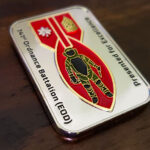
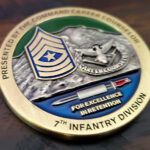
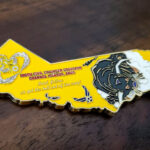
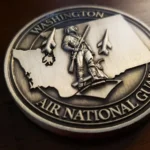
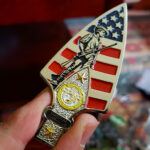
The coin is shaped like the tip of an arrow, with machine-carved graphics on both faces. The front carries the Counterdrug logo and the reverse carries the image of a classic National Guard soldier. It was made for the Colorado Joint Counterdrug Task Force.
A Coin for a Joint Task Force
A counterdrug task force sits across several organizations at once, and that is the thing the coin has to represent.
It is National Guard but works with civilian law enforcement. The task force uses military skills and resources to support local, state and tribal police and works alongside federal agencies. So the people receiving the coin include soldiers, airmen, police officers and federal agents.
Which means the coin travels outside the Guard. A coin handed to a county detective or a DEA agent has to read to someone who does not know Guard insignia. That is an argument for a strong shape and a clear device rather than for heraldic detail only insiders would parse.
And it has to say both halves. This coin’s division handles it: the mission on one face, the organization on the other. The Counterdrug logo says what the task force does; the Guard soldier says who it belongs to. Either alone would be half the story.
The Guard’s dual role reinforces it. The Colorado National Guard has served since 1860 and is the state’s first military responder in emergencies, covering both Army and Air National Guard units. An organization that answers to both a state and a federal mission is used to representing two things at once.
See also joint unit challenge coins for detachments, a drug task force challenge coin and more National Guard challenge coins.
The Arrowhead and Its Associations
The arrowhead is a frequent choice for counterdrug and special operations units, and it is one of the sturdier pointed outlines available.
The head is a broad triangle, so the widest part of the shape is also the usable field, which is unusual among pointed shapes. There is one tip rather than five or eight, and a very slight rounding handles it. And a pointed shape gives the design a built-in axis, so elements arrange themselves down the face rather than having to be positioned on a blank circle.
The notches at the base of a traditional arrowhead do concentrate stress during the strike, so they are usually softened very slightly in artwork, but they should be kept rather than removed because they are what gives the form its character.
For the same outline used by a riding chapter, see a POW MIA challenge coin, and for custom outlines generally, custom shaped challenge coins.
Machine Carving on Both Faces
Both sides are machine carved rather than one carved and one flat, and on an arrowhead that is the right decision for a reason specific to the shape.
An arrowhead has a smaller usable area than its outline suggests, because the point and the notched base cannot carry readable content. That leaves one broad field per face, and if only one face is worked the coin has a strong side and a thin side.
Carving both means each face gets its single device properly, which is also why the content divides so cleanly here: one face, one subject. A design trying to fit a logo and a figure onto the same arrowhead face would have had neither read.
The planning note on any double-sided carving is that a coin has a finite thickness, so deep relief on both faces at the same point leaves little metal between them. The two sides have to be laid out together rather than one after the other.
A Figure on the Reverse
The reverse carries a classic National Guard soldier, and figures are among the more demanding coin subjects.
Posture carries the identification, not detail. A figure is recognized by its stance and silhouette. Facial features and uniform detail are the first things to disappear at coin size, and attempting them produces a blur where a face should be.
Which means a strong outline is the whole requirement. A figure with a clear profile reads at any size. One standing square on with arms at its sides does not, because there is no silhouette to read.
Smooth relief suits a figure better than line engraving. A continuous rising and falling surface lets light fall across the form the way it would on a sculpture, where cut outlines make a figure look like a diagram.
And a period figure needs a period marker. If the point is a historical soldier, one identifying element, a helmet shape, a rifle profile, a uniform cut, does more than general accuracy. That single detail is what places the figure in its era.
Order a Task Force Coin
Professional artwork is free with unlimited revisions, and nothing goes into production until you approve a digital proof. The challenge coin minimum is 50 pieces, standard production runs about 45 to 50 days after final artwork approval, rush production is available on many projects, and shipping within the continental United States is included. Embleholics is veteran-owned, SDVOSB and registered in SAM.gov.
Two suggestions. If the coin will be handed to partners outside your own service, lean on a strong shape and one clear device per face rather than heraldic detail, because the recipients will not share your insignia vocabulary. And for a joint unit, give the mission and the parent organization a face each; trying to fit both onto one face is how these designs end up unreadable. Request a free quote to begin.
Finished Coin (Front)
Finished Coin (Back)

Frequently Asked Questions
What is a Colorado National Guard challenge coin?
It is a coin for a Colorado Guard unit or task force. This one was made for the Joint Counterdrug Task Force, which uses military skills and resources to support local, state, tribal and federal law enforcement.
How should a joint task force coin be designed?
With the mission on one face and the parent organization on the other. The mission logo says what the unit does and the organizational device says who it belongs to, and either alone tells half the story.
Does it matter that the coin goes to civilians?
Yes. A coin handed to a county detective or a federal agent has to read to someone who does not know military insignia, which argues for a strong shape and one clear device rather than heraldic detail only insiders would parse.
Why is the arrowhead common on counterdrug coins?
Partly association and partly practicality. It carries connotations of precision and pursuit, and it is one of the sturdier pointed outlines: the head is a broad usable field and there is only one tip to worry about.
Should both faces of an arrowhead coin be carved?
Yes, usually. An arrowhead has a smaller usable area than its outline suggests, so each face has room for one device. Working only one face leaves the coin with a strong side and a thin side.
What has to be planned when both faces carry deep relief?
The thickness. A coin has a finite depth, so deep relief on both faces at the same point leaves very little metal between them. Both sides have to be laid out together rather than in sequence.
How should a human figure be rendered on a coin?
By posture and silhouette rather than detail. Facial features and uniform detail disappear at coin size, so a figure needs a clear profile. Smooth relief suits figures better than cut line work, which makes them look like diagrams.
How do you show a historical soldier?
With one identifying period element, such as a helmet shape, a rifle profile or a uniform cut. That single detail places the figure in its era more effectively than general accuracy across the whole figure.
More National Guard Projects